Purchase Order vs. Invoice: How to Keep Orders and Bills Matched
Purchase order vs invoice is a workflow distinction: the buyer authorizes an order and the seller requests payment. Keep both records linked to prevent billing delays.
In this article
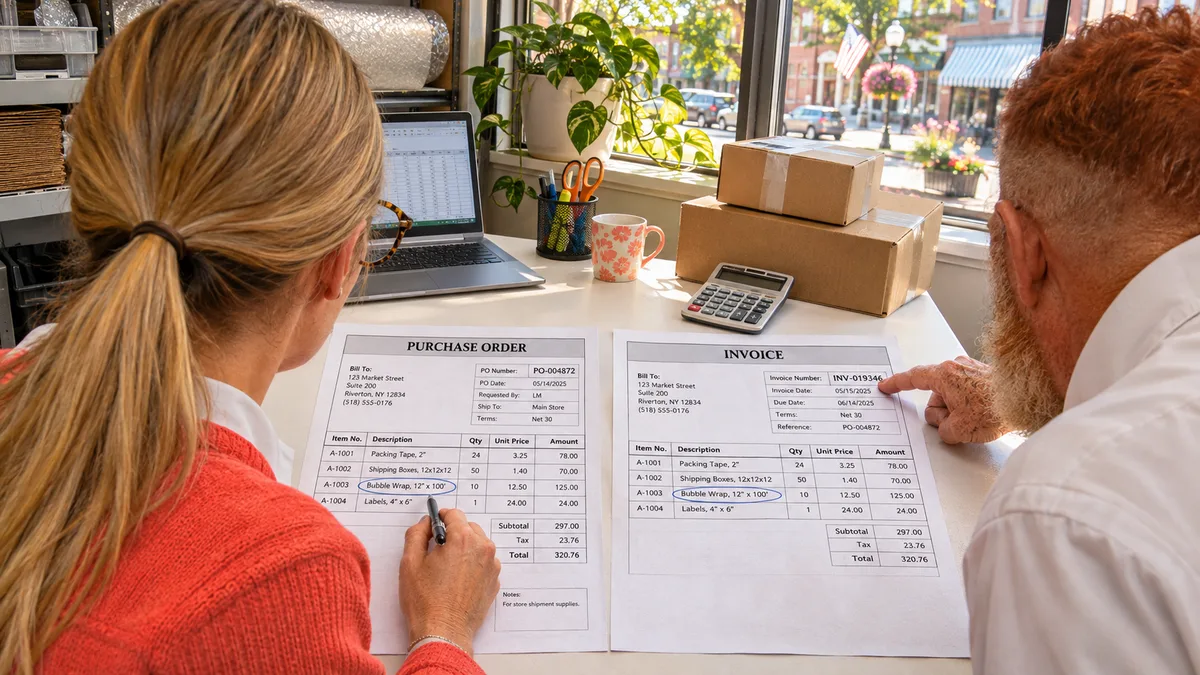
The basic purchase order vs invoice difference is who creates the document and what it does. A buyer issues a purchase order, or PO, to specify an intended purchase; the seller issues an invoice to request payment under the agreed billing arrangement. When a customer uses POs, the invoice normally needs to reference the customer's order while retaining the seller's own invoice number.
Receiving a PO is not the same as receiving payment, and sending an invoice does not prove that the customer has accepted every charge. Keep the authorization, fulfillment and billing records connected. That is particularly useful when your original customer contact is not the person who processes payment.
Purchase order vs invoice: follow the transaction sequence
A purchase order normally comes before fulfillment, while an invoice follows the transaction's agreed billing trigger. The ordinary sequence is buyer authorization, seller fulfillment, invoice submission, customer review and payment. Deposits, milestones and prepayment arrangements can change when invoicing occurs, so use the actual agreement rather than assuming every invoice must follow final delivery.
Adobe's document comparison explains the buyer-to-seller PO and seller-to-buyer invoice distinction. For a concrete U.S. institutional workflow, MIT's supplier instructions tell suppliers to wait for an official PO before providing goods or services and to submit an invoice after fulfillment. Those are MIT's requirements, not a rule imposed on every U.S. customer.
Record | Usually created by | Main task |
|---|---|---|
Purchase order | Buyer | Identify and authorize the specified order |
Delivery or completion record | Depends on the transaction | Show what was supplied or accepted |
Invoice | Seller | Request payment for the appropriate billed amount |
Payment or remittance record | Buyer or payment provider | Identify what payment was sent and applied |
Do not jump from “the customer ordered it” to “accounts payable can pay it.” The buyer may still need a receiving confirmation, correct billing details or supplier registration. Ask about those steps before relying on the expected payment date.
Keep the PO number and invoice number separate
The customer's PO number identifies its order; your invoice number identifies your bill. Put each in a clearly labeled field so the customer can match them without replacing one identifier with the other. A seller should not invent a customer's PO number merely to complete an invoice form.
In a simple example, the customer supplies PO-4821 and your invoice is INV-1068. Your document could show “Invoice number: INV-1068” and “Customer PO: PO-4821.” Later invoices for separately billable portions may refer to the same approved PO, but each needs its own traceable invoice identity and must comply with the buyer's process.
The purchase order vs invoice distinction matters during a payment inquiry as well. Ask the customer to search for your invoice number and its PO reference, rather than giving only a project nickname. Keep the submitted version and any portal acknowledgment so you can identify precisely what accounts payable received.
Match the bill to the authorized and delivered items
Compare the invoice with both the approved PO and the fulfillment record before submitting it. Check the seller and buyer details, item descriptions, quantities, agreed prices, delivery information and applicable adjustments. Do not assume a correct invoice total makes every line correct.
Consider this hypothetical order with no tax, shipping or discount included:
- Approved PO: 60 units at $25 each, totaling $1,500.
- First delivery: 40 units.
- First invoice, if partial billing is allowed: 40 x $25 = $1,000.
- Remaining order: 20 units, worth $500 at the same agreed price.
The first invoice is not automatically $1,500 simply because that is the PO total. Confirm whether the customer permits partial invoicing and what receiving evidence it needs. When the final 20 units are supplied, reconcile what was already billed before issuing another payment request.
These controls reflect real processing requirements. Penn State's billing guidance requires matching line-item quantities and prices and explains that missing receiving information or a mismatch can delay payment. Apply your customer's own instructions rather than treating Penn State's procedure as universal.
Resolve a missing or incorrect purchase order before billing
Contact the customer's authorized purchasing or accounts-payable contact when a required PO is missing, closed, insufficient or inconsistent with the work. Ask how the order should be corrected and how the invoice should reference the correction. Changing your invoice alone does not establish that an extra purchase was authorized.
For example, suppose the original 60-unit order expands to 70 units at the same $25 price. The additional 10 units would add $250, bringing the modeled goods total to $1,750. Before fulfillment and billing, obtain the buyer's required authorization for that change. Whether it needs a revised PO, another PO or a different documented approval depends on the customer and agreement.
If work already occurred without a required PO, explain the situation accurately and ask for the approved resolution. Do not backdate a document or present a newly created reference as if it authorized the original work earlier. Preserve the actual correspondence and dates.
The purchase order vs invoice question is therefore more than vocabulary. The buyer controls its order authorization, while the seller controls the accuracy of its payment request. Each side needs to correct its own record where the mismatch originated.
Send one complete invoice through the required channel
Submit the invoice through the customer's specified portal or address with the required supporting details, then retain the acknowledgment. Sending it to the person who requested the work may not satisfy the buyer's accounts-payable process. Confirm the submission route during customer setup.
Baylor University's invoice requirements provide a useful example: they require separate PO and invoice numbers and do not accept copies of purchase orders as substitutes for invoices. Baylor also describes rejection and correction procedures. The lesson is to obtain your customer's checklist, not to copy another institution's policy onto an unrelated transaction.
For an ordinary PDF invoice, the Eagle Post Daily Invoice Generator can help prepare line items, dates and notes. Include the PO reference where the customer requires it and save the finished file. The tool does not obtain purchasing approval, submit a customer portal form or store the invoice for later retrieval.
Avoid submitting the same bill through several channels just because payment has not arrived. MIT, for example, explicitly asks suppliers to send each invoice once using one method. For a correction, ask how the buyer wants the replacement identified so it is processed as a correction rather than an additional bill.
Payment terms remain a separate agreement. The net 30 vs. due-on-receipt guide explains how to specify the payment trigger and due date. Do not assume that a PO number itself establishes when money will reach your bank.
FAQ
Purchase order vs invoice questions are easiest to resolve by separating authorization, billing and payment evidence.
Does every small-business sale need a purchase order?
No. Customer procedures and transaction arrangements differ. Ask whether a PO is required before accepting work; do not infer a universal U.S. requirement from one institution's supplier instructions.
Can a purchase order replace the invoice?
Do not assume so. A PO authorizes or specifies an order, while an invoice requests payment. Buyers such as Baylor expressly require the supplier's invoice rather than a PO copy.
Can one purchase order have more than one invoice?
It can when the agreement and buyer's system permit partial or milestone billing. Give each invoice a distinct identifier, reference the applicable PO and track quantities and amounts already billed.
Does a purchase order guarantee payment?
No. A PO is not a payment receipt. Fulfillment, disputes, invoice acceptance and the agreed payment process still matter; contract enforceability depends on the actual documents and applicable law.
Spotted an error? Tell our editors. Read our corrections policy.