Comprehensive vs. Collision Insurance: What Each Covers
A damaged car may be covered by comprehensive insurance, collision insurance, or neither. Learn which policy pays for crashes, theft, hail, animal impacts, and other common losses before choosing your coverage.
This article is general information, not financial advice. Rates, prices and rules change; check the details with a qualified professional or the lender before you decide.
In this article
- What Is Comprehensive Car Insurance?
- What Is Collision Insurance?
- Comprehensive vs. Collision: Side-by-Side Comparison
- Is Hitting an Animal Comprehensive or Collision?
- What Happens if a Tree Falls on Your Car?
- How Do Comprehensive and Collision Deductibles Work?
- What Does Full Coverage Mean?
- Are Comprehensive and Collision Insurance Required?
- When Should You Consider Dropping Comprehensive or Collision?
- What if Your Car Is Declared a Total Loss?
- Which Coverage Should You Buy?
- Frequently Asked Questions
- The Bottom Line
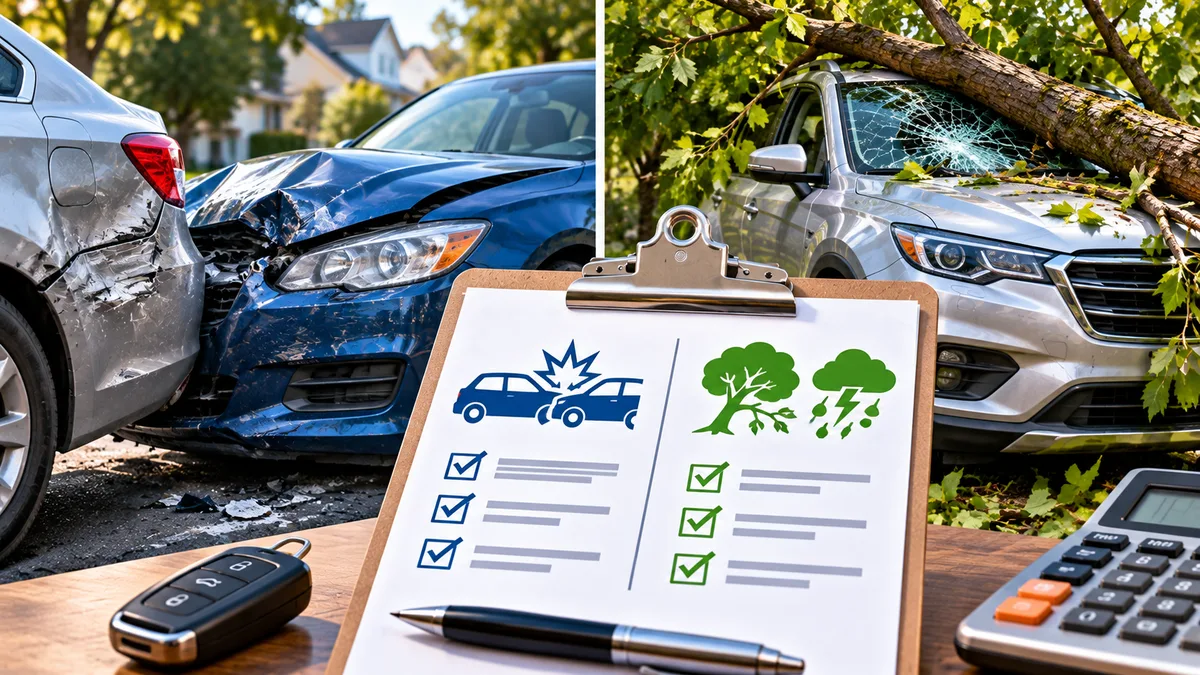
Comprehensive vs. collision insurance comes down to what caused the damage to your vehicle. Collision coverage generally helps pay for damage when your car hits another vehicle or object, or overturns. Comprehensive coverage generally protects against covered non-collision events such as theft, fire, hail, vandalism, and damage caused by falling objects.
Both coverages are typically optional under state insurance laws, although a lender or leasing company may require them. They also usually have separate deductibles, and both can be subject to the vehicle's actual cash value and other policy limitations.
The distinction matters most when you file a claim. A driver with only liability insurance generally cannot expect that policy to pay for damage to their own car after an at-fault collision or a covered weather event.
What Is Comprehensive Car Insurance?
Comprehensive car insurance covers specified types of physical damage to the insured vehicle that are generally unrelated to collisions with other vehicles or objects. It is sometimes described as other than collision coverage.
Typical covered causes include vehicle theft, vandalism, fire, hail, flooding, and damage from a falling tree branch. Certain impacts involving animals are also commonly handled through comprehensive coverage.
Comprehensive insurance does not necessarily pay for every problem unrelated to a crash. Mechanical breakdowns, ordinary wear, deterioration, and routine maintenance are generally outside the coverage provided by a standard personal auto policy.
Common Comprehensive Insurance Claims
A driver may use comprehensive coverage when a parked car is damaged by hail, an unknown person vandalizes the vehicle, or a deer runs into the vehicle's path.
A stolen vehicle may also qualify for comprehensive benefits if theft coverage was in force and the claim satisfies policy conditions. The insurer may investigate the loss and apply the relevant deductible and valuation provisions.
Comprehensive protection is especially relevant to risks that can occur even when a vehicle is parked and nobody is driving it.
What Is Collision Insurance?
Collision insurance generally covers physical damage to your vehicle resulting from a collision with another car or object, or from a rollover. It may apply regardless of which driver caused the accident, subject to the policy's terms.
For example, a driver who backs into a concrete pillar may be able to use collision coverage to repair their own car. The same coverage can be relevant when another driver causes a crash but their insurer has not yet resolved liability.
Collision insurance is different from property damage liability coverage. Liability insurance typically addresses covered damage you cause to someone else's property, while collision helps protect your own insured vehicle.
Comprehensive vs. Collision: Side-by-Side Comparison
Incident | Comprehensive | Collision |
Your car hits another vehicle | Usually no | Usually yes |
You back into a pole | Usually no | Usually yes |
Your car rolls over | Usually no | Usually yes |
Hail dents your car | Usually yes | Usually no |
Your car is stolen | Usually yes | Usually no |
A tree falls on your parked car | Usually yes | Usually no |
Your windshield is damaged by a covered flying object | Often | Depends on circumstances and policy |
You hit a deer | Commonly yes | Usually no |
Floodwaters damage the vehicle | Usually yes | Usually no |
Engine fails from ordinary wear | Generally no | Generally no |
Coverage depends on the actual policy wording and the circumstances of the incident. The table should be used to understand the usual distinction, not as a guarantee that a particular claim will be accepted.
Is Hitting an Animal Comprehensive or Collision?
Hitting an animal is generally classified as a comprehensive loss under many personal auto policies. That can include an impact with a deer, although details vary by insurer.
The situation can change when the driver swerves to avoid the animal and then hits a tree, guardrail, or another vehicle. In that case, the resulting damage may be treated as a collision loss because the car struck an object.
This is a practical example of why the exact sequence of events matters. Claim documentation should accurately describe what happened rather than simply state that an animal caused the accident.
What Happens if a Tree Falls on Your Car?
A falling tree or branch commonly creates a comprehensive insurance claim when it damages an insured vehicle. The driver's collision coverage usually is not the relevant protection because the damage was not caused by the car colliding with another vehicle or object while being operated.
If the tree belongs to a neighbor, that does not automatically make the neighbor legally responsible. Liability generally depends on whether negligence or another legally relevant factor can be established.
A separate homeowners insurance claim may arise if the same tree damages a house or other covered structure.
How Do Comprehensive and Collision Deductibles Work?
A deductible is the amount deducted from an eligible insurance payment or otherwise paid by the policyholder before the insurer pays its share of a covered loss.
Comprehensive and collision coverage can have different deductible amounts.
Consider two hypothetical policies:
Coverage | Deductible | Eligible repair cost | Illustrative insurer payment |
Collision | $1,000 | $4,500 | $3,500 |
Comprehensive | $500 | $4,500 | $4,000 |
These figures assume coverage applies, no other limitations affect payment, and the loss is not subject to a different settlement provision.
Some states or policies apply different rules to glass repairs or replacement. A driver should not assume that every windshield claim carries the standard comprehensive deductible.
What Does Full Coverage Mean?
Full coverage is a commonly used expression rather than one standardized insurance product. It often refers to a combination of liability, comprehensive, and collision coverage, but companies and consumers can use the phrase differently.
An auto insurance policy described as full coverage may still have exclusions, limits, deductibles, and optional benefits that are not included.
For example, rental reimbursement coverage is not necessarily part of the package. Eagle Post Daily explains that distinction in Rental Reimbursement Coverage: When Does Car Insurance Pay?.
A driver should review the declarations page to confirm exactly which protections have been purchased.
Are Comprehensive and Collision Insurance Required?
State law generally focuses on liability coverage or other financial responsibility requirements rather than requiring every driver to purchase comprehensive and collision insurance.
However, lenders and leasing companies commonly require physical damage protection because the car serves as collateral or is owned by the leasing company.
A borrower who removes required coverage could violate the financing agreement. The lender might then take action under the contract, including arranging insurance intended to protect its financial interest.
Before canceling either coverage, financed and leased vehicle owners should check their loan or lease requirements.
When Should You Consider Dropping Comprehensive or Collision?
A vehicle's age and market value can affect whether the premiums remain worthwhile. Older vehicles with low actual cash values may generate relatively small maximum claim payments after deductibles.
Suppose a car is worth $4,000 and the collision deductible is $1,000. Even if the vehicle is a covered total loss, the simplified maximum payment might be approximately $3,000, before other applicable adjustments.
If collision premiums are high relative to the protection available, the owner may consider whether self-funding potential repairs or replacement is financially manageable.
However, comprehensive and collision should not automatically be canceled together. They protect against different risks, may cost different amounts, and can have different deductibles.
What if Your Car Is Declared a Total Loss?
An insurer may declare a vehicle a total loss when repairing it is not economically appropriate under the applicable rules. The settlement generally depends on the vehicle's covered value, policy terms, deductible, and any relevant state requirements.
A total-loss settlement is not automatically equal to the original purchase price or outstanding loan balance.
If the car is financed, the claim payment may go toward the lienholder's interest. A separate GAP product may be relevant to certain remaining loan balances, but it is not automatically included in collision or comprehensive insurance.
Which Coverage Should You Buy?
The decision should account for the vehicle's value, financial obligations, local risks, savings, and the cost of replacement.
Collision is particularly relevant when the driver could not comfortably pay to replace a vehicle after a crash. Comprehensive may be especially valuable when the car is exposed to theft, severe weather, falling objects, or other covered non-collision risks.
Use quotes with comparable liability limits and deductibles. Comparing only the final premium can obscure differences that would matter after a loss.
The Total Cost of Ownership Calculator can help incorporate annual insurance premiums into the overall expense of keeping a vehicle. It does not estimate the probability that a specific insurance claim will occur.
Frequently Asked Questions
Is comprehensive insurance better than collision?
Neither is universally better. Comprehensive and collision protect against different categories of vehicle damage, and many drivers benefit from carrying both.
Does comprehensive cover accidents?
It may cover certain events commonly categorized as non-collision losses, but ordinary crashes with other vehicles are generally handled through collision insurance.
Does collision insurance cover theft?
Vehicle theft is generally a comprehensive coverage issue rather than a collision claim.
Do you pay a deductible if the other driver is at fault?
You may initially pay your collision deductible when claiming through your own policy. The insurer may later pursue recovery from the responsible party, but reimbursement is not guaranteed.
Should an older car have comprehensive insurance?
It depends on the vehicle's value, cost of coverage, deductible, and the owner's ability to absorb a loss. Comprehensive may remain worthwhile even when collision has become less attractive.
The Bottom Line
Comprehensive insurance generally covers theft, weather, falling objects, and other specified non-collision losses. Collision insurance generally covers damage to your vehicle from crashes and rollovers.
The right combination depends on the car, the driver's finances, financing requirements, and the actual policy terms. Reviewing each deductible and the vehicle's current value provides a clearer basis for choosing coverage than relying on the phrase full coverage.
Spotted an error? Tell our editors. Read our corrections policy.