Loss of Use Coverage: When Does Home Insurance Pay for a Hotel?
If a covered disaster makes a home unlivable, insurance may help pay for temporary accommodation and increased everyday expenses. Learn how reimbursement works, what limits apply, and which receipts to keep.
This article is general information, not financial advice. Rates, prices and rules change; check the details with a qualified professional or the lender before you decide.
In this article
- What Is Loss of Use Coverage?
- When Does Homeowners Insurance Pay for a Hotel?
- What Counts as Additional Living Expenses?
- Does Loss of Use Cover Food and Restaurant Meals?
- Additional Living Expenses Calculation Example
- Will Insurance Pay Your Mortgage While You Stay in a Hotel?
- How Long Will Loss of Use Coverage Pay?
- How Much Loss of Use Coverage Do You Have?
- Does Renters Insurance Include Loss of Use?
- What if Your Home Is Damaged but Still Livable?
- What Documents Are Needed for a Loss of Use Claim?
- How to File a Loss of Use Insurance Claim
- What if the Insurer Refuses to Pay for Temporary Housing?
- Frequently Asked Questions
- The Bottom Line
Loss of use coverage generally helps pay for additional living expenses when a covered event makes an insured home unfit to live in. It can reimburse eligible costs of temporary housing, increased meal expenses, and other necessary additional costs incurred while the property is being repaired or rebuilt.
The protection is commonly included in homeowners insurance and is also available in many renters insurance policies. However, it does not pay for every expense incurred after an inconvenience at home, and it usually does not reimburse ordinary living costs that would have existed without the damage.
The most important requirements are the cause of the loss, whether the home is considered uninhabitable under the policy, and whether the claimed expenses are reasonable and necessary.
What Is Loss of Use Coverage?
Loss of use coverage is the part of a property insurance policy designed to address eligible financial consequences of being unable to live in the insured residence after a covered loss. It is commonly associated with additional living expenses (ALE).
A homeowner whose kitchen is destroyed in a covered fire may need temporary accommodation. A renter whose apartment is made unlivable by a covered incident may also need somewhere else to stay.
Loss of use coverage is different from dwelling or personal property protection. One pays certain extra living costs, while the other coverages address qualifying physical damage to insured buildings or belongings.
When Does Homeowners Insurance Pay for a Hotel?
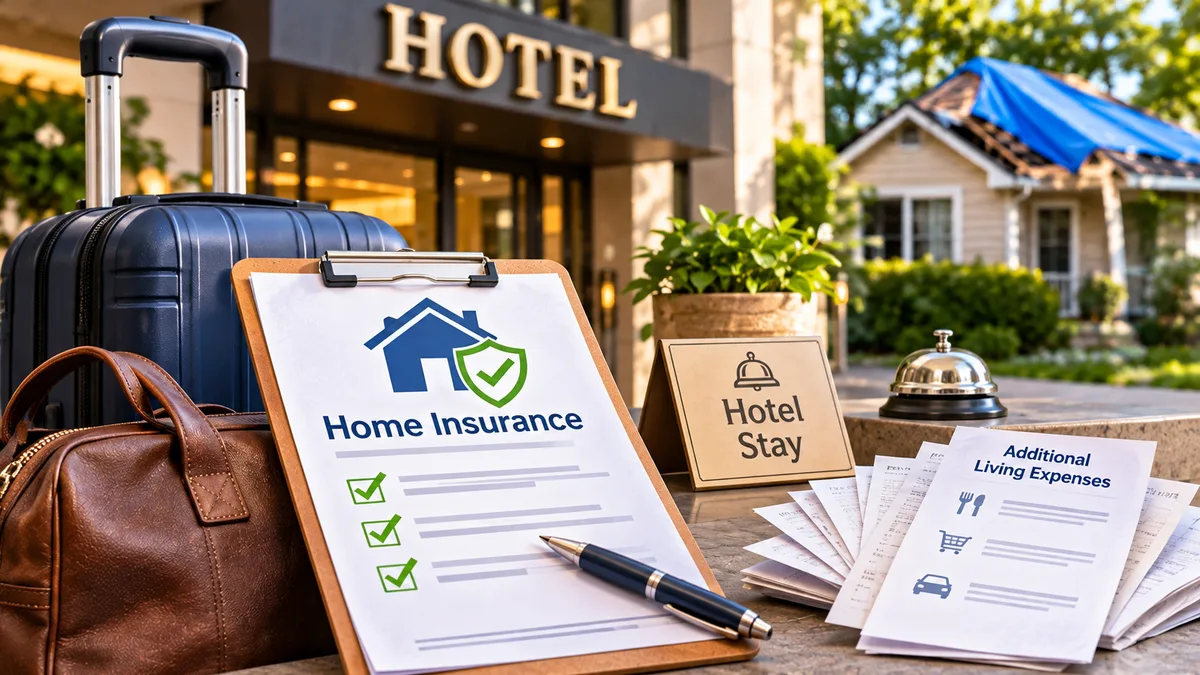
Homeowners insurance may pay for reasonable hotel expenses when a covered incident makes the property unfit for normal occupancy. The stay must be related to the insured loss and comply with the policy's requirements.
A serious covered fire, substantial storm damage, or qualifying water damage may trigger this protection. However, the policy must be examined before assuming that every problem requiring temporary accommodation qualifies.
Situation | Potential loss of use coverage |
Covered fire makes the home uninhabitable | Often |
Covered storm damage requires extensive repairs | Often |
Covered sudden pipe failure makes the home unusable | Potentially |
Routine home renovation | Generally not |
Remodeling a functional kitchen | Generally not |
Flood damage without applicable flood-related coverage | Often excluded under ordinary homeowners coverage |
Voluntary temporary move for convenience | Generally not |
Mandatory evacuation without damage | Depends on specific civil authority provisions and policy conditions |
Some policies provide limited coverage when a civil authority prohibits access because of qualifying nearby damage. Those provisions are distinct from ordinary additional living expenses after physical damage to the insured home.
What Counts as Additional Living Expenses?
Additional living expenses are generally reasonable costs above the household's normal expenses because of a covered displacement. The insurer does not necessarily replace the entire household budget.
The National Association of Insurance Commissioners identifies hotel stays, temporary rentals, and certain increased meal costs as common examples.
Eligible expenses can include additional lodging costs, increased food expenses when cooking facilities are unavailable, and certain transportation or other costs directly related to the displacement.
However, eligibility must be established using the policy. Some expense categories may be limited or excluded.
Does Loss of Use Cover Food and Restaurant Meals?
Loss of use may cover the reasonable increase in meal costs when the household cannot prepare food in its usual way. This is not a promise that every restaurant bill will be reimbursed.
Suppose a family normally spends $700 per month on groceries but temporarily spends $1,100 on necessary meals while staying in a hotel without a kitchen.
The simplified increase is $400. If the expenses are reasonable, documented, and otherwise eligible, the insurer may consider that additional amount rather than the entire $1,100.
Costs that are extravagant or unrelated to the covered displacement may not qualify.
Additional Living Expenses Calculation Example
Consider a family forced to relocate for one month after covered damage.
Expense | Ordinary monthly cost | Temporary monthly cost | Increase |
Housing-related living expense | $1,500 | $2,400 | $900 |
Food | $700 | $1,150 | $450 |
Transportation | $300 | $425 | $125 |
Laundry | $40 | $90 | $50 |
Total | $2,540 | $4,065 | $1,525 |
The hypothetical additional cost is $1,525, assuming all categories are eligible and the comparison accurately reflects expenses that the household continues to bear.
The calculation must be adjusted for avoided expenses. For example, utility costs may decrease while the home is unoccupied, and the insurer may account for those savings.
The covered payment depends on the actual policy limits, documentation, and insurer's assessment.
Will Insurance Pay Your Mortgage While You Stay in a Hotel?
Loss of use insurance generally does not replace ordinary mortgage payments. A homeowner remains responsible for the mortgage under the loan agreement unless a separate arrangement is made with the lender.
ALE primarily addresses increased costs caused by displacement. It is not a general mortgage payment benefit.
This distinction is important because a household may have to continue paying its mortgage while also meeting temporary accommodation expenses.
For homeowners reviewing the wider cost of ownership, the Mortgage Payment Calculator can help separate principal, interest, property taxes, and insurance from temporary living expenses.
How Long Will Loss of Use Coverage Pay?
The length of loss of use coverage depends on the policy. Limits may be expressed as a maximum dollar amount, a percentage of dwelling coverage, a period of time, or some combination.
Some policies refer to the shortest reasonable period required to repair or replace covered damage, subject to applicable limits. Others include specific maximum periods.
The fact that rebuilding takes longer than expected does not automatically extend the coverage limit.
A policyholder should ask the insurer to explain the remaining benefits and the conditions under which temporary housing expenses are approved.
How Much Loss of Use Coverage Do You Have?
The declarations page often identifies a Coverage D amount for homeowners policies. The limit can be set in different ways, depending on the policy form and insurer.
For example, a hypothetical home insured for $350,000 might have a loss of use limit calculated as a percentage of the dwelling limit. The exact percentage and calculation must be read from the contract.
Renters insurance may use a fixed dollar limit or other structure.
The stated coverage maximum does not mean the insurer will automatically pay the entire amount. Reimbursement generally depends on eligible expenses actually incurred.
Does Renters Insurance Include Loss of Use?
Many renters insurance policies provide additional living expense coverage when a covered event makes the rented residence unfit to occupy.
The landlord's insurance ordinarily addresses the landlord's insured interests, not the renter's personal living expenses under a separate renters policy.
Renters should review their own insurance contract and contact the insurer promptly if the apartment becomes uninhabitable.
Temporary rent obligations, lease termination, and habitability rights may also depend on state landlord-tenant law. Insurance coverage does not automatically resolve those legal questions.
What if Your Home Is Damaged but Still Livable?
Loss of use benefits often depend on whether the residence is genuinely uninhabitable under the applicable policy terms. An inconvenient repair does not necessarily make a home unfit to occupy.
For example, cosmetic damage in one room may not qualify for temporary accommodation, while a covered loss that destroys essential utilities or creates a serious safety hazard might.
The insurer may consider whether a portion of the home can still be occupied safely, how long repairs are expected to take, and whether alternative living arrangements are necessary.
What Documents Are Needed for a Loss of Use Claim?
A strong claim includes the underlying covered-loss information and clear proof of additional expenses.
Useful records include hotel or rental agreements, itemized receipts, receipts for meals and transportation, a normal pre-loss household budget, and correspondence about the expected repair schedule.
Keep receipts as expenses occur rather than attempting to reconstruct every purchase later. A spreadsheet comparing ordinary and temporary expenses can make the claim easier to review.
How to File a Loss of Use Insurance Claim
The first step is reporting the underlying property damage. The insurer generally needs to determine whether the incident qualifies under the policy before approving related accommodation expenses.
Ask the claims representative which living arrangements are reasonable, whether the insurer can arrange direct billing, and what documentation is required.
Confirm spending limits before entering an expensive long-term rental agreement. Retain the written approval, the contract, and all receipts.
If the insurer disputes whether the property was unlivable, request its reasons in writing and provide relevant records from contractors, inspectors, or authorities.
What if the Insurer Refuses to Pay for Temporary Housing?
A refusal may arise because the underlying damage is excluded, the property is considered habitable, the expense is deemed unreasonable, or a limit has been exhausted.
The first task is to determine which explanation applies.
A coverage denial requires a different response from a dispute over the amount of an otherwise accepted hotel bill. Eagle Post Daily's Homeowners Insurance Claim Denied: How to Appeal and Protect Your Rights explains how to review written decisions and document disagreements.
Frequently Asked Questions
Does homeowners insurance pay for Airbnb or a vacation rental?
It may pay for suitable temporary rental accommodation when the displacement qualifies and the cost is reasonable. Obtain the insurer's approval where required.
Does loss of use cover a hotel after a flood?
Ordinary homeowners insurance generally excludes flood damage. Separate flood insurance does not automatically provide equivalent additional living expense benefits.
Does insurance pay for pet boarding?
Some policies may cover reasonable additional pet-related accommodation costs when directly caused by a covered displacement. The actual terms and expense limits control.
Will the insurer pay for a larger temporary home?
The insurer typically evaluates what accommodation is reasonable for the household's needs and normal living arrangements, subject to coverage limits.
Do you have to pay a deductible on loss of use?
The way deductibles apply depends on the underlying property claim and policy provisions. Ask the insurer how the deductible is being applied rather than assuming a separate ALE deductible.
The Bottom Line
Loss of use coverage helps protect a household from eligible additional living expenses when a covered event makes the insured residence uninhabitable. It commonly helps with temporary lodging and reasonable increases in ordinary costs.
To avoid surprises, review the coverage limit, confirm the insurer's expectations before booking accommodation, and document the difference between normal and temporary expenses.
Spotted an error? Tell our editors. Read our corrections policy.