Replacement Cost vs. Actual Cash Value: Why Home Insurance Payouts Can Be So Different
Two homeowners can experience the same $20,000 loss and receive very different insurance payments. Learn how replacement cost and actual cash value work, why insurers withhold depreciation, when you can recover it and what to check before filing a claim.
This article is general information, not financial advice. Rates, prices and rules change; check the details with a qualified professional or the lender before you decide.
In this article
- Replacement Cost vs. Actual Cash Value: What's the Difference?
- How Is Actual Cash Value Calculated?
- Replacement Cost vs. Actual Cash Value: A $20,000 Claim Example
- What Is Recoverable Depreciation in Home Insurance?
- Does Replacement Cost Coverage Pay for a New Roof?
- Does Replacement Cost Cover Personal Belongings?
- Replacement Cost vs. Market Value: Why They Are Different
- How Do Deductibles Change the Final Insurance Payment?
- What If the Insurance Company Underestimates Your Replacement Cost?
- How to Choose Between Replacement Cost and Actual Cash Value Coverage
- Replacement Cost vs. Actual Cash Value FAQ
- The Bottom Line
The difference between replacement cost vs actual cash value can determine whether your homeowners insurance pays enough to replace damaged belongings or leaves you responsible for thousands of dollars in additional costs. Replacement cost coverage generally pays the eligible cost of repairing or replacing covered property with comparable materials or items without a depreciation deduction. Actual cash value coverage generally accounts for depreciation, reducing the amount paid for property that has aged or deteriorated.
Understanding replacement cost vs actual cash value is especially important after storm damage, a fire, theft or a major plumbing loss. A homeowner may discover that the insurer's initial check is much lower than the contractor's estimate, even when the policy provides replacement cost coverage. That difference can result from a deductible, temporarily withheld depreciation, coverage limits, an incomplete repair estimate or a combination of these factors.
The essential distinction is that replacement cost describes the eligible cost of replacing covered property, while actual cash value reflects a valuation that accounts for depreciation. Neither coverage guarantees payment for excluded damage or expenses above applicable policy limits.
Replacement Cost vs. Actual Cash Value: What's the Difference?
A replacement cost vs actual cash value comparison starts with the purpose of each settlement method. Replacement cost value, commonly abbreviated RCV, generally measures the amount required to repair or replace damaged covered property with materials or items of comparable kind and quality. Actual cash value, or ACV, generally considers depreciation due to age, condition or wear when determining the covered loss.
The National Association of Insurance Commissioners explains that replacement cost protection can provide more money toward rebuilding or replacing possessions. ACV protection may leave a larger difference between the insurer's payment and the price of a comparable new replacement. The deductible, limits, exclusions and additional policy conditions still apply to both approaches.
Feature | Replacement Cost Value (RCV) | Actual Cash Value (ACV) |
Main valuation basis | Eligible current repair or replacement cost | Depreciated value of covered damage |
Depreciation deduction | Generally not deducted from final eligible replacement payment | Generally deducted |
Initial payment | May initially reflect ACV until repair or replacement | Usually based on the eligible ACV settlement |
Additional payment | Recoverable depreciation may be available | Usually no separate depreciation recovery |
Deductible | Applies when required by policy | Applies when required by policy |
Coverage limits | Apply | Apply |
Typical consideration | More complete replacement protection | Potentially lower premium, more out-of-pocket risk |
Expert takeaway: Replacement cost vs actual cash value is not a comparison between guaranteed full reimbursement and no reimbursement. The cause of loss must still be covered, and the insurer will apply the policy's limits, deductibles and settlement conditions. The correct comparison is the amount payable for the same covered damage under two different valuation provisions.
How Is Actual Cash Value Calculated?
In a typical replacement cost vs actual cash value calculation, an insurer begins with an eligible repair or replacement estimate and subtracts depreciation. Depreciation reflects the condition and remaining usefulness of the damaged property, although the precise method can differ by property type, policy wording and state law. Some disputes involve whether depreciation can apply to particular labor costs, so a simplified national formula does not resolve every claim.
A useful illustrative formula is:
Actual cash value = eligible replacement cost − applicable depreciation
Suppose a washing machine costs $1,200 to replace with a comparable model. If the insurer assigns $480 in depreciation, its estimated ACV is $720 before any applicable deductible or other adjustments. The $480 figure is illustrative; an insurer's actual depreciation calculation must be supported by the relevant facts, policy and applicable law.
Replacement cost vs actual cash value calculations should account for an item's condition rather than treating age as its only characteristic. A well-maintained appliance and a severely deteriorated appliance of the same age may justify different valuations under applicable methods. When depreciation appears excessive, ask the adjuster to explain its basis and provide the relevant estimate details.
How does insurance depreciation work?
Depreciation in a replacement cost vs actual cash value claim reflects the reduction in value attributed to wear, age, condition or other relevant factors. Insurers may use estimated useful life, percentage-based depreciation schedules or property-specific assessments when permitted. A depreciation schedule is an estimation tool, not proof that every eight-year-old appliance has the same remaining value.
A homeowner evaluating replacement cost vs actual cash value should review the depreciation applied to each line item. If a roof, floor or appliance was recently replaced, invoices and dated photographs may help demonstrate its actual condition. An unsupported blanket depreciation percentage can be a reasonable subject for clarification or dispute.
Replacement Cost vs. Actual Cash Value: A $20,000 Claim Example
The financial impact of replacement cost vs actual cash value is easiest to see when both policies cover the same hypothetical loss. Assume a covered storm damages part of a roof, the eligible replacement estimate is $20,000, the insurer applies $6,000 depreciation and the policy has a $2,000 deductible. The numbers below assume the loss remains within the policy limit and that no special endorsement changes the settlement.
Claim calculation | ACV policy | RCV policy |
Eligible replacement estimate | $20,000 | $20,000 |
Depreciation | −$6,000 | −$6,000 initially |
Deductible | −$2,000 | −$2,000 |
Initial insurer payment | $12,000 | $12,000 |
Potential recoverable depreciation | $0 | Up to $6,000 |
Potential total insurer payment | $12,000 | $18,000 |
Owner's remaining share of $20,000 repair | $8,000 | $2,000 |
Expert takeaway: Replacement cost vs actual cash value can produce the same first insurance check but a different final result. The RCV homeowner may receive the additional $6,000 only after meeting the policy's repair or replacement conditions. If actual repairs cost less than the estimate, the supplemental payment may also be limited by the terms and documented expenses.
The replacement cost vs actual cash value example demonstrates why the initial check should not always be treated as a final settlement. The homeowner needs to know whether $6,000 is recoverable depreciation, permanently deducted depreciation or an adjustment arising from another policy provision. Ask for the itemized estimate before deciding how much money is available to hire a contractor.
What Is Recoverable Depreciation in Home Insurance?
Recoverable depreciation is a central feature of many replacement cost vs actual cash value claims. Under an eligible replacement cost policy, an insurer may initially pay the depreciated amount and later release additional funds after the homeowner completes qualifying repair or replacement. This arrangement is often described as an ACV payment followed by an RCV supplement.
Recoverable depreciation does not mean the insurer must automatically issue the withheld amount on request. The policy may require completed work, invoices, photographs, receipts or other proof within a specified period. Certain items may have special restrictions, and some policies establish deadlines or conditions for recovering the withheld portion.
A replacement cost vs actual cash value review should therefore distinguish recoverable depreciation from nonrecoverable depreciation. Under an ACV-only provision, the reduction may be permanent. Under an eligible RCV provision, it may be payable later, but only within the scope of the actual covered repair and applicable contract terms.
How do you claim recoverable depreciation?
The process for recovering depreciation in a replacement cost vs actual cash value claim generally involves confirming the settlement terms, carrying out qualifying repairs and documenting the completed work. Contact the adjuster before repairs begin if the scope differs from the insurer's estimate. Doing so helps prevent a disagreement about whether additional work was covered or whether the claim requires a supplemental inspection.
A practical sequence can keep the claim organized. The documents should establish the damaged property, approved repair scope and final eligible expense. Do not assume an invoice by itself guarantees reimbursement if the work performed falls outside the covered loss.
- Read the policy's replacement-cost conditions. Identify deadlines, repair requirements and settlement limitations.
- Request the itemized estimate. Separate replacement cost, depreciation, deductible and exclusions.
- Confirm the repair scope. Ask the insurer to review omitted damage before additional work is concealed.
- Complete qualifying repairs safely. Use appropriate licensed contractors where required.
- Submit proof of completion. Provide invoices, receipts, photographs and other requested documentation.
- Request the supplemental payment. Refer to the claim number and specific depreciation withheld.
- Review the final calculation. Confirm what was paid, what remains withheld and why.
Expert takeaway: Replacement cost vs actual cash value disputes frequently arise because homeowners confuse the insurer's initial payment with the amount available after repairs. Keep a written record of each payment and condition, including any deadline for requesting additional funds. If the insurer rejects a depreciation request, ask for the exact policy provision supporting that determination.
Does Replacement Cost Coverage Pay for a New Roof?
A replacement cost vs actual cash value comparison is particularly important for roof claims because policies can treat roofs differently from other parts of a home. Some homeowners policies cover the dwelling on a replacement-cost basis while using a separate ACV endorsement for roof surfaces. Other policies may include roof schedules, cosmetic-damage exclusions, wind or hail deductibles and restrictions based on roof condition.
A homeowner should never assume that replacement cost dwelling coverage automatically guarantees full replacement-cost treatment for every roof component. Review the declarations page, endorsements and relevant loss-settlement provisions. The NAIC specifically warns that a roof may receive ACV treatment even when other parts of the home receive replacement-cost coverage.
Does roof age determine the insurance payout?
Roof age can influence depreciation and eligibility under certain replacement cost vs actual cash value provisions, but it does not establish whether a loss is covered. A 15-year-old roof damaged by a covered windstorm may have a different claim outcome from a similarly aged roof affected primarily by normal deterioration. The cause of damage, policy wording, roofing materials and condition all matter.
For replacement cost vs actual cash value disputes involving roof depreciation, request the estimate's component-by-component calculations. Ask whether age, condition or a policy endorsement caused the deduction. A qualified inspection may help explain the roof's condition, but it cannot create coverage for a loss excluded by the contract.
Does Replacement Cost Cover Personal Belongings?
Replacement cost vs actual cash value applies to personal property as well as dwelling repairs, although the policy may treat the two categories differently. Many homeowners policies provide replacement-cost settlement for the structure but ACV for household contents unless an additional endorsement has been purchased. This distinction matters after theft, smoke damage or a fire that destroys furniture, electronics and clothing.
For example, suppose a sofa originally purchased for $1,500 would cost $1,800 to replace today. Under replacement-cost coverage, the eligible comparable replacement amount may be based on the current $1,800 price, subject to the policy. Under ACV, depreciation could significantly reduce the valuation based on the sofa's age and condition.
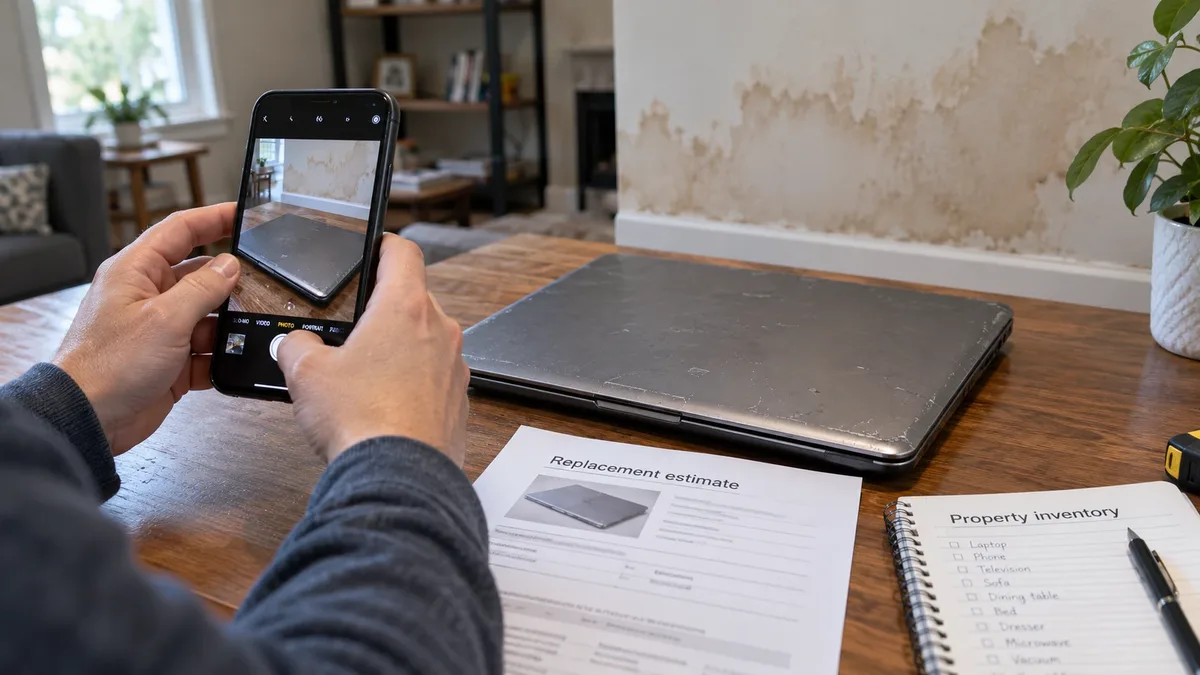
A replacement cost vs actual cash value comparison should also account for special limits on jewelry, collectibles, electronics, cash and other categories of property. An insurer may apply a category limit or require scheduled coverage even when the general personal-property provision uses replacement cost. An accurate home inventory can help establish ownership, condition and replacement specifications.
Replacement Cost vs. Market Value: Why They Are Different
Replacement cost vs actual cash value should not be confused with the market value of the home. Market value reflects what buyers may pay for the property, including the land and local housing conditions. Replacement cost focuses on the cost of rebuilding the insured structure with comparable materials, labor and construction methods.
A home worth $350,000 on the market might have a substantially different insured rebuilding cost. The property's land, neighborhood demand, local construction costs and structural features affect the comparison. An insurance limit based solely on a real estate listing price can therefore be inappropriate for estimating rebuilding needs.
When reviewing replacement cost vs actual cash value before a policy renewal, ask the insurer how it estimates dwelling replacement cost. Review square footage, construction type, improvements, local labor costs and applicable coverage extensions. A substantial renovation or building-cost increase can leave an older insurance limit inadequate even when the original estimate was reasonable.
How Do Deductibles Change the Final Insurance Payment?
Both sides of a replacement cost vs actual cash value comparison are affected by deductibles. A deductible is the portion of an otherwise covered claim that the insured generally must bear before the insurance payment is calculated. Homeowners insurance may use fixed dollar deductibles, percentage deductibles or separate deductibles for events such as hurricanes or windstorms.
Consider an insured dwelling value of $400,000 with a hypothetical 2% wind deductible. That percentage produces an $8,000 deductible, not a $2,000 deductible based on the current roof repair estimate. The actual policy determines the applicable percentage base, and a large deductible can materially reduce the settlement even when replacement-cost coverage applies.
A replacement cost vs actual cash value calculation should never subtract the deductible twice. If an adjuster's initial estimate has already applied the deductible, a subsequent recoverable-depreciation payment should be reconciled with that prior deduction. Ask for the full payment ledger when the settlement figures are unclear.
What If the Insurance Company Underestimates Your Replacement Cost?
A replacement cost vs actual cash value dispute may actually be a disagreement over repair quantities, materials, local labor rates or the work needed to restore damaged property. A contractor might identify hidden structural damage, building-code requirements or additional materials missing from the initial estimate. These questions should be addressed separately from whether depreciation is recoverable.
When challenging a replacement cost vs actual cash value estimate, prepare detailed evidence rather than relying on a single higher quote. An itemized contractor estimate, photographs, relevant building-code provisions and records of pre-loss materials can help establish the scope. The insurer should be asked to identify which items are denied, which prices are disputed and which expenses require a separate endorsement.
If a claim is denied entirely, the issue goes beyond replacement cost vs actual cash value. An excluded flood, neglected maintenance problem or other noncovered peril may generate no payment regardless of the valuation method. Contact the insurer for its written coverage explanation and use the appropriate state insurance department process if a claim-handling dispute remains unresolved.
How to Choose Between Replacement Cost and Actual Cash Value Coverage
The decision between replacement cost vs actual cash value should consider the premium, deductible, risk of a major loss and ability to replace property using personal savings. Replacement-cost coverage often provides stronger financial protection against depreciation but may cost more. ACV can be a less expensive option in some situations, though the premium difference must be confirmed through actual insurance quotes.
Use the following questions when shopping for a policy. They help identify whether a lower premium comes with substantial limitations on claims. Compare otherwise similar offers rather than relying only on the insurer's marketing description.
- Does the dwelling use RCV or ACV settlement? Confirm the actual contract provision.
- Are personal belongings insured differently? Look for replacement-cost contents endorsements.
- Does the roof have a special schedule or ACV limitation? Review every relevant endorsement.
- What deductible applies to different perils? A percentage deductible can be significant.
- Are code upgrades or extended rebuilding costs covered? Check ordinance-or-law and extended replacement-cost provisions.
- How is depreciation recovered? Ask about deadlines and documentation requirements.
- Is the coverage limit sufficient? Compare the insured limit with a current rebuilding estimate.
Expert takeaway: Replacement cost vs actual cash value is only one part of choosing adequate homeowners insurance. The more useful comparison includes covered perils, settlement conditions, deductibles, limits and current rebuilding costs. An attractive premium does not necessarily represent good value if the homeowner could not afford the out-of-pocket loss after a claim.
Replacement Cost vs. Actual Cash Value FAQ
Is replacement cost better than actual cash value?
Replacement cost vs actual cash value generally favors RCV when the primary goal is reducing depreciation-related out-of-pocket expense after a covered loss. However, the premium and conditions may be different, and coverage limits still apply. The appropriate choice depends on the policy and the homeowner's ability to absorb potential losses.
Can you receive actual cash value first and replacement cost later?
Yes, many replacement cost policies initially pay ACV and then provide additional eligible depreciation after qualifying repair or replacement. This is an important feature of replacement cost vs actual cash value claim settlements. Payment conditions and deadlines must be checked in the policy.
Is recoverable depreciation guaranteed?
No, recoverable depreciation in a replacement cost vs actual cash value claim is subject to the actual policy and qualifying repair expenses. The homeowner may need invoices, photographs and proof that covered property was repaired or replaced. A permanent ACV limitation generally does not create a separate right to recover depreciation.
Does replacement cost include upgrades to better materials?
Replacement cost vs actual cash value provisions generally focus on comparable replacement, not optional upgrades to higher-end materials. Some expenses may be covered under special endorsements or applicable building-code provisions. Upgrades chosen by the homeowner may remain the owner's responsibility.
Does homeowners insurance cover the market value of your house?
Homeowners coverage generally concerns insured property and rebuilding or repair costs rather than guaranteeing the home's real estate market price. Replacement cost vs actual cash value addresses the valuation of covered damage. Land value, neighborhood demand and other market factors can make the property sale price very different from its insured rebuilding cost.
The Bottom Line
Replacement cost vs actual cash value can create a substantial difference in what homeowners receive after covered property damage. Replacement-cost coverage generally avoids permanent depreciation deductions on eligible replacement expenses, while ACV coverage typically reflects a depreciated settlement. Deductibles, limits, endorsements and the cause of loss still determine the amount payable.
Before buying insurance or accepting a claim settlement, review the declarations page, loss-settlement provisions and itemized estimate. Confirm whether depreciation is recoverable, what proof is required and when the request must be submitted. The right information can prevent a temporary first payment from being mistaken for a final loss.
Spotted an error? Tell our editors. Read our corrections policy.