EV Charging Slow in Cold Weather? Why It Happens and How to Speed It Up
Electric cars may take longer to charge in freezing conditions even at powerful DC fast chargers. Discover why battery temperature matters and how to improve winter charging performance.
This article is general information, not financial advice. Rates, prices and rules change; check the details with a qualified professional or the lender before you decide.
In this article
- Why Does Cold Weather Slow EV Charging?
- How Much Slower Is EV Charging in Winter?
- What Is Battery Preconditioning?
- Does Driving Before Charging Warm the Battery?
- Level 1 vs. Level 2 vs. DC Fast Charging in Winter
- Why Is EV Charging Slow After 80%?
- What Else Can Make an EV Charge Slowly?
- How to Tell Whether the Charger or Battery Is Limiting Power
- Seven Ways to Improve EV Charging Speed in Cold Weather
- Does EV Battery Heating Use Extra Electricity?
- Is It Safe to Charge an EV in Snow or Rain?
- Planning a Winter Road Trip in an EV
- Frequently Asked Questions
- The Bottom Line
EV charging can be slower in cold weather because low battery temperatures restrict how quickly the battery can safely accept electrical energy. An electric car connected to a powerful DC fast charger may therefore charge at a fraction of the station's advertised maximum output during winter.
This does not necessarily indicate a defective charger or a damaged battery. The vehicle's battery management system may intentionally limit charging power to protect the cells while they are too cold.
Understanding battery preconditioning, charging curves, and differences between charging methods can help drivers reduce waiting time and plan winter journeys more effectively.
Why Does Cold Weather Slow EV Charging?
Cold weather slows EV charging because electrochemical reactions inside lithium-ion batteries become less favorable at low temperatures. Charging a cold battery too aggressively can increase the risk of unwanted lithium plating and other forms of degradation.
To limit these risks, the vehicle's battery management system controls how much power the battery can accept. Charging power may remain limited until the battery warms to an appropriate temperature.
A charger advertised at 150 kW does not guarantee that an EV will charge at 150 kW. The final charging power depends on both the charger and the vehicle, including battery temperature, battery state of charge, battery chemistry, and the car's maximum supported charging rate.
How Much Slower Is EV Charging in Winter?
Winter charging slowdowns vary considerably across electric vehicle models and weather conditions. Factors include the starting temperature of the battery, the distance driven before charging, the charging technology, and whether the vehicle has warmed its battery.
Research from Idaho National Laboratory has demonstrated that cold conditions can significantly increase DC fast-charging times. However, results from a particular EV model should not be presented as a universal slowdown percentage for all electric cars.
Charging condition | Possible behavior |
Warm battery, low state of charge | Vehicle may accept relatively high charging power |
Cold battery, low state of charge | Charging may begin at reduced power |
Battery warming during a session | Charging power may gradually increase |
High battery state of charge | Power often decreases regardless of weather |
Battery properly preconditioned | Vehicle may reach a more favorable charging rate |
Cold charger cable or connector | Additional handling or equipment issues may occur |
The cold-weather effect is not the same as the decline in driving range. Both can occur simultaneously, but they describe different aspects of EV performance.
What Is Battery Preconditioning?
Battery preconditioning is the process of bringing the battery closer to a suitable operating temperature before driving or charging. Many electric vehicles can warm the battery using their thermal management systems.
Some models begin battery preconditioning when a compatible DC fast-charging station is selected in the built-in navigation system. Other vehicles provide a manual setting, while some do not offer the function at all.
The U.S. Department of Energy recommends using vehicle preconditioning when available, particularly while the EV remains plugged in at home. This can reduce the amount of stored battery energy needed for initial heating and improve vehicle efficiency.
How to Precondition an EV Before Fast Charging
The exact procedure varies by manufacturer, but a typical approach is to select the intended charging station through the vehicle's supported navigation system. When appropriate conditions are met, the car may automatically begin warming the battery before arrival.
Drivers should check their owner's manual for the required settings, minimum battery charge, supported charging networks, and other conditions. Not every navigation app triggers battery preconditioning.
Selecting a public charger in a phone's mapping application does not necessarily communicate the intended destination to the EV's battery management system.
Does Driving Before Charging Warm the Battery?
Driving can help warm an EV battery, but the effect depends on ambient temperature, vehicle design, driving conditions, and thermal management. A brief trip in very cold weather may not provide enough time for the battery to reach an optimal fast-charging temperature.
Some cars actively warm the battery while driving toward a fast charger. Others rely on different thermal strategies.
Drivers should not attempt aggressive acceleration or unsafe driving merely to heat the battery. Using the manufacturer's supported preconditioning process is a better approach when available.
Level 1 vs. Level 2 vs. DC Fast Charging in Winter
Cold weather affects different charging methods in different ways. Fast charging is particularly sensitive to battery temperature because the vehicle may otherwise be expected to accept substantial power in a short period.
Charging type | Typical purpose | Winter consideration |
Level 1 AC | Slow charging from compatible household supply | Battery and cabin heating may consume a meaningful portion of incoming power |
Level 2 AC | Home, workplace, and destination charging | Often practical for overnight charging, but cold conditions can affect net energy stored |
DC fast charging | Rapid charging during trips | Battery temperature can substantially limit power acceptance |
The actual charging power varies widely across vehicle models and stations. Owners should use their vehicle's rated capabilities rather than assume every charger within a category performs identically.
Why Is EV Charging Slow After 80%?
EV charging commonly slows at high state of charge because the battery management system reduces power as the battery approaches its full usable capacity. This behavior can occur even in warm weather.
Cold temperatures may introduce an additional limitation. A vehicle with a cold battery at 85% state of charge may receive relatively little charging power compared with the same vehicle at 20% and a more suitable battery temperature.
The Department of Energy notes that the final 80%–100% portion of DC fast charging can take disproportionately long. When practical, drivers may save time by making shorter charging stops rather than routinely charging to 100% at each station.
However, long journeys through areas with widely spaced chargers may justify charging to a higher level. The correct target depends on the route, weather, reserve energy, and available charging infrastructure.
What Else Can Make an EV Charge Slowly?
Cold weather is only one possible explanation. A charging session can also be limited by station hardware, power sharing, battery state of charge, or vehicle-specific restrictions.
Possible causes include:
- An unusually high starting state of charge.
- A charger that provides less power than advertised.
- A vehicle whose DC charging limit is lower than the station's rating.
- Station power sharing among several charging ports.
- Battery temperature outside the recommended range.
- A charging station fault or communication problem.
- Vehicle software or thermal management restrictions.
If charging is consistently slow even in favorable conditions, check whether the issue occurs at multiple stations and consult vehicle diagnostics or manufacturer support.
How to Tell Whether the Charger or Battery Is Limiting Power
The vehicle's charging display can provide useful information, such as state of charge, charging power, and estimated completion time. Some vehicles also show battery temperature warnings or preconditioning status.
Comparing the same vehicle at different stations can help identify patterns, but charging conditions must be similar for the comparison to be meaningful.
For example, charging at 30% state of charge with a warm battery is not directly comparable to charging at 90% with a cold battery. Differences in power do not automatically indicate a faulty station.
Seven Ways to Improve EV Charging Speed in Cold Weather
Winter charging performance improves most reliably when drivers use vehicle-supported thermal management and avoid unnecessary high-state-of-charge charging.
- Use supported battery preconditioning. Select a compatible DC charging destination in the vehicle's navigation when required.
- Charge while the vehicle is still warm. Charging after a sufficiently long trip may be more favorable than after an extended cold soak.
- Use home charging when available. Starting a journey with adequate energy can reduce reliance on cold fast-charging sessions.
- Plan charging stops intelligently. Arriving with a suitable reserve and a relatively low state of charge may improve fast-charging performance.
- Allow extra winter travel time. Do not assume summer charging stops will take the same amount of time.
- Choose appropriately rated chargers. A higher-power charger helps only when the vehicle can actually accept the power.
- Follow manufacturer guidance. Preconditioning controls and charging limits differ substantially between models.
The goal is not to force the battery to accept more power than its management system allows. It is to create the conditions in which the car can safely use its charging capabilities.
Does EV Battery Heating Use Extra Electricity?
Battery heating consumes energy, but it can also support better charging performance and vehicle operation. Whether preconditioning saves time or improves overall efficiency depends on the situation.
When a vehicle is connected to home charging, preconditioning may draw some energy from the grid rather than from stored driving range. This can be helpful before departure in cold weather.
On a road trip, the vehicle may use battery energy to warm the pack ahead of a charging stop. The benefit is often improved charging performance, though actual net energy consumption depends on the vehicle and conditions.
Is It Safe to Charge an EV in Snow or Rain?
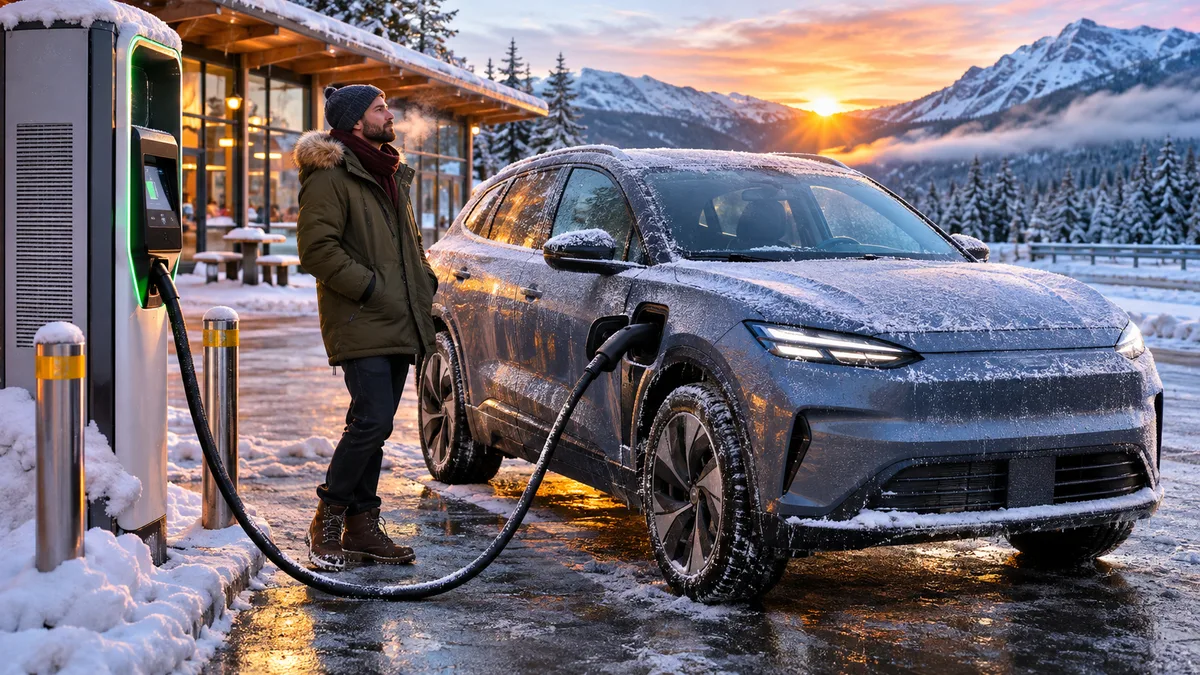
EV charging equipment is designed for outdoor use under specified environmental conditions. However, connectors and charge ports should be kept free of heavy ice accumulation and used according to manufacturer instructions.
The Department of Energy recommends protecting connectors from freezing and returning public charging equipment properly after use. Drivers should not force a frozen connector or attempt improvised heating methods that might damage electrical equipment.
When a charging port or connector becomes stuck, use the vehicle or charging-network provider's recommended release procedure.
Planning a Winter Road Trip in an EV
Winter trip planning should account for reduced driving range, charging delays, weather conditions, and the location of alternative stations. Drivers should also consider how cabin heating, elevation changes, wind, and road conditions affect energy consumption.
A practical route includes charging stops with a reasonable energy reserve and alternatives if a station is unavailable. It is particularly important not to arrive at an isolated winter charging station with almost no remaining range.
A charging session that takes an extra 20 minutes may be inconvenient; arriving without enough energy to reach a functioning charger can create a more serious safety problem.
Frequently Asked Questions
Is slow EV charging in cold weather normal?
Yes. Battery temperature can cause the vehicle to limit charging power. Persistent slow charging under otherwise favorable conditions may require further investigation.
Can you precondition an EV while driving?
Many models support preconditioning while driving to a compatible fast charger, but availability and operation vary by vehicle.
Does fast charging damage a cold EV battery?
Modern EVs use battery management systems to control charging power and reduce battery risks. Drivers should follow the vehicle's normal charging procedures rather than try to bypass protective limits.
Is Level 2 charging better than DC fast charging in winter?
Level 2 is useful for longer charging periods and home charging, while DC fast charging remains valuable during trips. Which is preferable depends on the time available, battery temperature, and charging requirements.
Why does my EV charge quickly at first and then slow down?
A decreasing charging rate often reflects the normal charging curve as state of charge rises. Battery temperature, station limitations, and other factors may also influence the rate.
The Bottom Line
Slow EV charging in cold weather is often the result of battery temperature management rather than a defective charger. The most useful solutions involve supported preconditioning, realistic route planning, and understanding when the battery can accept higher power.
Drivers should compare charging sessions under similar conditions before diagnosing a problem. With suitable preparation, winter EV charging becomes more predictable even when freezing temperatures make it slower than expected.
Spotted an error? Tell our editors. Read our corrections policy.