Employment Background Check: What Shows Up, What Is Legal, and How to Respond
A background report can affect a job offer even when the information is incomplete or belongs to someone else. Learn what employers may verify, when written permission is required, how criminal and credit records differ, and what to do before a hiring decision becomes final.
This article is general information, not financial advice. Rates, prices and rules change; check the details with a qualified professional or the lender before you decide.
In this article
- What Can Employers Actually See in a Background Report?
- When Can an Employer Screen a Job Applicant?
- How Far Back Does an Employment Background Check Go?
- Can a Criminal Record Fail an Employment Background Check?
- Can Hiring Screening Include Medical Records or Drug Testing?
- What Happens When Screening Finds Negative Information?
- How to Dispute an Employment Background Check Error
- How Long Does Pre-Employment Screening Take?
- How to Prepare Before Your Background Screening
- Can Employers Run Another Background Check After Hiring?
- Employment Background Check FAQ
- The Bottom Line
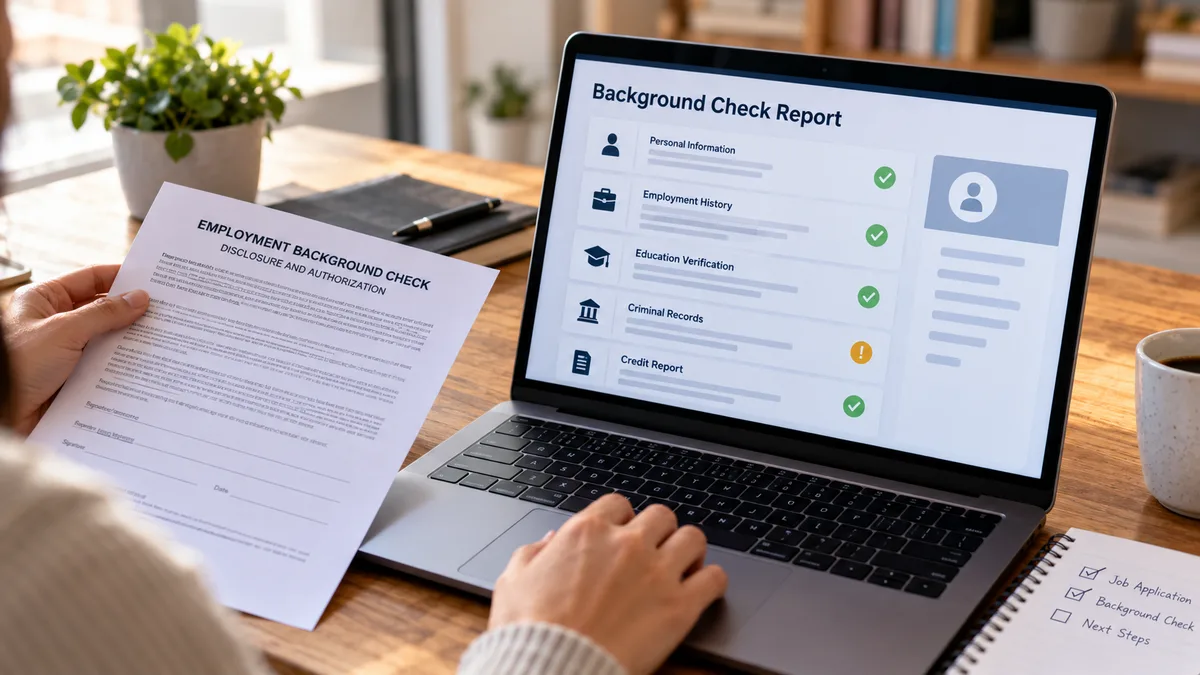
An employment background check can include verification of previous jobs, education, professional licenses, criminal records, driving history, and sometimes credit or other public-record information. The exact scope depends on the position, the employer, applicable federal and state laws, and whether a third-party screening company prepares a report. When an employer buys a covered background report from a screening company, the Fair Credit Reporting Act (FCRA) generally requires advance written disclosure and authorization, plus additional notices before and after certain negative employment decisions.
An employment background check does not automatically reveal every detail of someone's life, and an unfavorable record does not always disqualify a qualified applicant. A direct call to a former supervisor is legally different from buying a consumer report, while an arrest is legally different from a conviction. Knowing those distinctions helps candidates protect their privacy, spot errors, and respond before an inaccurate report costs them an opportunity.
What Can Employers Actually See in a Background Report?
An employment background check may draw from several separate sources rather than one universal database. Screening firms offer different packages, and employers typically request information relevant to a particular position. A warehouse driver may be screened for driving violations, for example, while an accounting applicant may face different verification requirements. Neither example guarantees that a credit report or criminal search will be included.
Screening component | What may be verified | Important limitation |
Employment history | Prior employers, dates, job titles, sometimes eligibility for rehire | Employer policies differ on what former employers disclose. |
Education and credentials | Degrees, enrollment, licenses, certification status | A verification discrepancy may reflect a changed school name or incomplete record. |
Criminal history | Certain arrests, charges, convictions, and case dispositions | Reporting limits, record-sealing laws, and job-related restrictions vary. |
Credit or financial history | Selected credit-file or public financial information | It is not the same as providing an employer with a consumer's credit score; state restrictions may apply. |
Motor vehicle records | License status, relevant violations, driving history | Usually tied to roles involving driving or vehicles. |
Public online information | Publicly available posts, business information, or professional profiles | Protected-class discrimination rules still apply to employment decisions. |
Specialized screening | Regulated-industry records, sanctions, or applicable substance-testing results | May involve separate procedures, privacy laws, and job-specific requirements. |
The table is a menu of possible screening components, not a list that appears in every screening report. The applicant should ask which checks are being ordered, whether a third party will prepare them, and which particular requirements arise from the role. For many jobs, identity, past employment, and education verification may matter more than an extensive investigation.
Can a background check reveal jobs missing from a resume?
An employment background check may reveal additional employment through information held by verification providers, payroll-related databases, references, or records supplied for screening, but no single provider has a complete record of every job. A prior employer may confirm a period of work even if it was omitted from a short resume. An omitted position is not automatically evidence of fraud: resumes intentionally summarize experience, whereas applications may ask for a comprehensive work history.
Candidates should answer each application question accurately instead of assuming that every entry on a resume must mirror an exhaustive background report. If the report shows an incorrect job title or dates, pay stubs, tax documents, offer letters, or HR records may help resolve the discrepancy. Avoid sending sensitive tax or identity information through an unverified email address.
Does an employment background check include a credit score?
An employment background check may include information from a credit report where the employer has a lawful basis to request it and state or local law permits the inquiry. However, a traditional employment credit report does not simply hand the hiring manager a consumer credit score, and a credit-history screening inquiry generally does not affect the applicant's score. Rules restricting employment use of credit history vary significantly by jurisdiction, with some roles subject to exceptions.
The employer's interest may concern financial obligations or identity verification rather than a candidate's creditworthiness as a borrower. Applicants can review their own credit files through AnnualCreditReport.com before the screening process. Correcting information early is useful, but checking the three nationwide credit bureaus does not replace reviewing a separate specialist employment-screening report.
When Can an Employer Screen a Job Applicant?
An employment background check can occur at different hiring stages, subject to applicable laws and the screening method. Some employers verify professional qualifications before interviews, while others order outside reports only after a conditional offer. Local fair-chance laws, industry licensing requirements, and internal hiring procedures may change when criminal-history questions are permitted.
For an employment background check performed through a consumer reporting agency, the FCRA generally requires the employer to disclose in a stand-alone written document that the report may influence an employment decision and to obtain written authorization before ordering it. The required notice should not be buried in the employment application, although authorization may be included with the stand-alone disclosure. An employer may lawfully decline to proceed with an application when an applicant refuses a lawful required screening, subject to other applicable rights and restrictions.
Does a third-party screening report require your permission?
An employment background check obtained from a third-party consumer reporting agency generally requires written authorization under the FCRA. That is different from an employer directly reviewing publicly available information or contacting a reference without purchasing a consumer report; those activities do not automatically trigger every FCRA disclosure rule. Nevertheless, anti-discrimination, privacy, contractual, and state-law restrictions can still govern the employer's conduct.
For ongoing screening after hiring, the initial authorization may sometimes cover later reports if the employer clearly and conspicuously says so, under the applicable rules. Applicants should read what they are authorizing and keep a copy. Ask which screening company is involved, what type of information it collects, and how to request a copy of the resulting report.
Is a conditional job offer guaranteed after screening starts?
No. An employment background check that begins after a conditional offer does not make the offer unconditional or guarantee a start date. A legitimate employer may need to verify a degree, professional license, driving eligibility, or relevant record before finalizing employment, but it must respect applicable disclosure, decision-making, and nondiscrimination rules. The offer letter should identify contingencies and any deadline for submitting information.
Avoid resigning from an existing job solely because the screening portal displays a status such as “in progress” or “complete.” Those labels can mean that the vendor finished gathering data, not that the employer has reviewed it or approved the hire. Confirm the final offer, start date, and any outstanding contingencies with the employer's authorized representative.
How Far Back Does an Employment Background Check Go?
An employment background check has no single nationwide seven-year limit across all information and all types of searches. Under the federal FCRA, certain older adverse information is generally restricted in consumer reports, but criminal convictions are not subject to a general federal seven-year reporting limit. Certain employment reports involving an expected annual salary of at least $75,000 may also fall within a statutory exception to some age limits, while state law can impose additional restrictions.
Education dates and basic job-history verification can also extend beyond seven years, since accurately reported older degrees or employment dates are not automatically prohibited adverse items. Conversely, non-conviction information such as certain older arrests can face federal reporting limits and state-specific protections. An employment background check should distinguish the date an event occurred, its final disposition, and whether a record was sealed or expunged rather than assuming all criminal-history records remain equally reportable.
Information | Broad federal reporting principle | What to double-check |
Criminal convictions | No general FCRA seven-year cap on convictions | State restrictions, sealing, relevance, and industry-specific rules. |
Certain arrests and other adverse items | Often subject to a seven-year FCRA rule, with exceptions | Disposition, reporting period, salary exception, and local laws. |
Bankruptcy filings | May have a different federal reporting period, up to 10 years | Report accuracy and applicable exceptions. |
Education and past employment dates | Not subject to one blanket seven-year cutoff | Completeness and factual accuracy. |
Directly obtained records | FCRA consumer-report age restrictions do not necessarily apply | Other federal, state, and local restrictions still matter. |
A common misunderstanding is that a hiring report cannot show anything more than seven years old. Another is that a screening company may report a sealed case without investigating whether disclosure is legally restricted. Both oversimplify federal law; the report must be assessed by record category, location, role, and the source of the information.
Can a Criminal Record Fail an Employment Background Check?
An employment background check showing a criminal record does not mean every employer must reject the applicant, nor does it mean the record must be ignored. Federal equal-employment law restricts discriminatory treatment, and the EEOC advises considering the nature and seriousness of an offense, how much time has passed, and the relationship between the conduct and the job. Some occupations also have specific legal bars or licensing requirements that differ from an ordinary private-sector job.
An arrest alone is not proof that the person committed the alleged offense. If an employment background check includes an arrest without conviction, the employer should not automatically treat that fact as guilt; any consideration of underlying conduct must comply with applicable law and be grounded in relevant evidence. A blanket exclusion policy may raise disparate-impact concerns if it disproportionately excludes protected groups without being job-related and consistent with business necessity.
What are “ban-the-box” and fair-chance hiring laws?
Fair-chance or “ban-the-box” rules limit when certain employers can ask about or consider an applicant's criminal history. There is no single nationwide rule that applies the same way to every private employer. The federal Fair Chance to Compete for Jobs Act generally delays criminal-history inquiries for many federal agency and federal contractor hiring decisions until after a conditional offer, subject to exceptions. States and cities may impose their own timing, notice, or assessment requirements.
A screening process that is lawful in one jurisdiction may require additional steps in another. Applicants should identify the state and locality where the job is based, the type of employer, and the particular regulated position before relying on a generalized rule. A fair-chance restriction does not necessarily prohibit all eventual consideration of relevant convictions.
Can an old conviction be explained instead of causing rejection?
An employment background check can prompt an employer to seek context where the law and hiring process permit it. Relevant explanations might include a case that was dismissed, an incorrectly matched record, a completed sentence, a long interval without further conduct, professional training, or evidence that the offense bears little relationship to the role. Documentation is stronger than unsupported assurances.
Applicants should not disclose more sensitive information than is requested or required, but they should avoid false statements on legally permitted application questions. If a report identifies something the applicant believes is mistaken or legally restricted from disclosure, start with the screening company and supporting records. If the question is whether a valid conviction may legally be used, local employment counsel or a fair-employment agency may be needed rather than a simple data dispute.
Can Hiring Screening Include Medical Records or Drug Testing?
An employment background check is not blanket permission to obtain an applicant's private medical files, genetic information, or family medical history. Under the Americans with Disabilities Act, employers generally cannot ask disability-related questions or require medical examinations before a conditional job offer. After a conditional offer, different rules apply, including consistent treatment of individuals entering the same job category and other limits on using medical information.
Drug and alcohol testing may accompany hiring in some workplaces, but it is not interchangeable with ordinary record verification. A screening vendor's service menu might advertise health or substance-testing capabilities without establishing that a particular employer can lawfully demand every such test. State law, the kind of test, the position, and industry regulations require separate review, and medical information is subject to confidentiality obligations.
What Happens When Screening Finds Negative Information?
An employment background check that includes unfavorable information triggers a specific federal process when the employer is relying on a third-party consumer report to make an adverse employment decision. Before taking the negative action, the employer must provide the applicant a copy of the report and A Summary of Your Rights Under the Fair Credit Reporting Act. This is the pre-adverse-action stage, when the applicant can inspect the information and flag mistakes.
The FCRA does not prescribe one universal five-business-day waiting period between a pre-adverse-action notice and the final decision. The employer must provide a meaningful opportunity for the applicant to review the report, with additional waiting-period rules possible under state or local law. An employment background check report marked “consider” or “review” does not by itself mean an adverse decision has legally been made.
If the employer ultimately rejects the applicant, withdraws a promotion, or takes another adverse action based on the report, a separate adverse-action notice generally must identify the reporting company, explain that the company did not make the decision, and state the applicant's right to dispute inaccurate information and obtain another free copy under applicable time limits. Under FTC guidance, the applicant can request that free report from the screening company within 60 days of the adverse decision. The employer's notice and the reporting company's correction obligations are separate protections.
Example: A background report shows someone else's conviction
Imagine a screening report matching a candidate to a court record belonging to a different person with a similar name. The employer sends a pre-adverse-action notice, but the applicant recognizes that the birth date, county, or case number does not match their records. That discrepancy should be raised immediately with the reporting company and the employer, with copies of reliable identity or case records submitted through secure channels.
A correction may require the vendor to consult the originating court or data supplier, not merely rename a record. The candidate should request a written dispute confirmation, ask for the corrected report to be sent to the employer, and follow up before the hiring decision if possible. A disputed report does not automatically compel the employer to hold the job indefinitely, but a timely, well-documented response can prevent an avoidable mistake from becoming a final rejection.
How to Dispute an Employment Background Check Error
An employment background check error should be disputed directly with the consumer reporting agency that created the report, and the employer should be told promptly if the information may affect hiring. The FCRA requires the reporting company to conduct a reasonable investigation of a qualifying dispute, usually within 30 days, with certain circumstances permitting more time. A mistaken criminal disposition, the wrong person's record, an inaccurate degree result, or employment dates attributed to the wrong individual each requires a different supporting document.
A useful process for challenging an employment background check begins with obtaining the report and identifying each error. Documenting the issue early gives the employer an opportunity to review accurate information before deciding. Follow these steps:
- Request the full report. Obtain all pages, not merely a portal status or employer summary, and identify the screening company by its legal name.
- Mark each inaccurate entry. Record the field, the reported value, and the correction needed, such as “dismissed” rather than “pending.”
- Collect authoritative evidence. Use court dispositions, license databases, school registrar confirmations, employer HR letters, or payroll records as appropriate.
- Submit the dispute to the screening company. Follow its published dispute method, retain a confirmation, and send copies rather than original documents.
- Notify the employer promptly. Explain that a particular entry is disputed and offer to provide the corrected result when available.
- Review the reinvestigation outcome. Verify that the error was corrected or deleted and ask that corrected information reach recipients who need it.
- Escalate unresolved errors. Consider the CFPB complaint process, the FTC for reporting-rule concerns, or appropriate legal assistance depending on the issue.
For an employment background check involving a criminal record, the correction may need to begin with the court or state repository as well as the screening firm. A report that omits a case dismissal can be misleading even if it accurately records that an arrest occurred. Preserve the initial report, the filed dispute, the documents sent, and the vendor's final response in case further action is necessary.
The CFPB maintains a list of consumer reporting companies that includes specialist employment-screening providers. The list is useful for locating a vendor and learning how to request a file, but it is not an exhaustive directory of every agency. If a vendor refuses to correct demonstrably false information, a CFPB complaint may be appropriate after the applicant has followed available dispute steps.
How Long Does Pre-Employment Screening Take?
An employment background check does not have one fixed completion time. Basic automated verification may return quickly, while county court searches, international education confirmations, licensing checks, and discrepancies requiring manual review may take longer. The FCRA establishes important consumer protections but does not impose a universal deadline by which all employer screening must be completed.
When a screening request appears delayed, ask whether information is missing, whether a specific jurisdiction or registrar has not responded, and whether the planned start date depends on final clearance. Supply only documents needed for the legitimate verification, and use the employer's verified portal. An unexplained request for an upfront “background-check deposit,” cryptocurrency transfer, or copies of banking credentials should be treated as a potential employment scam, not a normal compliance step.
How to Prepare Before Your Background Screening
An employment background check is easier to navigate when dates, credentials, and contact information are consistent before a job offer arrives. Applicants should gather a reliable employment timeline, verify their degree and license names, review their credit files if relevant, and be ready to explain records that could be misunderstood. Preparation should focus on factual accuracy rather than attempts to conceal information through misleading applications.
A practical preparation checklist includes checking whether professional certifications are current, confirming prior employers' official names, making sure public professional profiles do not materially contradict applications, and reviewing local fair-chance rules. If an employment background check will rely on a specialist vendor, ask for its name and the proper way to obtain a copy of the report. The site's Careers & Work section covers other decisions around interviews, job applications, offers, and compensation without confusing those subjects with screening rights.
How can you protect personal information during screening?
A legitimate employment background check may require sensitive identity details, but the request should come from a verified employer or reputable screening provider through an appropriate secure process. Do not publish a Social Security number, date of birth, driver's license image, or bank account information on a resume or general job board. Confirm the employer's official contact details independently if a message asks for unusually broad access to personal accounts or financial records.
An employment background check disclosure should explain the employer's intended use of a third-party report. Read the authorization carefully and avoid assuming that consenting to identity verification allows unrestricted searches of personal devices, medical files, or private accounts. If a request seems unrelated to the job, ask for its legal basis and the applicable employer policy before providing more data.
Can Employers Run Another Background Check After Hiring?
An employment background check can be repeated during employment when lawful and related to retention, promotion, reassignment, regulatory compliance, or another legitimate employment purpose. If a consumer reporting company supplies the report, relevant FCRA permissions and adverse-action protections can still apply. An authorization covering later reports should state that continuing use clearly, and state or local rules may add safeguards.
Employees who learn of a new screening should confirm what triggered the review, which provider is handling it, and which policies or regulations apply. The ability to monitor records does not override federal nondiscrimination law or the ADA's separate limits on medical inquiries during employment. If a report leads to a negative action, request the applicable documents and follow the same evidence-based dispute process rather than assuming rights end after hiring.
Employment Background Check FAQ
Does a hiring background check show every past job?
No. An employment background check may confirm some jobs through records, prior employers, or verification databases, but no vendor has a guaranteed complete list of every position. The extent depends on the screening package and available records. Be accurate on the employment application, especially when it asks for a complete history rather than a selective resume.
Can bad credit cause a failed hiring screen?
A credit-related issue can influence some employment decisions where a lawful credit review is permitted, but there is no universal rule that poor credit automatically disqualifies an applicant. An employment background check may not include credit information at all, and several states or localities limit when employers may consider it. If a third-party report drives a rejection, the FCRA's notice and dispute requirements may apply.
Can an expunged record appear on a background report?
An employment background check should not assume that expunged, sealed, and publicly available records are interchangeable. Legal restrictions on reporting and access depend on the jurisdiction, record status, and relevant rules. If a legally restricted case appears on a screening report, request the full record and dispute it with documentation of the sealing or expungement order.
Must screening finish before your start date?
Not under one universal federal deadline. An employment background check may be a condition of a specific offer, license, security requirement, or employer policy, and the company can adjust the start date according to applicable rules. Obtain written confirmation of any outstanding conditions before relying on the proposed date.
What if a report costs you a job?
Ask for the screening report and both stages of notice if a third-party consumer report was used, identify the specific reason, and dispute any inaccurate or incomplete information promptly. An employment background check rejection may also raise an anti-discrimination issue or a state fair-chance violation, depending on the facts. Preserve emails, notices, case records, and deadlines, and seek advice from a relevant agency or qualified attorney when needed.
The Bottom Line
An employment background check can support a legitimate hiring decision, but it should not be treated as an infallible verdict about a person. Applicants have important rights when third-party reports are involved, including disclosure, authorization, access to reports before certain adverse decisions, and opportunities to correct errors. The strongest response is to understand what was checked, verify the source, document mistakes quickly, and apply the federal and local protections that actually govern the job.
Spotted an error? Tell our editors. Read our corrections policy.