On-Call Pay Rules: When Must Your Employer Pay You for Waiting?
Being on call does not always mean every hour must be paid. Learn when waiting counts as working time, how restrictions affect compensation, and what records employees should keep.
This article is general information, not financial advice. Rates, prices and rules change; check the details with a qualified professional or the lender before you decide.
In this article
- What Is On-Call Pay?
- When Must On-Call Time Be Paid Under the FLSA?
- Does Being On Call at Home Count as Hours Worked?
- On-Call at Work vs. On-Call at Home
- Are Call-Back Hours Paid?
- How to Calculate On-Call Pay: Three Examples
- Does On-Call Pay Count Toward Overtime?
- Do State Laws Provide More On-Call Pay Protection?
- What Records Should On-Call Employees Keep?
- What if Your Employer Refuses to Pay On-Call Hours?
- Frequently Asked Questions
- The Bottom Line
On-call pay rules depend on whether an employee can use standby time effectively for personal activities or is so restricted that the waiting period effectively becomes working time. Under the federal Fair Labor Standards Act (FLSA), simply being required to answer a phone does not automatically make every on-call hour compensable.
However, an employer generally must count time spent actually performing covered work. Waiting at an employer's workplace or operating under unusually restrictive on-call conditions can also qualify as hours worked.
The distinction is especially important for healthcare workers, IT support employees, emergency technicians, maintenance teams, and other workers expected to respond outside regular shifts.
What Is On-Call Pay?
On-call pay is compensation associated with being available for work outside a normal schedule. It may refer to payment for standby time, compensation for time spent responding to calls, or an additional allowance provided by company policy.
Federal law does not require one universal standby payment rate for all industries. Instead, the FLSA determines when on-call time qualifies as working time for covered nonexempt employees, while employment contracts, collective bargaining agreements, and state laws may provide additional compensation.
A company may voluntarily pay a fixed weekly on-call allowance even when not every standby hour is legally required to be paid. That allowance is a separate issue from whether time counts toward minimum wage or overtime obligations.
When Must On-Call Time Be Paid Under the FLSA?
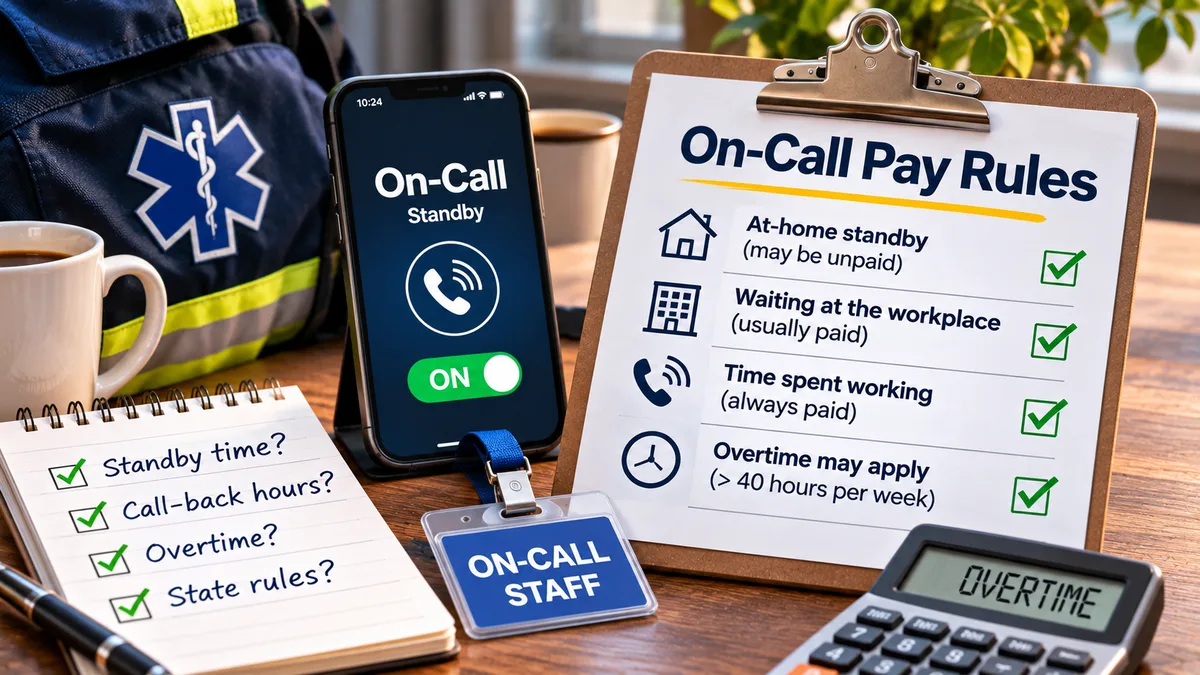
On-call time generally must be paid when the employee is required to remain at the employer's premises or is otherwise so restricted that the employee cannot effectively use the waiting time for personal purposes.
The U.S. Department of Labor distinguishes employees who are engaged to wait from those who are waiting to be engaged. The first category generally describes compensable working time; the second may describe noncompensable standby periods.
On-call situation | General federal treatment |
Required to stay at the workplace and remain ready | Usually compensable |
At home, free to pursue normal activities and reachable by phone | Often not compensable as standby time |
Required to answer a work call and perform tasks | Actual work is generally compensable |
Required to respond so rapidly that meaningful personal activity is impossible | Standby time may be compensable |
Frequently interrupted by calls throughout the evening | Restrictions and call frequency may make waiting compensable |
Paid a voluntary on-call allowance | Treatment of standby time still depends on the applicable rules |
These are general principles, not automatic outcomes. The full circumstances matter, and additional state rules or agreements may apply.
Does Being On Call at Home Count as Hours Worked?
Being on call at home generally does not count as hours worked under federal rules if the employee can effectively use the time for personal activities. The ability to remain at home, run errands, watch a movie, or spend time with family can be relevant to that evaluation.
However, location alone does not decide the issue. An employee may technically be at home but face such severe restrictions that meaningful personal use of time becomes impractical.
The Department of Labor considers the actual impact of those restrictions rather than merely whether the employer labels the arrangement “on call.”
Does Carrying a Work Phone Make Standby Time Paid?
Carrying a work phone does not, by itself, require payment for all standby hours. The key question is whether other obligations substantially restrict the employee's activities.
For example, an IT employee may carry a phone from 6 p.m. to midnight and receive only one short call. If the employee can otherwise spend the evening normally, the standby hours may not all qualify as working time.
The time actually spent resolving a technical problem, however, generally counts as work for a covered nonexempt employee.
What if You Must Respond Within 15 Minutes?
A short response deadline can make on-call time more restrictive, especially if the worker must remain close to the workplace. But no single federal rule makes every 15-minute response requirement automatically compensable.
The employer's location requirements, frequency of calls, ability to exchange shifts, and actual interference with personal activities are relevant factors.
A worker who must repeatedly abandon meals, outings, or sleep may have a stronger argument that the entire period is effectively controlled by the employer.
On-Call at Work vs. On-Call at Home
The distinction between workplace and home standby can substantially affect compensation. An employee required to remain at the employer's establishment generally has less freedom to use the time for personal activities.
For example, a maintenance worker required to sit in a facility's control room for three hours while awaiting possible service requests is generally working during that period. A different employee permitted to remain at home and respond only if a problem arises may not be working throughout the entire standby period.
Workers who live on an employer's premises or work shifts lasting 24 hours or longer may be subject to additional rules concerning sleep and off-duty time.
Are Call-Back Hours Paid?
Time spent performing work after an on-call employee is contacted is generally compensable for a covered nonexempt employee. This can include troubleshooting a problem remotely, completing required reports, or returning to a worksite.
Whether travel related to a call-back is compensable depends on the circumstances and applicable rules. The Department of Labor's Field Operations Handbook addresses situations in which travel during a call-back constitutes working time.
Employees should document when the call began, how long the task lasted, whether additional work followed, and any required travel.
How to Calculate On-Call Pay: Three Examples
The following scenarios illustrate the principles rather than determine the legal outcome of a real dispute.
Example 1: IT Employee Available by Phone
An employee earns $30 per hour and is on call for 12 hours on Saturday. The employee remains at home, is free to pursue normal activities, and spends 45 minutes resolving a customer problem.
If the standby period does not qualify as working time, but the 45-minute intervention does, the additional gross pay at the regular hourly rate would be:
0.75 hours × $30 = $22.50
Overtime rules may increase the amount if those hours bring the employee's compensable workweek above the applicable overtime threshold.
Example 2: Maintenance Worker Required to Stay On-Site
A maintenance employee earns $24 per hour and must remain at the facility for four hours awaiting a possible equipment malfunction.
If all four hours qualify as hours worked, the gross straight-time amount would be:
4 hours × $24 = $96
The employee does not need to be physically repairing equipment throughout those hours for the waiting time to potentially qualify as working time.
Example 3: Repeated Evening Interruptions
A support technician is on call for six hours and receives nine calls lasting a total of three hours. Frequent calls, short response deadlines, and restrictions on leaving home may affect whether additional standby time is compensable.
The three hours actually worked should be documented. Whether some or all of the remaining standby period must also be paid requires a factual analysis.
Does On-Call Pay Count Toward Overtime?
Compensable on-call hours generally count as hours worked when determining overtime for covered nonexempt employees. Under the usual federal FLSA framework, overtime is due at not less than 1.5 times the employee's regular rate for hours worked over 40 in a workweek.
Some states impose additional daily overtime rules or other requirements. Also, certain on-call payments may affect calculation of the regular rate, depending on their character and the applicable exclusions.
Suppose a nonexempt employee works 39 regular hours and then performs four compensable on-call hours during the same workweek. The worker has 43 hours worked, meaning three hours would generally qualify for federal overtime.
For simple gross-pay comparisons, Eagle Post Daily offers a Salary to Hourly Calculator. It does not determine the legal regular rate or resolve which standby hours are compensable.
Do State Laws Provide More On-Call Pay Protection?
State employment laws can provide greater protection than the FLSA, including different rules about minimum reporting pay, scheduling, split shifts, or compensable time. Some collective bargaining agreements and employment contracts establish paid standby allowances.
Employees should identify the state where they work and review the relevant labor agency's guidance. An employer operating across several states should not assume that one uniform federal policy satisfies every local requirement.
Where federal and state requirements overlap, the applicable rule that provides greater legally required employee protection may control the particular issue.
What Records Should On-Call Employees Keep?
Accurate records help employees determine whether the employer has counted all compensable hours. They are also useful when repeated call-backs make personal time difficult to use.
A practical record should include the scheduled on-call period, specific restrictions, each contact received, work start and end times, response requirements, and relevant travel. Work-related messages and scheduling notices can help confirm the timing.
Employees should compare these records with pay statements and internal on-call policies before raising a dispute.
What if Your Employer Refuses to Pay On-Call Hours?
A dispute about on-call compensation should begin with identifying which hours qualify as work under the relevant rules. A worker can then ask payroll or HR to explain how the employer classified the standby period.
If the explanation appears inconsistent with federal law, the employee may contact the Department of Labor's Wage and Hour Division. State labor agencies may also provide complaint procedures for state-law violations.
Employees should retain relevant records and avoid assuming that an employer's statement that standby time is unpaid automatically settles the legal question.
Frequently Asked Questions
Do employers have to pay you to be on call?
Employers generally must pay for on-call time that qualifies as hours worked under applicable law. Merely being reachable does not always make the entire standby period compensable.
Does a short response time make on-call hours paid?
A short response requirement is relevant, but no single response deadline automatically determines the result under federal law. The overall restrictions and actual effect on personal activities matter.
Are after-hours work calls compensable?
For covered nonexempt employees, time spent performing required work after hours generally counts as working time. That includes eligible remote work as well as work performed on-site.
Is on-call pay always overtime?
No. Overtime depends on compensable hours and applicable overtime rules. An employee can receive on-call-related compensation without necessarily exceeding the federal 40-hour workweek threshold.
Can an employer pay a flat on-call stipend?
An employer may provide a stipend under its policies, but that does not necessarily replace legal obligations to pay for compensable work or calculate overtime correctly.
The Bottom Line
On-call pay depends less on the label placed on a schedule than on what the employee must actually do. Working on-site, performing call-back tasks, and operating under unusually restrictive conditions can trigger payment requirements, while less restrictive standby time at home may not.
Employees should document on-call restrictions and actual work, check applicable state laws, and verify how the hours appear on their pay statements. The factual circumstances determine whether standby time is legally compensable.
Spotted an error? Tell our editors. Read our corrections policy.