How Long Should a Resume Be in 2026? One Page or Two?
For most U.S. job seekers, a resume should be one or two pages. One page often works for early-career applicants, while two pages can be stronger when relevant experience genuinely requires the space.
This article is general information, not financial advice. Rates, prices and rules change; check the details with a qualified professional or the lender before you decide.
In this article
- How Long Should a Resume Be for Most Jobs?
- One-Page vs. Two-Page Resume: Quick Guide
- When Should Your Resume Be One Page?
- When Is a Two-Page Resume Better?
- Is a Three-Page Resume Too Long?
- How Far Back Should a Resume Go?
- How Much Space Should Each Job Get?
- How Long Should a Federal Resume Be in 2026?
- Does Resume Length Affect ATS?
- What Should You Cut to Make a Resume Shorter?
- What Should You Never Cut Just to Save Space?
- Resume Length Checklist
- FAQ
- The Bottom Line
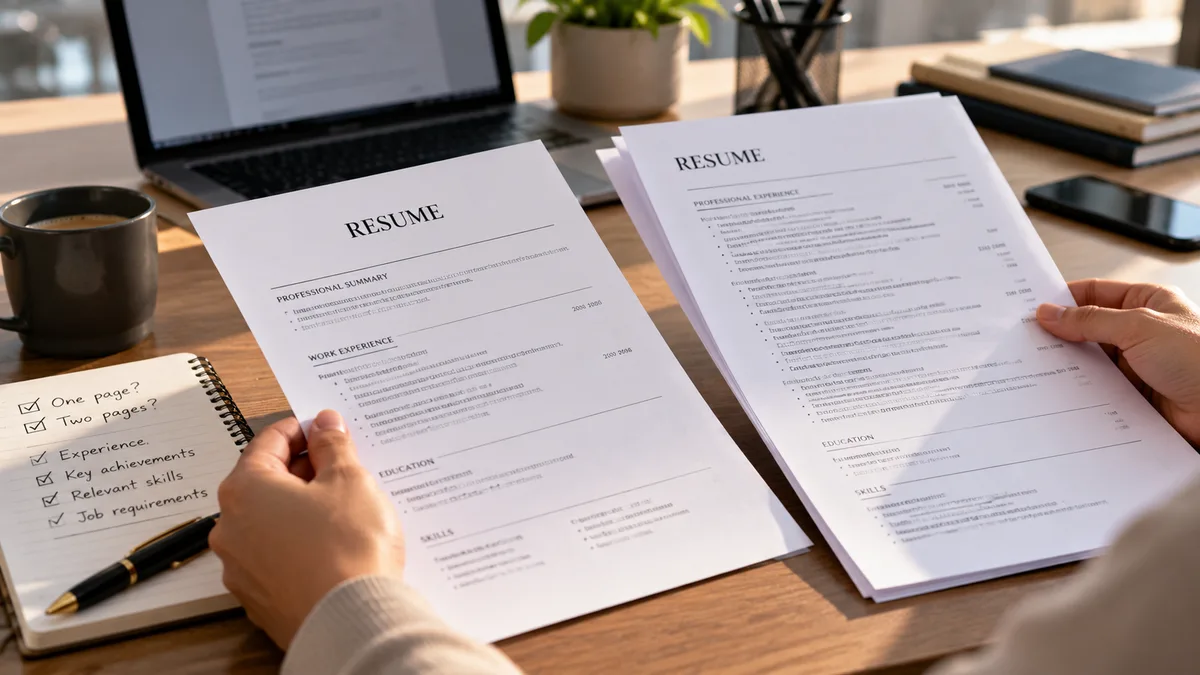
How long should a resume be? For most U.S. job seekers in 2026, one or two pages is the right answer. CareerOneStop recommends a resume length of one to two pages and says a second page should be used when the amount of relevant experience actually requires it.
That means the old rule that every resume must fit on one page is too rigid. A recent graduate can often communicate everything important on one page, while a manager with 12 years of relevant experience may weaken the application by deleting strong accomplishments simply to obey an arbitrary page count. The right resume length is the shortest version that still proves the candidate is qualified.
How Long Should a Resume Be for Most Jobs?
Most private-sector resumes should be one or two pages. CareerOneStop's current Resume Guide explicitly recommends that range and advises applicants to use the second page only when their experience makes it necessary.
The choice should depend on relevant information rather than age or ego. A candidate with 15 years in three highly relevant roles may need two pages, while someone with 15 years of unrelated short-term positions may still be able to create a focused one-page resume for a career change. The job posting determines what deserves space.
Page count is therefore an editing decision. If cutting the second page removes evidence the employer needs, keep it; if the second page is mostly old duties and filler, cut it.
One-Page vs. Two-Page Resume: Quick Guide
A resume should not become longer simply because an applicant has been working for a certain number of years. The better test is whether the extra content changes the employer's understanding of the candidate's fit for the job. The table below shows the most common situations.
Candidate type | Typical resume length | Why |
Student or recent graduate | 1 page | Education, internships and early experience usually fit comfortably |
Early-career professional | 1 page | Focus on the strongest relevant work and skills |
Mid-career professional | 1–2 pages | Two pages can support more accomplishments and progression |
Senior professional or manager | Often 2 pages | Leadership scope and measurable results may require more space |
Career changer | 1–2 pages | Emphasize transferable experience and relevant recent work |
U.S. federal applicant | Maximum 2 pages for standard USAJOBS resume | Federal agencies now enforce the two-page limit |
CareerOneStop uses one to two pages as its general recommendation, while USAJOBS now states that federal agencies accept resumes of two pages or less under the Merit Hiring Plan. The federal change is especially important because older advice describing very long federal resumes is now outdated for standard USAJOBS applications.
When Should Your Resume Be One Page?
A one-page resume works best when it can show the candidate's strongest qualifications without crowding. Students, recent graduates and people early in their careers often have enough room to present education, internships, skills and the most relevant job experience on one clean page. CareerOneStop's sample materials include a one-page recent-graduate resume for exactly this type of situation.
One page can also work for an experienced candidate making a narrow career change. If only the most recent five years are directly relevant to the target job, filling a second page with unrelated earlier work may make the application weaker rather than stronger. A concise resume can communicate direction more effectively.
Do not achieve one page by shrinking the font until the document becomes difficult to read. CareerOneStop recommends professional fonts around 10–12 points and a clean layout with adequate white space.
When Is a Two-Page Resume Better?
Two pages are appropriate when the candidate has enough relevant experience, accomplishments and leadership scope to justify the additional space. CareerOneStop specifically says two pages can be used when necessary because of the amount of experience. A second page is not a problem when the material remains focused.
A project director might need room to show major programs, budgets, teams and results across several roles. A cybersecurity specialist may need relevant certifications and technical experience in addition to work history. A healthcare professional may have licenses, specialized training and years of directly relevant clinical experience that genuinely strengthen the application.
The second page should continue the argument started on the first. It should not become storage for everything that did not fit above.
Is a Three-Page Resume Too Long?
For most ordinary U.S. private-sector applications, three pages are usually unnecessary. CareerOneStop's standard guidance stops at two pages, which is a useful signal that most applicants should be able to prioritize the relevant material within that space. A longer document may be appropriate in specialized contexts such as academic CVs, research careers or applications that explicitly ask for a different format.
If a resume reaches three pages, first look for repeated responsibilities. An experienced manager does not need five different roles to say “managed schedules, attended meetings and prepared reports” in slightly different ways. Older jobs can usually be compressed while the most recent relevant experience receives detail.
The problem is not that page three is forbidden. The problem is that important information becomes harder to find when weak information is allowed to stay.
How Far Back Should a Resume Go?
CareerOneStop recommends that applicants with longer work histories emphasize jobs that add the most value and generally focus on roughly the past 12–15 years. Older unrelated roles can be summarized more briefly when they are still useful for showing continuity.
This does not mean every job older than 15 years must disappear. A senior executive may have an earlier leadership role that remains highly relevant, while a technical professional may need to show when a specific long-term specialty began. Relevance matters more than one mechanical cutoff.
If an old position only repeats skills shown more recently, reduce it to the essentials. Resume length becomes easier to control when recent evidence receives priority.
How Much Space Should Each Job Get?
The newest and most relevant roles should generally receive the most space. CareerOneStop suggests roughly five to eight bullets for jobs when there is enough important material and advises focusing on tasks and accomplishments related to the job goal. That does not mean every role needs eight bullets.
A current role might receive five strong accomplishment bullets, the previous role four and an older role only two. The correct number is whatever is needed to show progression and relevant results without repeating the same responsibilities. Candidates should also use numbers and context where they help demonstrate impact.
One strong result is more valuable than three generic duty statements. If the resume feels long, reducing repetition is usually better than deleting the evidence that makes the candidate distinctive.
How Long Should a Federal Resume Be in 2026?
This answer changed recently. USAJOBS now states that federal agencies only accept resumes up to two pages to comply with the Merit Hiring Plan, and the system will not allow applicants to upload or build a longer standard resume.
That is a major shift from the traditional long-form federal resume many applicants used in the past. USAJOBS says the two-page resume still needs to show how the candidate meets the qualifications and requirements in the announcement, and agencies will not simply assume experience that is not clearly described.
Some specialized jobs may ask for another format such as a CV or long-form clinical or research resume, and USAJOBS tells applicants to follow the specific announcement in those cases. For ordinary federal applications, however, “federal resumes should be five pages” is now outdated advice.
Does Resume Length Affect ATS?
An applicant tracking system is more likely to have trouble with complex formatting than with whether a standard resume is one page or two. CareerOneStop recommends a simple single-column layout and warns against tables, text boxes, graphics, multiple columns and important information placed in headers or footers because some ATS platforms can misread those elements.
Do not remove useful keywords or experience simply to force the resume onto one page for the ATS. The system still needs enough information to connect the applicant with required qualifications. A clear two-page resume can be much stronger than a one-page resume that deletes relevant evidence.
Formatting and relevance matter together. The ATS should be able to read the document, and the recruiter should be able to understand it.
What Should You Cut to Make a Resume Shorter?
Reducing resume length should begin with low-value content rather than strong accomplishments. Generic objectives, long descriptions of old jobs, repeated skills and obvious responsibilities are usually better candidates for deletion than measurable results. Every line should answer why the information helps with the target job.
Before cutting, look for:
- A generic objective that adds no information.
- Summary sentences repeated again in the experience section.
- Very old jobs unrelated to the target role.
- Responsibilities repeated across multiple positions.
- Soft skills listed without evidence.
- Outdated software or technology no longer relevant to the job.
- College details that no longer matter for an experienced candidate.
- Multiple bullets describing routine work with no outcome.
- References or “references available upon request.”
- Excessive personal information.
- Large blank areas created by inefficient formatting.
After trimming, read the resume as though you know nothing about the applicant. If the remaining document still shows career progression, relevant skills and meaningful results, the removed content was probably unnecessary.
What Should You Never Cut Just to Save Space?
Do not remove a qualification simply because it forces the resume onto a second page. If a certification is required, a major accomplishment directly answers the job posting or an earlier role provides the only evidence of a critical skill, that information deserves space. Page count should serve the application rather than control it.
Also avoid turning the resume into dense walls of text. CareerOneStop recommends clean spacing, standard headings and readable formatting because the document needs to work for both hiring professionals and screening systems. A one-page resume that nobody wants to read is not better than a clear two-page one.
The correct question is not “How do I make this one page?” It is “What does the employer need to see, and how efficiently can I show it?”
Resume Length Checklist
A final page-count decision is easier when the content is evaluated in order of importance. Start with relevance, then remove repetition and only then adjust formatting. This prevents cosmetic preferences from weakening the application.
Check:
- Is every major section relevant to the target job?
- Does the first page contain the strongest qualifications?
- Are recent jobs more detailed than old jobs?
- Are accomplishments stronger than routine duty descriptions?
- Is any information repeated in two sections?
- Can old unrelated work be compressed?
- Is the font still readable?
- Does the document use a clean single-column structure?
- Does page two contain genuinely useful information?
- Does the specific employer or application impose a page limit?
If the answer to the final question is yes, that rule controls. USAJOBS is a clear 2026 example because the current federal system enforces its two-page maximum.
FAQ
How long should a resume be in 2026?
For most U.S. job seekers, one or two pages. CareerOneStop recommends a one- to two-page resume and says two pages should be used when the applicant's experience requires the additional space. The best length is the shortest version that still shows the qualifications needed for the job.
Is a two-page resume too long?
No. A two-page resume is completely appropriate when both pages contain relevant experience and accomplishments. CareerOneStop explicitly includes two pages within its recommended length. The problem is not page two itself but filler that does not strengthen the application.
Should a resume be one page for 10 years of experience?
Not necessarily. Someone with 10 years of closely relevant experience may need two pages to show progression and measurable accomplishments without overcrowding the layout. Someone whose earlier work is unrelated may still be able to use one page.
Can a federal resume be longer than two pages in 2026?
Standard USAJOBS resumes cannot. USAJOBS states that federal agencies accept resumes of two pages or less under the Merit Hiring Plan and that the system will not allow longer standard resumes. Some specialized postings can request another document format, so applicants should still read the announcement carefully.
Is a three-page resume ever okay?
It can be in specialized contexts such as academic, research or clinical CVs or when an employer specifically requests another format. For ordinary private-sector resumes, one or two pages is usually enough. A three-page draft is often a sign that older or repetitive information needs stronger editing.
The Bottom Line
How long should a resume be? One to two pages is the strongest default for most U.S. applicants in 2026. CareerOneStop supports that range, and even federal hiring now uses a two-page maximum for standard USAJOBS resumes.
Use one page when the strongest evidence fits comfortably. Use two when cutting to one would remove relevant accomplishments, leadership, technical skills or experience the employer genuinely needs to evaluate. The ideal resume is not the shortest possible resume – it is the clearest complete case for why the candidate deserves the interview.
Spotted an error? Tell our editors. Read our corrections policy.