How to Write a Cover Letter in 2026 That Adds Something to Your Resume
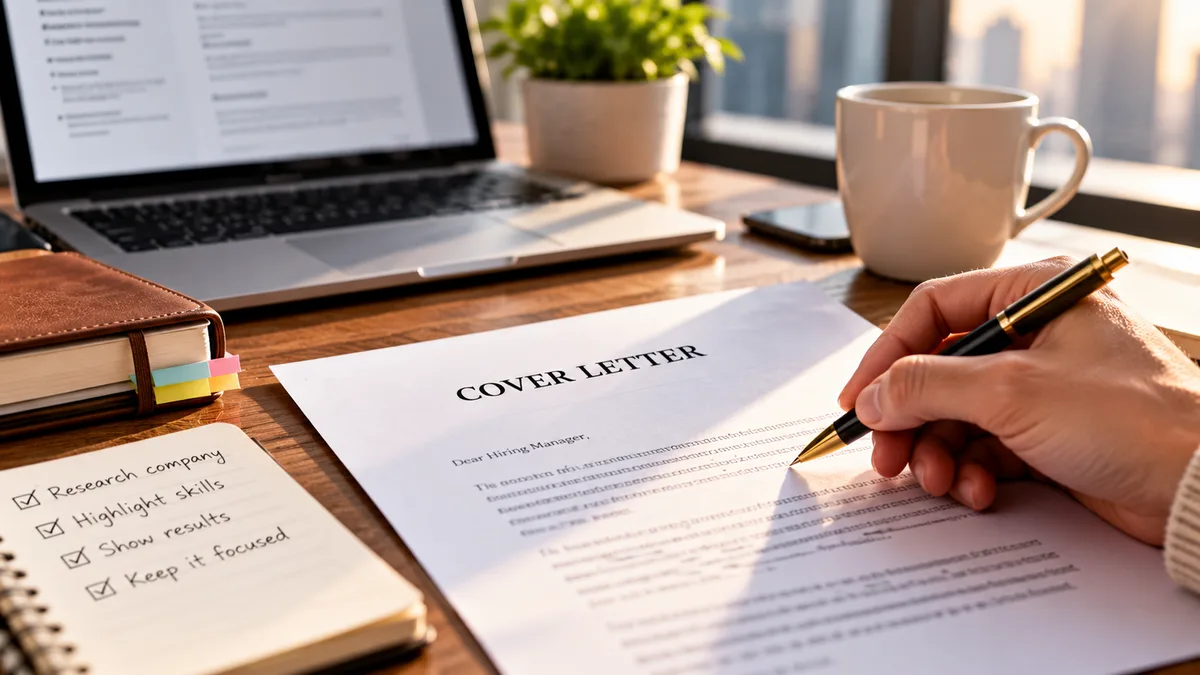
A useful cover letter does not repeat the resume. In about 200-400 words, it should explain why this job fits, highlight one or two pieces of evidence and give the employer a reason to read the application more closely.
This article is general information, not financial advice. Rates, prices and rules change; check the details with a qualified professional or the lender before you decide.
In this article
- Do You Still Need a Cover Letter in 2026?
- How to Write a Cover Letter: The Four-Part Structure
- How Long Should a Cover Letter Be?
- How to Start a Cover Letter
- How to Address a Cover Letter
- What to Put in the Middle of a Cover Letter
- Explain Why This Employer – Without Flattery
- How to End a Cover Letter
- Complete Cover Letter Example
- Can You Use AI to Write a Cover Letter?
- Common Cover Letter Mistakes
- FAQ
- The Bottom Line
Knowing how to write a cover letter starts with understanding what the document is supposed to do. CareerOneStop describes the cover letter as a place to sell relevant skills, show interest in the position and highlight achievements that make the applicant a strong fit. It also recommends tailoring the letter to each position rather than sending the same generic introduction everywhere.
A strong cover letter is usually short. CareerOneStop says about 200–400 words in three or four short paragraphs can be enough for most applications, while its veteran career guidance recommends keeping a cover letter to one page. The purpose is not to reproduce the resume in paragraph form but to explain the connection between the applicant, the employer and the job.
Do You Still Need a Cover Letter in 2026?
A cover letter is still useful when the employer requests one, when the application says it is optional or when the candidate has something important that is difficult to communicate through the resume alone. CareerOneStop says a requested cover letter should be included and that an optional one can help explain interest in the employer, employment gaps or circumstances that deserve more context.
That does not mean every job application needs an elaborate letter. CareerOneStop notes that many employers do not ask for one, and a strong resume may already communicate what the employer needs. If the application does not request a cover letter and there is no useful story to add, forcing one into the process may not improve the application.
The key question is whether the letter contributes new value. If it simply repeats job titles and duties already visible on the resume, it is not doing enough.
How to Write a Cover Letter: The Four-Part Structure
The easiest way to write a cover letter is to organize it around four clear jobs. The opening identifies the role and creates relevance, the middle proves fit, another short section explains why the employer is specifically interesting and the close moves toward an interview. CareerOneStop's current guidance uses essentially this structure.
A practical cover letter structure looks like this:
- Heading and Greeting. Include contact information where appropriate and address a specific person when possible.
- Opening Paragraph. Name the position and state why the opportunity is relevant.
- Evidence Paragraph or Paragraphs. Highlight the experience and accomplishments that best match the role.
- Closing Paragraph. Reaffirm interest, thank the reader and indicate readiness to discuss the position.
The structure is simple because the substance matters more than formatting tricks. Every paragraph should help answer one employer question: Why should this candidate receive an interview?
How Long Should a Cover Letter Be?
For most jobs, aim for roughly 200–400 words and three to four short paragraphs. That is the range CareerOneStop currently recommends for a good cover letter, and it is usually enough space to establish interest and provide meaningful evidence without creating another full-page resume narrative.
A cover letter can be shorter when the resume is especially strong and the candidate only needs to make one connection clear. A more complex career change may require somewhat more explanation, but the letter should still remain focused. One page is a useful ceiling for most private-sector applications.
Do not make the font tiny or remove spacing to force a dense letter onto one page. If the document is overflowing, the better solution is usually editing.
How to Start a Cover Letter
The first paragraph should identify the role and quickly establish why the application is worth reading. Avoid openings that spend three sentences saying you are “writing to express interest” without revealing anything about the candidate. A better opening combines the job title with one relevant qualification or reason the role fits.
For example:
I’m applying for the Operations Analyst position because the role closely matches the work I have spent the past four years doing in logistics reporting and process improvement. In my current role, I built a capacity-planning dashboard used across six distribution sites and helped reduce weekly scheduling errors by 22%. I’m especially interested in this position because your team is expanding its network-planning function.
This opening works because the applicant becomes specific almost immediately. The employer learns which job is being targeted, what the candidate has done and why this company is not receiving a generic letter.
How to Address a Cover Letter
CareerOneStop recommends addressing the letter to a specific person whenever possible. If no name is available, it suggests using an appropriate title or group such as “Hiring Manager,” “Human Resources” or “Search Committee” rather than an outdated generic greeting.
Do not spend an hour trying to discover a person's name through guesswork. If the posting does not identify a hiring manager and there is no reliable official source, “Dear Hiring Manager” is clear and professional. An incorrect name is worse than a neutral accurate greeting.
The greeting is a small part of the application. The employer is far more likely to care about whether the next 250 words demonstrate fit.
What to Put in the Middle of a Cover Letter
The middle of the cover letter should show evidence rather than list adjectives. CareerOneStop recommends connecting skills, education, experience and achievements with the employer's needs and using examples that add to rather than repeat the resume.
Choose one or two accomplishments closely related to the job. A candidate applying for a sales-management role might discuss leading a territory that exceeded quota by 18% and developing an onboarding process that reduced new-hire ramp time, while a software engineer might explain a system migration that reduced cloud costs or failure rates. The strongest example depends on what the employer is actually hiring someone to solve.
A cover letter should therefore be selective. Two relevant achievements with context are usually stronger than six vague strengths.
Explain Why This Employer – Without Flattery
A useful cover letter should contain a reason the candidate wants this particular role or employer. CareerOneStop specifically recommends showing that the applicant has researched the organization and explaining how the person's background connects with its projects, needs or direction.
Avoid empty compliments such as “Your company has always been an industry leader” unless the statement leads to something concrete. It is better to mention a specific business area, product, project, customer group or challenge that genuinely connects with your experience. That makes the interest believable.
This section does not need to become company history. One or two specific sentences are enough when they explain why the role makes sense.
How to End a Cover Letter
The closing should be confident but not presumptuous. Thank the reader, reaffirm interest and make it clear that you would welcome the opportunity to discuss the role. CareerOneStop recommends ending with appreciation and an invitation to continue the conversation.
For example:
I would welcome the opportunity to discuss how my experience improving multi-site operations could support the team’s expansion plans. Thank you for considering my application. I look forward to the possibility of speaking with you.
There is no need to write that you will call the employer next Tuesday unless the application process specifically encourages direct follow-up. Modern application systems usually make the employer's next step clear enough without creating an unsolicited deadline.
Complete Cover Letter Example
A full example is useful because the parts should read like one argument rather than separate templates pasted together. The following version stays within the focused length CareerOneStop recommends and adds information beyond a resume. It is intentionally specific enough to show the structure while still being adaptable.
Dear Hiring Manager,
I’m applying for the Project Coordinator position because it closely matches the work I have been doing across scheduling, vendor coordination and cross-functional project delivery. In my current role with a regional healthcare company, I coordinate implementation timelines across five departments and recently helped move a six-site system rollout from four weeks behind schedule to an on-time launch.
Much of my work involves translating project requirements into clear deadlines, identifying dependencies and keeping teams aligned when priorities change. Last year, I also redesigned our weekly project-status process, reducing meeting time by about 30% while giving department leads a clearer view of overdue tasks and risks. Those experiences align strongly with the coordination and reporting responsibilities described in your posting.
I’m particularly interested in your organization’s expansion of outpatient services because it creates the kind of multi-site project environment where I have done my strongest work. I would welcome the opportunity to bring that experience to your operations team and continue developing toward larger implementation responsibilities.
Thank you for considering my application. I would be glad to discuss how my project-coordination experience could contribute to the role.
Sincerely,
Morgan Ellis
The example works because it does not retell every job on the resume. It introduces a clear fit, demonstrates results and gives the employer a reason for the application.
Can You Use AI to Write a Cover Letter?
Yes, but AI should be used as a drafting and editing tool rather than as the source of the candidate's experience. CareerOneStop explicitly says tools such as ChatGPT can help draft a cover letter from a resume and job posting, while advising applicants to edit the result so it reflects their own voice, skills, experience and genuine interest.
The biggest risk is factual drift. A generated draft may quietly turn “supported a project” into “led a project,” add a metric that was never provided or write enthusiastic claims about the employer that the applicant cannot explain. Every accomplishment and qualification should be checked before submission.
AI can save time on structure. It should never be allowed to invent the substance.
Common Cover Letter Mistakes
Most cover letters fail through generic writing rather than a major technical mistake. A letter that could be sent unchanged to 50 employers gives the reader little reason to believe the application is targeted. Another common problem is spending too much space describing what the candidate wants without showing what the employer gains.
Avoid:
- Repeating the resume line by line.
- Using the same letter for unrelated jobs.
- Writing more than a page without a strong reason.
- Opening with several sentences of generic enthusiasm.
- Claiming skills without evidence.
- Addressing the letter to the wrong company or person.
- Explaining personal circumstances in unnecessary detail.
- Filling the letter with employer praise instead of role relevance.
- Letting AI invent accomplishments or experience.
- Sending the letter without proofreading names and job titles.
A strong cover letter feels written for one opening. The job description and the candidate's best evidence should be visible in the choices the writer makes throughout the letter.
FAQ
How do you write a good cover letter?
Tailor the letter to the specific job, explain why the role fits and support that claim with one or two relevant achievements. CareerOneStop recommends a concise letter of roughly 200–400 words in three or four short paragraphs. The document should add context to the resume rather than repeat it.
Do employers still want cover letters in 2026?
Some do and some do not. CareerOneStop says a requested cover letter should always be included, while an optional cover letter can still be useful when it explains fit, interest or an issue the resume cannot communicate well. If the employer does not request one and the candidate has nothing useful to add, the resume may be enough.
Should a cover letter be one page?
Yes for most ordinary applications. CareerOneStop's guidance recommends about 200–400 words, and its career materials describe one page as a normal cover-letter length. Longer is not automatically stronger.
Can a cover letter explain an employment gap?
Yes, when the gap is relevant enough that a short explanation improves the application. CareerOneStop specifically notes that a cover letter can be used to explain employment gaps or other circumstances. Keep the explanation factual and spend more space on current qualifications than on defending the past.
The Bottom Line
Learning how to write a cover letter is mostly about learning what to leave out. Use roughly 200–400 words, tailor the letter to the job and focus on one or two accomplishments that demonstrate why the employer should look closely at the resume. CareerOneStop's current guidance strongly favors concise, specific and customized letters over generic application statements.
A good cover letter should make the application easier to understand. It explains the connection between experience, employer and opportunity in a way a list of resume bullets cannot always do. If the reader reaches the end with a clearer reason to interview you, the cover letter has done its job.
Spotted an error? Tell our editors. Read our corrections policy.