Meal Break vs. Rest Break: Which Breaks Must Be Paid?
Federal law treats short rest breaks differently from genuine meal periods. Learn when breaks count as hours worked, what happens if lunch is interrupted, and how state laws may provide additional protection.
This article is general information, not financial advice. Rates, prices and rules change; check the details with a qualified professional or the lender before you decide.
In this article
- Are Lunch Breaks Paid in the United States?
- Are 10- or 15-Minute Breaks Paid?
- Meal Break vs. Rest Break: Side-by-Side
- What Makes a Meal Period Truly Unpaid?
- What if Your Lunch Break Is Interrupted?
- Automatic Lunch Deductions: Are They Legal?
- What if You Work Through Lunch Without Permission?
- Do Employers Have to Give Breaks in Every State?
- California Meal and Rest Break Rules
- Can Break Time Affect Overtime?
- What Records Should Employees Keep?
- What if Your Employer Refuses to Pay for Breaks?
- Frequently Asked Questions
- The Bottom Line
The difference between a meal break vs. rest break is important because federal wage law generally treats short rest breaks as paid working time, while a bona fide meal period may be unpaid when the employee is completely relieved from work duties.
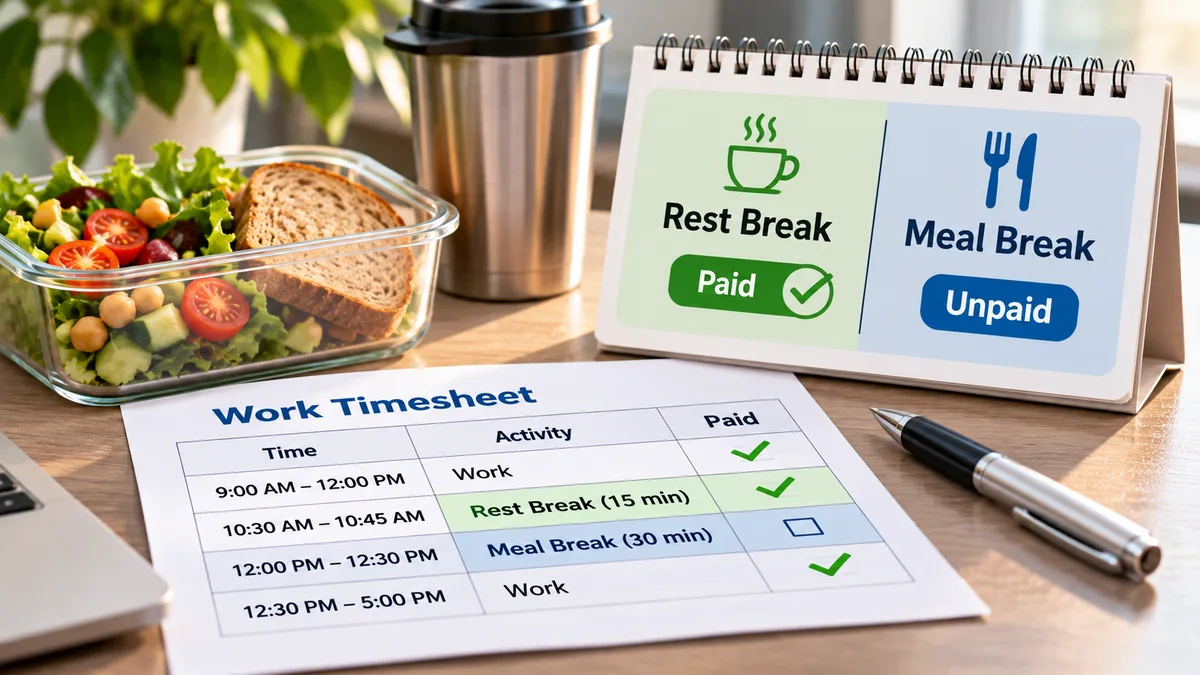
Under the Fair Labor Standards Act (FLSA), short breaks lasting approximately five to twenty minutes generally count as compensable hours worked. Genuine meal periods, often lasting at least thirty minutes, can usually be excluded from paid working time if employees are not required to perform duties.
Federal law does not generally require employers to provide lunch or coffee breaks. Some states, however, require particular meal or rest periods and impose additional rules when employers fail to provide them.
Are Lunch Breaks Paid in the United States?
Lunch breaks are generally unpaid under federal law when they qualify as bona fide meal periods. The employee must be completely relieved from duties during that time.
An employee who eats lunch while answering customer calls, watching equipment, or continuing assigned work may not have received a genuine unpaid meal period.
Simply labeling thirty minutes on a timesheet as “lunch” does not determine whether the time is compensable. Actual duties and circumstances matter.
Are 10- or 15-Minute Breaks Paid?
Short rest breaks of roughly five to twenty minutes generally must be counted as hours worked under the FLSA when provided by the employer. These breaks can also count toward overtime calculations for covered nonexempt employees.
The Department of Labor explains that brief rest periods promote efficiency and are customarily paid. Whether the employee spends the break drinking coffee, relaxing, or using the restroom does not change that basic rule.
An employer should not automatically subtract two fifteen-minute breaks from compensable hours merely because the worker was not actively performing tasks during those periods.
Meal Break vs. Rest Break: Side-by-Side
Break type | Typical duration | General federal pay treatment |
Short rest break | 5–20 minutes | Generally paid |
Bona fide meal period | Usually 30 minutes or more | May be unpaid |
Meal period with substantial work duties | Varies | Often compensable |
Break longer than 20 minutes | Depends on circumstances | Requires analysis |
Unauthorized extension of a rest break | Beyond permitted break | Specific conditions may affect compensation |
State-required meal period | State-specific | State rules control additional requirements |
The table summarizes federal principles. State laws and employment agreements may create additional rights.
What Makes a Meal Period Truly Unpaid?
An unpaid meal period generally requires that the employee be relieved of duties. Employees do not necessarily have to leave the work premises, but the time must be used as an actual meal period rather than primarily for the employer's benefit.
For example, an office worker who leaves their workstation for thirty minutes and performs no work may have a bona fide unpaid lunch. A reception employee required to answer calls while eating may have a different legal situation.
The nature of the duties matters more than whether the worker happens to eat food during the break.
What if Your Lunch Break Is Interrupted?
An interrupted meal period may become compensable when work duties prevent the employee from receiving a bona fide break. The legal outcome can depend on how often interruptions occur, how extensive they are, and the circumstances.
The Department of Labor gives healthcare examples in which meal periods interrupted to the extent that they predominantly benefit the employer must be paid.
A worker required to remain at a nursing station, continuously monitor patients, or answer ongoing emergency requests may not be fully relieved.
Employees should accurately document interruptions rather than routinely accepting automatic lunch deductions when they continue working.
Automatic Lunch Deductions: Are They Legal?
Automatic payroll deductions are not necessarily unlawful, but they must accurately reflect compensable time. If an employer deducts thirty minutes from every shift, the system needs a reliable way to recognize when employees worked during the supposed break.
An employee who worked through lunch should report the time through the employer's process and keep records. Employers generally cannot avoid wage obligations merely because a worker failed to follow an internal timekeeping procedure when the employer knew or had reason to know that work occurred.
For example, if a worker is scheduled from 9:00 a.m. to 5:30 p.m. with a thirty-minute unpaid meal period, the expected compensated time is eight hours. If the worker spends twenty minutes of lunch performing required duties, the actual compensable time may be greater.
What if You Work Through Lunch Without Permission?
Work performed for the employer can be compensable even when it violates a company policy, provided the employer suffers or permits the work under applicable rules. The employer may separately enforce lawful scheduling and conduct policies.
An employee should not assume that unauthorized work automatically becomes unpaid. Conversely, a person should not intentionally disregard clearly communicated work-hour restrictions and assume there can be no disciplinary consequences.
Accurate reporting remains essential.
Do Employers Have to Give Breaks in Every State?
Federal law generally does not require meal or rest breaks, but some states do. The requirements can depend on shift length, worker age, industry, and special conditions.
California, for example, has detailed meal and rest period requirements applicable to many nonexempt workers. Other states follow different systems, and some rely mainly on federal wage rules for adult employees.
Issue | Federal FLSA | Additional state rules |
Must an employer offer a lunch break? | Generally not required | Some states require it |
Must short breaks be paid? | Generally yes, when provided | Additional protections possible |
Must a meal period be duty-free? | Required for typical unpaid treatment | State-specific standards |
Penalties for missing breaks | Federal wage consequences may apply | Some states impose additional remedies |
Rules for minors | Separate restrictions may apply | Often stricter state standards |
Workers should check the labor department for the state in which they actually work.
California Meal and Rest Break Rules
California generally requires qualifying nonexempt employees to receive meal periods and paid rest breaks under specific conditions. A thirty-minute meal period is ordinarily required when the statutory shift-length threshold is met, subject to applicable waivers and exceptions.
California also has rules about the timing of meal periods and additional compensation when employers fail to provide legally compliant breaks.
Because the rules contain exceptions and industry-specific provisions, workers should consult the state's Division of Labor Standards Enforcement for their exact situation.
Can Break Time Affect Overtime?
Paid rest breaks generally count toward hours worked for federal overtime purposes. Unpaid bona fide meal periods generally do not.
Suppose a nonexempt employee has 39.5 compensable hours recorded before considering two fifteen-minute rest breaks that were improperly deducted. Adding the thirty minutes could bring the employee to 40 compensable hours.
A different weekly total could produce overtime obligations. The calculation must use actual compensable time and the applicable regular rate rather than simply count scheduled hours.
What Records Should Employees Keep?
Workers who regularly miss or interrupt lunch should keep accurate records of scheduled shifts, actual work, break interruptions, and payroll entries. Notes can include the time a break started, the interruption, the work completed, and when the employee resumed the break.
Work-related messages, timekeeping corrections, and communications with supervisors can support a clear factual timeline.
Employees should raise discrepancies through payroll or HR where appropriate and seek guidance from the relevant labor agency when necessary.
What if Your Employer Refuses to Pay for Breaks?
The first step is to identify whether the disputed time qualifies as compensable work. Compare the work schedule, payroll record, employer policy, and applicable laws.
Ask the employer to correct inaccurate records in writing and preserve copies of the request. If a federal wage violation appears possible, employees may contact the Department of Labor's Wage and Hour Division.
State labor departments may provide additional complaint procedures and protections against retaliation.
Frequently Asked Questions
Is a 30-minute lunch break always unpaid?
No. It can generally be unpaid when the employee is fully relieved of duties. If substantial work is required, it may be compensable.
Are 15-minute breaks paid?
Short rest breaks of approximately five to twenty minutes generally count as paid work time under federal law when provided.
Can an employer make employees work during lunch?
Employers may assign work, but required compensable work time cannot simply be excluded from wages by calling it lunch.
Is a break required for an eight-hour shift?
Federal law generally does not require one, but state requirements may differ.
Can an employer automatically deduct lunch?
Automatic deductions may be used, but payroll must accurately reflect actual compensable hours, including interrupted or worked-through meal periods.
The Bottom Line
Short rest breaks and bona fide meal periods are treated differently under federal law. Rest breaks lasting around five to twenty minutes generally count as paid hours, while a genuine duty-free meal period can be unpaid.
The key question is whether the employee was actually free from work. State rules may provide more protection, so employees should verify both the federal standards and the law where they work.
Spotted an error? Tell our editors. Read our corrections policy.