Can You Deposit a Check Made Out to Two People? And vs. Or Explained
A check payable to two people may require one signature or both. The wording between the names matters, but bank policies can also affect how the check is deposited or cashed.
This article is general information, not financial advice. Rates, prices and rules change; check the details with a qualified professional or the lender before you decide.
In this article
- Does a Check Made Out to Two People Require Both Signatures?
- What Does “And” Mean on a Check?
- What Does “Or” Mean on a Check?
- What About “And/Or” on a Check?
- Can You Deposit a Two-Person Check Into a Joint Bank Account?
- Can You Deposit a Check With Two Names Into One Person's Account?
- Can You Mobile Deposit a Check Made Out to Two People?
- What if One Person Is Unavailable to Sign?
- What if the Check Has No “And” or “Or”?
- How to Endorse a Two-Person Check
- Special Cases: Insurance, Tax Refund and Settlement Checks
- Frequently Asked Questions
- The Bottom Line
A check made out to two people can often be deposited or cashed, but the required endorsements depend on the wording between the payees' names. A check payable to “Alex and Jordan” generally requires both signatures, while a check payable to “Alex or Jordan” generally allows either person to endorse it.
The Consumer Financial Protection Bureau confirms this general distinction. However, a financial institution may have additional procedures for verifying identities, accepting third-party endorsements, or processing mobile deposits.
Before signing the back of the check, examine the exact wording on the front. The terms and, or, and and/or can change how the bank handles the transaction.
Does a Check Made Out to Two People Require Both Signatures?
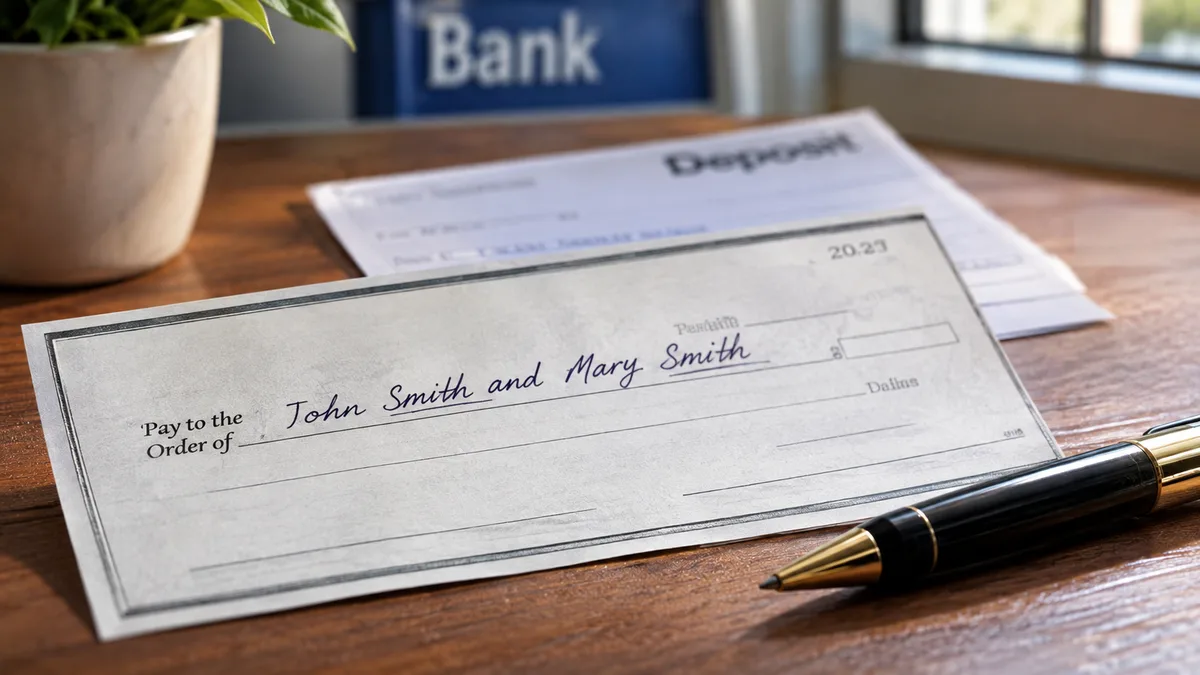
A check made out to two people generally requires both signatures when the payees are joined by and. When their names are joined by or, either person can generally endorse the check.
Payee wording | General endorsement requirement |
Alex and Jordan | Both payees |
Alex or Jordan | Either payee |
Alex and/or Jordan | Often treated as allowing either, subject to bank policy |
Alex, Jordan — no clear connector | Bank interpretation and applicable rules matter |
Alex and Jordan, deposited to their joint account | Both endorsements may still be required |
The fact that two people share a bank account does not automatically eliminate endorsement requirements. The words on the check and the receiving institution's rules remain important.
What Does “And” Mean on a Check?
And generally means both named payees must endorse the check before the bank accepts it. The check is payable jointly rather than alternatively.
Suppose an insurance company sends a $3,000 reimbursement check to “Alex Morgan and Jordan Morgan.” Both people generally must sign the check even if one of them plans to deposit the entire amount.
The receiving bank may require the payees to appear together, provide identification, or deposit the money into an account consistent with its policies.
A joint payee should never imitate the other person's signature simply to speed up the deposit.
What Does “Or” Mean on a Check?
Or generally means either named payee may endorse and negotiate the check. For example, a check issued to “Alex Morgan or Jordan Morgan” can generally be signed by Alex without Jordan also signing.
This can be helpful when two people are not available at the same time. However, banks may still have restrictions on accepting a check into an account belonging solely to one person.
A bank's decision about account eligibility is separate from the general rule about who can endorse the check.
What About “And/Or” on a Check?
And/or can create uncertainty because it combines language used for joint and alternative payment. Many institutions treat it as permitting either payee to endorse, but individual bank policies and applicable law can affect the result.
The safest approach is to ask the receiving financial institution before making a mobile deposit or signing the check.
If the check represents a substantial amount and the payees disagree about ownership, endorsement rules do not necessarily resolve who is legally entitled to the proceeds.
Can You Deposit a Two-Person Check Into a Joint Bank Account?
A two-person check can often be deposited into a joint checking or savings account when the institution accepts the check and the endorsements satisfy its requirements. But an account jointly owned by both payees is not an automatic exception to the general rules.
For example, if a check says “Alex and Jordan,” a bank may still require both signatures even though Alex and Jordan own the account together.
A different check made payable to “Alex or Jordan” may be accepted with only one endorsement, subject to the bank's account and deposit policies.
A joint account also creates legal ownership considerations beyond the act of depositing a check. Eagle Post Daily's Joint Bank Account After Death: Who Gets the Money? explains how account ownership and survivorship rights can affect the money after an owner's death.
Can You Deposit a Check With Two Names Into One Person's Account?
A bank may accept some two-payee checks into an account owned by only one named payee, particularly when the check is payable to either person. However, acceptance is not guaranteed.
The bank may apply additional restrictions to third-party checks, insurance proceeds, tax refunds, or checks involving someone who is not an account holder.
Before visiting a branch, ask whether both payees need to be present, whether each must provide identification, and whether the account must be jointly owned.
A check that can legally be endorsed by one person may still fail a particular bank's deposit acceptance requirements.
Can You Mobile Deposit a Check Made Out to Two People?
Mobile deposit may be available for a two-payee check, but eligibility depends on the bank's remote deposit agreement and endorsement rules. Certain institutions prohibit or restrict mobile deposits of checks payable to multiple people.
A mobile deposit may be rejected when the check requires two signatures but only one appears, the payee names do not match the account, or the bank's mobile service does not accept the check type.
Before using the mobile app:
- Read the payee line carefully.
- Confirm the required endorsements with the bank.
- Check the mobile deposit eligibility rules.
- Follow any required restrictive endorsement wording.
- Keep the original check securely until the bank's retention instructions permit disposal.
Do not assume that an app's initial confirmation means the check has been finally accepted and cleared.
What if One Person Is Unavailable to Sign?
When a check is payable to two people jointly and one cannot sign, the bank may refuse the deposit until its endorsement requirements are satisfied. A valid power of attorney, legal representative, or other authorized arrangement might be relevant in specific circumstances.
However, a power of attorney does not automatically allow someone to sign every type of check, and institutions may require particular documentation.
If the missing payee has died, the situation becomes more complicated. Estate authority and the check issuer's procedures may affect whether the check needs to be reissued.
In many cases, requesting a replacement check with appropriate payee wording is simpler than attempting an endorsement the bank cannot accept.
What if the Check Has No “And” or “Or”?
A check may list two names separated by a comma or line break without clearly stating whether it is payable jointly or alternatively. The Uniform Commercial Code provides rules for interpreting ambiguous multiple-payee instruments, but the actual circumstances and receiving bank's procedures remain relevant.
A consumer should not independently add “or” to the check or change the payee line.
Contact the bank to confirm its interpretation. If necessary, request that the issuer prepare a replacement check with clear wording.
How to Endorse a Two-Person Check
The endorsements should match the requirements for the check as written. Both payees should sign using the names recognized by the bank when joint endorsement is required.
Avoid writing outside the endorsement area or marking over printed payee details. Some banks require wording such as “For mobile deposit only” followed by the institution's name.
For a large payment, an in-person deposit may be more practical than trying multiple mobile submissions.
If a check is rejected, ask for the precise reason before attempting another deposit.
Special Cases: Insurance, Tax Refund and Settlement Checks
Some checks involve additional payees because of financing arrangements or legal obligations. An insurance claim check may name the property owner and mortgage company, while another payment may name two individuals.
These checks can require additional approvals or endorsements beyond ordinary two-person checks.
A jointly payable check does not necessarily mean the two named people have equal ownership of the money. Legal entitlement depends on the underlying transaction and applicable law.
When the payment involves a lender, insurer, estate, or disputed property, the parties should follow the relevant issuer's procedure.
Frequently Asked Questions
Can one person deposit a check made out to two people?
Generally yes when the check is payable to one person or the other, subject to bank policies. A check payable to two people using and generally requires both endorsements.
Do both spouses need to sign a check?
Spouses generally both sign when the check is payable to them jointly using and. Marriage alone does not change the wording on the check.
Can I deposit a two-name check through an ATM?
It depends on the bank's ATM deposit rules and the check's endorsement requirements. Confirm before depositing.
What if my bank rejects the check?
Ask why the bank rejected it and whether the issue can be corrected through proper endorsements, an in-person deposit, or reissuance by the payer.
Can I cash a check made out to two people at a check-cashing store?
The business may impose its own acceptance and identification requirements. A check requiring both endorsements generally still requires both payees to satisfy the applicable rules.
The Bottom Line
The difference between and and or is the starting point for depositing a check payable to two people. “And” generally requires both payees to sign; “or” generally permits either one.
Bank account ownership, mobile deposit restrictions, and special check types can create additional requirements. Confirm those details before endorsing or submitting a large or unusual check.
Spotted an error? Tell our editors. Read our corrections policy.