Credit Card Statement Balance vs. Current Balance: What Should You Pay?
Your credit card statement balance vs current balance can show different amounts. A simple transaction timeline helps separate the bill due now from newer spending.
This article is general information, not financial advice. Rates, prices and rules change; check the details with a qualified professional or the lender before you decide.
In this article
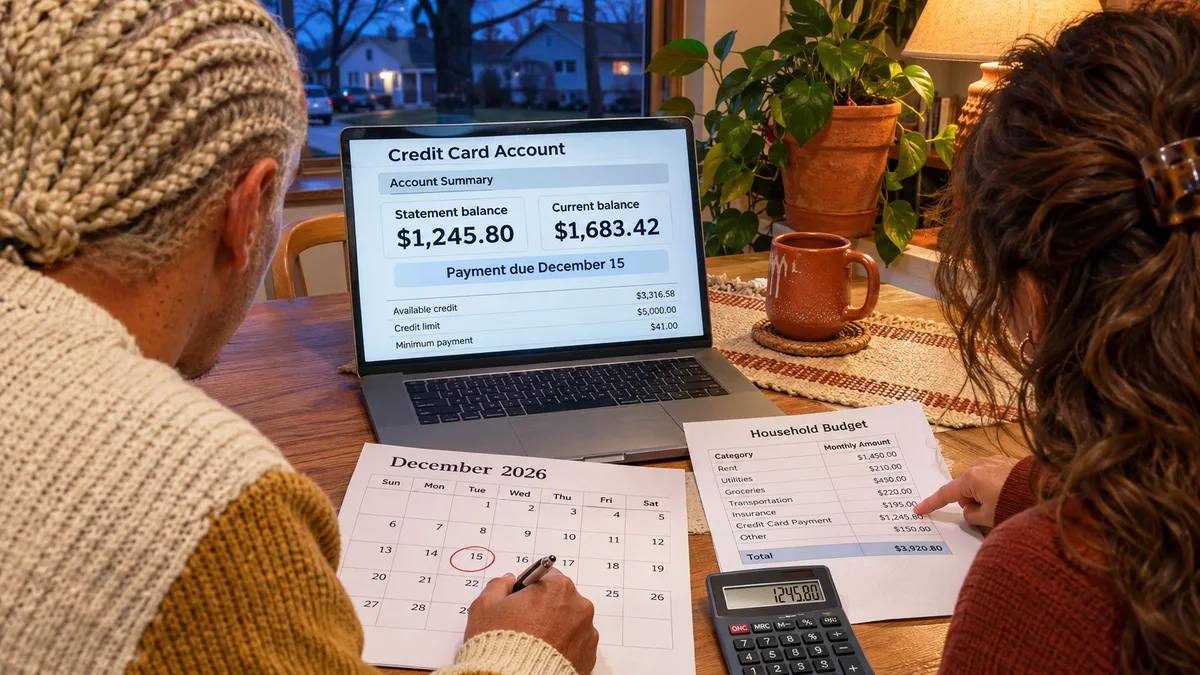
Your credit card statement balance is the amount shown when a billing cycle closes; your current balance reflects later posted activity as well. For ordinary purchases on an account with an active grace period, paying the full remaining statement amount by its due date generally avoids purchase interest. Paying the current balance may also cover newer spending that has not reached its payment deadline yet.
Before choosing an amount, check the statement date, payment due date, payments already credited and the issuer's remaining statement amount. The credit card statement balance vs current balance distinction is useful only when those dates and adjustments are included. A printed statement can continue to display its original total after you have paid part of it.
Which balance answers which question?
The statement balance answers what the account owed at the last cycle's close, while the current balance answers what is posted now. Neither should be confused with available credit or the minimum payment. Capital One's explanation distinguishes these balances and notes that pending transactions are excluded from its current-balance figure.
Account figure | What to use it for | What it does not establish |
|---|---|---|
Statement balance | Identify the total on the closed billing cycle | How much of that bill remains unpaid after later payments |
Remaining statement amount, if displayed | Check the issuer's adjusted amount still needed for that bill | Whether every transaction qualifies for a grace period |
Current balance | Review posted debt after newer activity | That the entire amount is due on the next payment date |
Minimum payment due | Identify the required minimum for that bill | The amount needed to avoid purchase interest |
This is a credit card comparison, not a checking-account balance comparison. Money available in the bank must also cover the payment you choose. The separate available-balance guide explains why a deposit balance may differ from spendable cash.
Follow the transactions before making another payment
A transaction timeline shows why the current balance can differ from the unpaid portion of the statement. Consider this hypothetical account with no interest, fees or refunds during the example:
Event | Amount | Effect |
|---|---|---|
Billing cycle closes | $800 statement balance | Establishes the closed-cycle bill |
New purchases post afterward | $250 | Raises the current balance to $1,050 |
A payment is credited | $300 | Lowers the current balance to $750 |
The original statement still says $800. Under the example's assumptions, $500 of that statement remains unpaid: $800 minus the credited $300. The $750 current balance consists of that $500 plus $250 of newer purchases.
For this credit card statement balance vs current balance example, paying another $800 because the original PDF has not changed would ignore the payment already made. Paying $750 would clear the posted balance in the illustration, including newer purchases. The actual issuer display controls when there are additional adjustments or different transaction types.
Keep pending payments separate from credited ones. A payment you scheduled for tomorrow is not the same event as a payment already reflected on the account. Check its status and the scheduled date before initiating another transfer.
When is the statement amount enough to avoid interest?
The full statement amount is generally the relevant purchase-interest target when the account has an active purchase grace period and you satisfy its terms. The Consumer Financial Protection Bureau explains that grace periods are not required, although most cards offer one on purchases. It also explains that carrying a balance can cause the grace period to be lost.
That qualification matters more than the label in the app. If you have been carrying debt, paying one statement total does not automatically prove that all interest has stopped. Ask the issuer about accrued interest and what is required to restore the grace period.
Cash advances and other transaction categories can follow different interest rules. A promotional balance or installment feature may also require checking its specific terms. Do not apply a simple credit card statement balance vs current balance example to every balance type on the same account.
What if you can pay only part of the bill?
If the full remaining statement balance is unaffordable, identify the minimum due and payment deadline, then decide what additional amount the budget can support. Paying the minimum is different from paying the bill in full. It can leave debt and interest costs to manage in later months.
For example, a hypothetical $800 statement with a $35 minimum does not make $35 the interest-free payment target. The $765 difference has not disappeared because the account accepts a smaller payment. The minimum-payment guide covers the separate long-term payoff problem.
Use verified take-home income and essential bills to choose a payment you can fund. Eagle Post Daily's Budget Calculator can organize that cash-flow check; it does not determine the issuer's required payment. If meeting the minimum is doubtful, contact the issuer before the deadline to ask what assistance is available.
Check autopay, refunds and the remaining amount together
Review autopay before making an extra manual payment, because its selected amount and scheduled withdrawal still matter. In a credit card statement balance vs current balance decision, the most expensive mistake may be losing track of two payments rather than misunderstanding the arithmetic.
Check what autopay is set to pay, which bank account it uses, its scheduled date and how the issuer handles a manual payment made beforehand. Do not assume that every issuer reduces or cancels an upcoming automatic withdrawal in the same way. Leave enough money in the funding account for the payment that is actually scheduled.
After a refund or statement credit, use the issuer's adjusted figures rather than subtracting the credit from the minimum on your own. If the screen is unclear, ask: "What remains due on this statement, and what amount must be paid to avoid purchase interest under my account's terms?" Save the answer and check the eventual payment confirmation.
FAQ
These answers address credit card statement balance vs current balance decisions for a monthly bill.
Does a higher current balance mean the entire amount is due now?
No. It can include purchases made after the last statement closed. Check the due date and the remaining amount associated with that statement before deciding what to pay.
Can paying the current balance still leave something pending?
Yes. A current posted balance does not necessarily include every pending purchase or later interest adjustment. Review subsequent activity instead of assuming a zero figure permanently settles the account.
What should you check immediately before submitting the payment?
Confirm the account, amount, due date, credited payments, pending payments and autopay. The practical purpose of comparing a credit card statement balance with its current balance is to pay the right bill once, with money available to cover it.
Spotted an error? Tell our editors. Read our corrections policy.