Does Renters Insurance Cover Theft Outside Your Apartment?
Your belongings may be covered even when they are stolen far from your rented home. Learn how off-premises renters insurance works, which exclusions matter, and how to estimate a claim payment.
This article is general information, not financial advice. Rates, prices and rules change; check the details with a qualified professional or the lender before you decide.
In this article
- What Is Off-Premises Coverage in Renters Insurance?
- What Types of Theft Outside Your Apartment May Be Covered?
- Does Renters Insurance Cover Theft From a Car?
- Does Renters Insurance Cover Theft While Traveling?
- How Much Does Renters Insurance Pay for Stolen Property?
- Do Renters Insurance Policies Have Limits for Off-Premises Property?
- What's the Difference Between Theft and Accidental Loss?
- How to File a Renters Insurance Claim for Theft Away From Home
- Is Filing a Small Theft Claim Worth It?
- How to Protect Valuable Belongings Outside Your Apartment
- Frequently Asked Questions
- The Bottom Line
Renters insurance may cover theft outside your apartment because many policies include personal property protection for belongings temporarily located away from the insured residence. This can include items stolen from a car, hotel room, gym locker, or another location while traveling.
However, coverage is not unlimited. Deductibles, off-premises limits, special limits for valuables, exclusions, and the policy's settlement method can all reduce or eliminate a payment.
The most important question is not simply where the item was stolen. It is whether the specific property, circumstances of the theft, and claimed loss meet the policy's requirements.
What Is Off-Premises Coverage in Renters Insurance?
Off-premises coverage is a form of personal property protection that can extend to covered belongings outside the rented home. It is generally part of the personal property section of a renters insurance policy rather than a separate guarantee that everything carried while traveling is protected.
For example, a renter whose laptop is stolen from a hotel room may have coverage under the same policy that protects the laptop against covered theft at home. The policy's deductible and limits still apply.
The Texas Department of Insurance explains that renters insurance often covers personal property stolen from vehicles or while traveling. Specific policy terms determine the extent of protection.
What Types of Theft Outside Your Apartment May Be Covered?
The circumstances of theft affect whether an insurer will pay a claim. A covered theft is not the same as accidentally losing an item, leaving something behind, or discovering property missing without evidence of theft.
Situation | Potential renters insurance coverage | What to check |
Laptop stolen from a parked car | Often possible | Personal property coverage and deductible |
Luggage stolen from a hotel room | Often possible | Off-premises limit and documentation |
Bicycle stolen from a public rack | May be covered | Bicycle limits and proof of ownership |
Phone stolen from a backpack | May be covered | Device valuation and deductible |
Jewelry stolen while traveling | May be limited | Special jewelry sublimits |
Bag accidentally left in a taxi | Often excluded as simple loss | Whether any accidental-loss coverage applies |
Business equipment stolen | May have limited coverage | Business-property sublimits |
These examples are not approvals of individual claims. The insurer must evaluate the specific policy and supporting documentation.
Does Renters Insurance Cover Theft From a Car?
Renters insurance may cover personal belongings stolen from a car, while the auto policy ordinarily does not cover those belongings. This distinction can surprise people who assume vehicle insurance covers everything inside a vehicle.
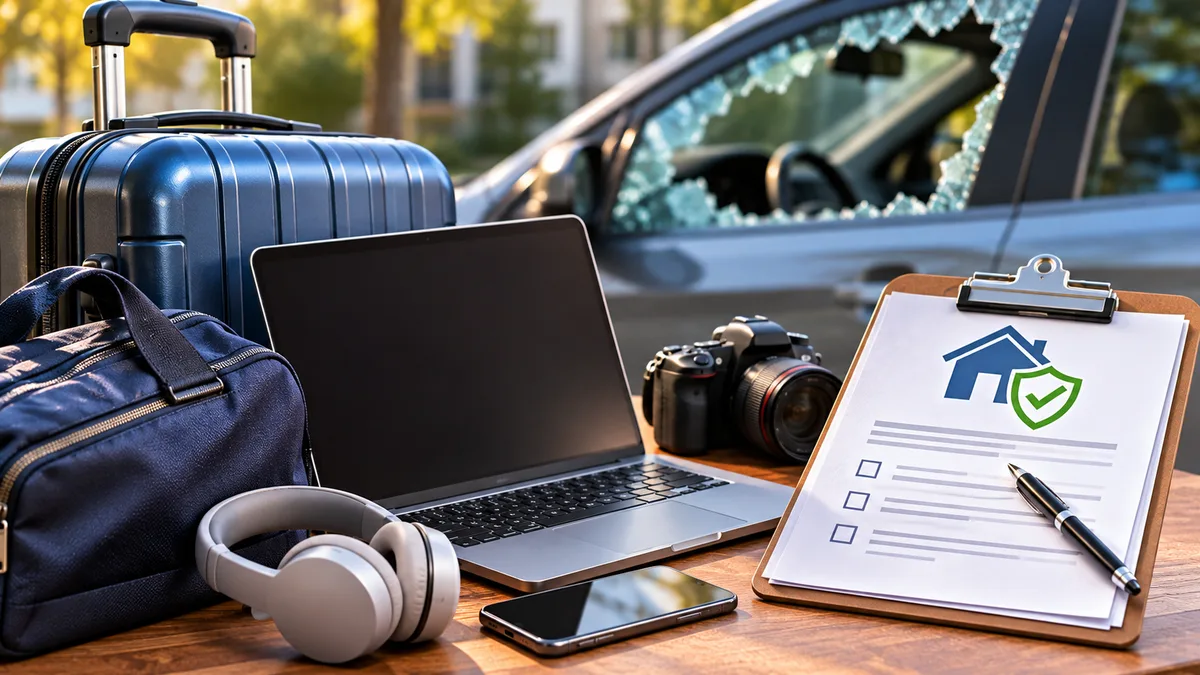
Suppose a thief breaks a car window and steals a laptop. The broken car window may be addressed under the applicable auto coverage, while the stolen laptop may be considered under renters insurance.
That can mean different policies, deductibles, and claim procedures apply to the same incident.
The Texas Department of Insurance confirms this general division between auto coverage and personal property coverage. It is particularly important for drivers who regularly carry computers, cameras, or other valuable belongings.
Does Renters Insurance Cover Theft While Traveling?
Renters insurance may protect eligible personal property during domestic travel or while staying away from home. Hotels, vacation rentals, and temporary accommodations do not necessarily eliminate off-premises protection.
International travel requires more careful review. Some policies impose territory restrictions or special conditions, and other insurance products may offer coverage with different terms.
Travelers should also determine whether the item was stolen, damaged, delayed, or merely misplaced. An airline's responsibility for checked luggage is distinct from the renter's insurance coverage.
How Much Does Renters Insurance Pay for Stolen Property?
The amount an insurer pays depends on the eligible loss value, the applicable deductible, and the policy's coverage limits. Replacement cost and actual cash value provisions can produce substantially different payouts.
Consider a hypothetical laptop stolen from a hotel room.
Claim component | Amount |
Cost of comparable replacement laptop | $1,500 |
Applicable policy deductible | $500 |
Potential payment before other limitations | $1,000 |
This simplified calculation assumes that replacement cost coverage applies, the theft is covered, and no additional off-premises limitation or exclusion reduces the amount.
If the policy instead settles the item at actual cash value, depreciation could reduce the covered amount before application of the deductible. The result may be much smaller.
Eagle Post Daily explains these differences in Replacement Cost vs. Actual Cash Value: Why Home Insurance Payouts Can Be So Different.
Do Renters Insurance Policies Have Limits for Off-Premises Property?
Off-premises coverage may be subject to a separate limit or percentage of the overall personal property coverage amount. A policy could also establish different rules for property normally kept at another residence.
For instance, a renters policy with $30,000 in personal property coverage might contain a separate off-premises limit. The applicable amount cannot be determined safely without reading the contract.
Certain categories of property may face additional restrictions.
Jewelry and Watches
Jewelry, watches, precious metals, and certain collectibles can be subject to special limits for theft. An item worth several thousand dollars may have substantially less available coverage under an ordinary renters policy.
Scheduled personal property coverage or a separate insurance arrangement may provide broader protection, depending on the insurer and product.
Bicycles and Sports Equipment
Bicycles may fall under personal property coverage, but limitations can apply. High-value bicycles may warrant a review of theft exclusions, deductibles, and whether coverage applies while the bicycle is in use or stored elsewhere.
A lock requirement should not be assumed universally. Check whether the particular policy includes any security conditions.
Equipment Used for Business
Work computers, professional cameras, tools, and business inventory can be subject to special limits. Personal renters insurance should not be treated as a substitute for commercial property insurance when substantial business assets are involved.
What's the Difference Between Theft and Accidental Loss?
Theft generally involves someone unlawfully taking property, while accidental loss may involve forgetting, dropping, or misplacing an item. An ordinary renters insurance policy often covers theft as a named covered peril but may not cover accidental disappearance.
For example, a camera stolen during a documented break-in may be treated differently from a camera that cannot be located after a trip.
The insured should explain what actually happened and provide available evidence. Describing an uncertain loss as a confirmed theft without support can create serious problems during claims review.
How to File a Renters Insurance Claim for Theft Away From Home
The claim process should begin with documenting the incident and protecting any remaining property. An insurer may need proof of ownership, evidence of theft, purchase records, and information about the circumstances.
A useful sequence is:
- Ensure personal safety and report the incident to appropriate local authorities.
- Contact the insurer and confirm the policy's theft and off-premises provisions.
- Obtain a police report or incident record when appropriate or required.
- Gather receipts, serial numbers, photographs, and other ownership evidence.
- Record the location, date, and circumstances of the theft.
- Submit the requested claim materials.
- Review the insurer's valuation, deductible, and any limitations applied.
A police report can be helpful, but the requirement for one depends on the policy and situation. Keep copies of correspondence and any formal claim decision.
Is Filing a Small Theft Claim Worth It?
A theft claim may not always be financially worthwhile when the deductible is close to the loss amount. A $600 item under a $500 deductible could result in a relatively small payment, assuming the item is fully covered.
Claims may also affect future underwriting or premiums, depending on applicable rules and insurer practices. The impact should not be assumed to be identical across companies or states.
Before submitting a claim, ask the insurer how the deductible applies and whether the incident would be covered. Avoid making inaccurate statements or withholding material information.
How to Protect Valuable Belongings Outside Your Apartment
Preventing theft remains useful even when insurance is available. Keep receipts and serial numbers for expensive electronics, photograph important belongings, and review high-value property limits before traveling.
Avoid leaving valuable items visible in parked vehicles. Use secure storage when available, and consider additional coverage if the ordinary policy's special limits are too low for the property carried regularly.
A periodic insurance review can also reveal that the renter's belongings have become more valuable than the existing coverage amount.
Frequently Asked Questions
Does renters insurance cover a stolen laptop?
A stolen laptop may be covered under personal property protection, including off-premises coverage. The insurer will examine the circumstances, deductible, valuation method, and any special restrictions.
Does renters insurance cover luggage stolen from a hotel?
It may cover eligible belongings stolen from a hotel, subject to the policy's terms. Travelers should keep documentation and distinguish theft from airline loss or simple misplacement.
Is a stolen bicycle covered if it was locked outside?
A bicycle may qualify for personal property theft coverage even away from home. The applicable limits and any policy-specific conditions should be reviewed.
Does renters insurance cover property stolen abroad?
Some policies provide protection outside the United States, but geographic restrictions can vary. Confirm the coverage territory before international travel.
Will renters insurance pay the full replacement price?
Not necessarily. The settlement method, deductible, coverage limit, special sublimits, and exclusions determine the actual payment.
The Bottom Line
Renters insurance protection may follow personal belongings beyond the apartment, including when they are stolen from a car or during travel. However, a covered theft does not guarantee reimbursement for the full purchase price.
Review the personal property terms, off-premises limits, deductible, and settlement method before relying on coverage. Good documentation and an accurate understanding of the incident make the claims process more straightforward.
Spotted an error? Tell our editors. Read our corrections policy.