Buying a Car Out of State: How to Avoid Tax, Title and Registration Problems
An out-of-state car listing may look cheaper, but registration restrictions, tax credits, shipping fees and missing title paperwork can erase the savings. Follow this U.S. buyer's guide before paying a deposit or bringing the vehicle home.
This article is general information, not financial advice. Rates, prices and rules change; check the details with a qualified professional or the lender before you decide.
In this article
- Is Buying a Car Out of State Worth It?
- Which State Charges Sales Tax When You Buy a Car Elsewhere?
- How to Check Whether an Out-of-State Car Can Be Registered
- What Paperwork Do You Need to Buy a Car Across State Lines?
- Can You Drive an Out-of-State Car Home Immediately?
- Buying a Used Car Out of State: What Should You Inspect?
- What Are the Hidden Costs of Buying a Car Out of State?
- How Do You Register the Car in Your Home State?
- How to Avoid Out-of-State Car Buying Scams
- Buying a Car Out of State FAQ
- The Bottom Line
Buying a car out of state can help you find a better price, a rare model or a vehicle with the exact features you want. However, the advertised price is only one part of the transaction because the purchase must also satisfy the rules of the state where you intend to register and operate the vehicle. Before sending a deposit, confirm that the car is eligible for registration in your home state, calculate the applicable taxes and fees, and establish how you will obtain a valid title and legally transport the vehicle.
The process of buying a car out of state differs depending on whether you purchase from a licensed dealer or a private seller, finance the vehicle or pay cash, and drive it home or arrange shipping. Emissions requirements, temporary permits, title procedures and taxation are administered under different state rules. This guide explains the decisions that should be made before purchase, the documents to obtain and the costs that can turn an apparently inexpensive vehicle into a bad deal.
Is Buying a Car Out of State Worth It?
Buying a car out of state makes financial sense when the total savings or vehicle advantages exceed the added costs and administrative risks. A neighboring dealer may offer a lower purchase price, while a distant specialist may have the specific used or new model unavailable locally. The relevant comparison is the complete delivered and registered cost, not simply the difference between two advertised prices.
When considering buying a car out of state, request a written out-the-door quote from the seller. The Federal Trade Commission recommends written dealer pricing because it helps reveal unwanted add-ons and charges that are not apparent in the advertisement. Then obtain your home state's tax and registration requirements and calculate transportation, inspections and potential post-purchase repairs.
Cost component | Local purchase | Out-of-state purchase |
Vehicle sale price | Local quote | Distant seller's written quote |
Sales or use tax | Applicable home-state rules | Home-state liability and possible credit for other-state tax |
Title and registration | Local DMV requirements | Home-state requirements plus out-of-state paperwork |
Delivery | Local collection | Travel, temporary permit or shipping |
Inspection | Locally accessible | May require independent pre-purchase inspection |
Repairs and warranty | Potentially easier dealer follow-up | May require remote coordination or local authorized service |
Time and administrative risk | Usually simpler | More parties and state-specific conditions |
Expert takeaway: Buying a car out of state is worthwhile only if the vehicle can be registered and the full costs remain acceptable. A $2,000 advertised saving may disappear after shipping, tax adjustments and a needed repair. Confirm legal eligibility and seller documents before comparing financing offers.
Which State Charges Sales Tax When You Buy a Car Elsewhere?
The sales tax question is central to buying a car out of state because purchasing across a state border does not automatically eliminate tax. Many states impose sales or use tax when a resident registers or uses an acquired vehicle in that state. The details depend on residency, the state of purchase, any tax already paid, reciprocity provisions and possible exemptions.
A buyer researching buying a car out of state should not assume that the selling dealer's tax calculation is final. The dealer may be authorized to handle taxes and registration for another state, or the buyer may need to pay the home state directly. Ask for an itemized explanation of any sales tax collected and obtain a receipt identifying the jurisdiction to which it was remitted.
Will you pay sales tax twice?
Buying a car out of state does not always mean paying the full tax separately to two states, because credits or reciprocal arrangements may apply. California, for example, provides a potential credit against California use tax for qualifying sales or use tax paid to another U.S. state or political subdivision, subject to its rules and limits. The credit cannot exceed the California tax due, and it does not establish an identical policy in every state.
Before buying a car out of state, ask your home state's DMV or tax agency whether tax should be paid at purchase or registration. A dealer located in another state may collect one amount even though additional tax is due at home. Keep the original purchase agreement, tax receipts and registration documents so any available credit can be documented.
How do you estimate tax before visiting the dealership?
For a hypothetical example, suppose buying a car out of state involves a $28,000 purchase price and an assumed 6.25% applicable vehicle tax. Multiplying $28,000 by 0.0625 produces $1,750 before any taxable fees, trade-in treatment, local adjustments or credits. The example illustrates arithmetic only and should not be treated as the tax due in a specific state.
If the seller has already collected $1,000 that qualifies for a full home-state credit, the remaining hypothetical amount would be $750. If the payment does not qualify for a credit, the result may differ substantially. The buyer should verify both the tax base and the permitted credit with the relevant government agency before transferring funds.
How to Check Whether an Out-of-State Car Can Be Registered
A critical step when buying a car out of state is determining whether the vehicle satisfies the receiving state's registration requirements. A car that is legal to sell or drive in one state may require additional documentation, inspections or emissions compliance before it can be registered in another. This is particularly important when buying a nearly new vehicle originally manufactured for a different emissions market.
Buying a car out of state for registration in California requires special care. California DMV explains that certain vehicles with fewer than 7,500 miles are classified as new for relevant emissions-compliance purposes, even if already registered elsewhere. A vehicle that meets only federal emissions certification may not qualify for California registration unless an exception or other applicable rule allows it.
What inspections might be required?
The inspection requirements for buying a car out of state depend on the registration jurisdiction, vehicle type, county and age. Texas, for instance, requires emissions inspection in specified counties for affected noncommercial vehicles, while other categories may have different rules. Do not use an outdated nationwide checklist claiming that every state requires the same safety inspection.
Before buying a car out of state, check the home state's official DMV site for title inspection, odometer disclosure, emissions certification and VIN verification requirements. Ask whether the inspection can be completed after the car arrives or whether registration eligibility must be established before purchase. A vehicle that fails a mandatory test can generate significant additional expense and delay.
What Paperwork Do You Need to Buy a Car Across State Lines?
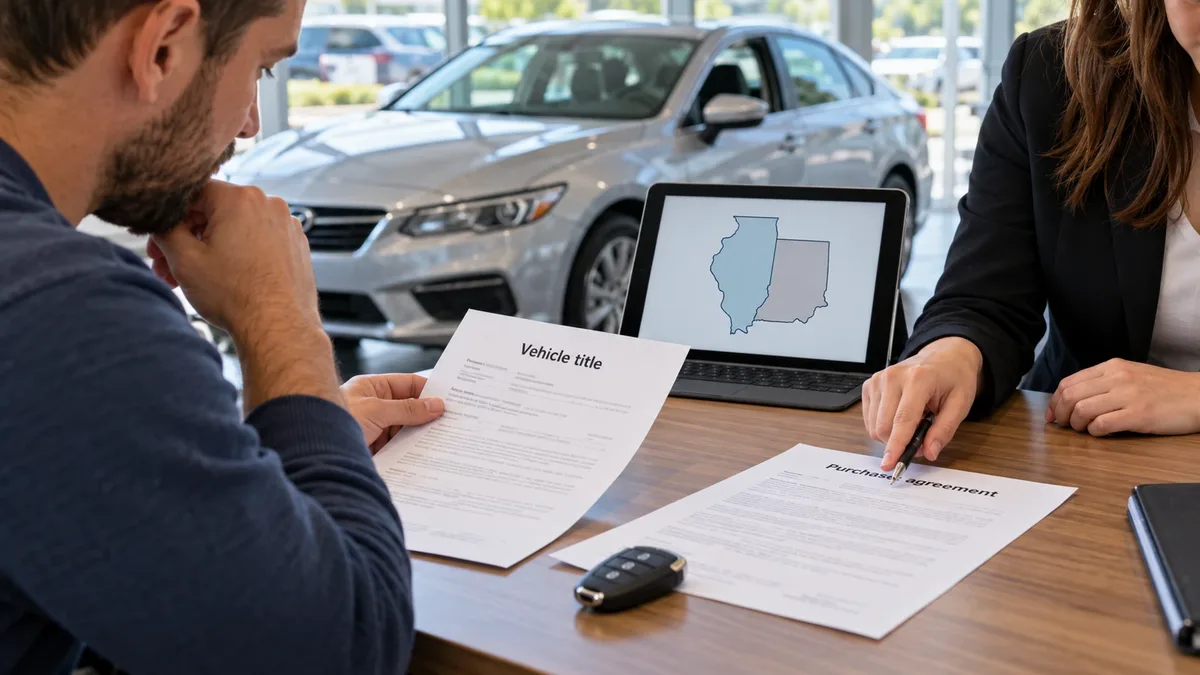
The paperwork for buying a car out of state is similar to a local transaction but has a greater risk of errors between jurisdictions. The buyer should obtain the appropriate evidence of ownership, a signed purchase agreement or bill of sale, required odometer disclosures and any dealer or lender documents. The exact title form, notarization rules and required signatures vary by state.
When buying a car out of state, verify that the seller is legally authorized to transfer ownership. A private seller's name should be consistent with the title or an authorized transfer process, and a dealer should explain how it will deliver a clean title or properly record a lender's lien. Avoid paying in full when critical title documents are missing unless a lawful, documented process adequately protects the transaction.
The following checklist is designed to prevent common handoff problems. It is not a claim that every document is required in every state. Confirm state-specific requirements before the vehicle changes hands.
- VIN and vehicle identification: match the VIN on the car, title and sale documents.
- Ownership evidence: verify the original or electronically transferable title, or the lawful alternative.
- Bill of sale or dealer purchase contract: confirm price, vehicle details and parties.
- Odometer disclosure: complete it where federal and state requirements apply.
- Lien and payoff information: establish whether an existing lender must release its interest.
- Tax documentation: retain receipts identifying taxes collected.
- Insurance evidence: arrange coverage effective before driving.
- Transport authorization: verify temporary registration, permits or shipping arrangements.
Expert takeaway: Buying a car out of state often fails at the paperwork stage rather than the mechanical stage. A missing signature, unresolved lien or inconsistent VIN can delay title transfer even if the car drives perfectly. Treat verified transfer documents as part of the car's value.
Can You Drive an Out-of-State Car Home Immediately?
The legality of driving home after buying a car out of state depends on valid registration, temporary permits, insurance and the rules of every relevant jurisdiction. A dealer may issue temporary registration or arrange transit tags where authorized, but that does not guarantee the permit is accepted for every route or length of travel. Private purchases can be more complicated because the seller's license plates may not lawfully remain on the vehicle after transfer.
A buyer planning on buying a car out of state should ask the selling DMV or dealer for the exact permit available and whether proof of ownership and insurance must be carried. Check the home-state rules for transporting an unregistered purchase and the deadline for completing registration. If the route cannot be completed lawfully under an available permit, professional shipping may be the safer option.
Does your current insurance cover a newly purchased car?
Insurance arrangements for buying a car out of state depend on the existing policy, insurer and vehicle circumstances. Some policies provide temporary coverage for newly acquired vehicles under specified conditions, while others require notification or changes before the car is driven. Never assume an informal grace period applies to all drivers.
Before taking possession when buying a car out of state, contact your insurer with the VIN, purchase date, intended driver and transport method. Ask whether liability, collision, comprehensive and any lender-required coverage will apply during the trip. Obtain confirmation in writing and keep the current insurance document accessible while transporting the vehicle.
Buying a Used Car Out of State: What Should You Inspect?
Buying a car out of state increases the value of an independent pre-purchase inspection, especially if the buyer cannot examine the vehicle personally. A history report may reveal prior title events or accidents, but it does not replace inspection of the body, structure, tires, powertrain and electronics. Request a mechanic who is not financially dependent on the seller whenever practical.
A buyer pursuing buying a car out of state should request the VIN before making a deposit and use the NHTSA recall lookup to investigate unrepaired safety recalls. Check whether the vehicle's title is branded salvage, rebuilt, flood or another relevant designation, and investigate any inconsistent odometer or ownership history. A clean-looking advertisement does not establish that the vehicle is mechanically sound.
Do out-of-state dealers have to provide a Buyers Guide?
The FTC's Used Car Rule generally requires covered used-car dealers to display a Buyers Guide and provide it to buyers. When buying a car out of state from a covered dealer, ask for the applicable guide and confirm whether the vehicle is offered with a dealer warranty or in the stated condition. Do not assume the manufacturer's remaining warranty, a service contract and a dealer warranty all provide identical coverage.
If buying a car out of state from a private seller, the FTC dealer Buyers Guide requirement generally does not apply in the same way. Obtain representations about title, condition and included equipment in the written agreement, and consider a qualified inspection before paying. Recovery after a misrepresentation may depend on state law and the specific facts rather than ordinary dealership return policies.
What Are the Hidden Costs of Buying a Car Out of State?
Buying a car out of state can generate expenses not shown in the initial listing. Travel, overnight accommodation, delivery, temporary permits, emissions work, inspection, title fees and additional registration charges can increase the total price. Financing arrangements may also differ when the dealer and lender operate in different states.
The most effective method for evaluating buying a car out of state is a complete cost comparison using realistic quotes. Consider the following hypothetical transaction: a local car costs $30,000, while an out-of-state equivalent is offered at $27,500. Assume the destination-state tax would be the same under either purchase, so the table focuses on differences beyond the base price.
Additional cost | Illustrative amount |
Out-of-state advertised price | $27,500 |
Transportation | $650 |
Independent inspection | $180 |
Temporary permit and paperwork | $100 |
Travel expenses | $250 |
Extra registration-related costs | $120 |
Total before common tax and financing | $28,800 |
Expert takeaway: Buying a car out of state saved $1,200 compared with the $30,000 local price under these assumptions, not the advertised $2,500 difference. One undisclosed repair could eliminate much of that advantage. Eagle Post Daily's Total Cost of Ownership Calculator can help compare the ongoing costs of the two vehicles after the purchase.
How Do You Register the Car in Your Home State?
After buying a car out of state, register and title the vehicle according to the home state's procedures and deadlines. Some states permit participating dealers to submit documents electronically, while others expect the buyer to visit a county tax office or motor vehicle agency. The buyer should confirm who is responsible for each filing and what happens if an out-of-state title takes longer than expected to arrive.
Texas provides a useful example for buying a car out of state: its DMV specifies documentation for vehicles purchased outside Texas, including ownership evidence, proof of insurance, required inspections, Form 130-U and applicable taxes and fees. It also identifies title-transfer and registration deadlines that buyers need to consider. These are Texas requirements and should not be used as a national deadline.
What if the title is held by a lender?
When buying a car out of state with financing, the lender may retain an electronic or paper lien interest, and title handling may involve coordination between the seller, lender and destination DMV. Clarify whether the bank handles registration and whether the state requires a separate lien document. Do not assume that possession of the car automatically proves the title transfer was completed.
If the seller is still financing the vehicle, buying a car out of state requires an even clearer payoff process. Ask how the outstanding loan will be discharged, who receives the original title or lien release and when ownership can legally transfer. Avoid relying solely on a seller's statement that the loan will be paid off after the buyer sends the purchase money.
How to Avoid Out-of-State Car Buying Scams
Buying a car out of state may make it harder to spot a fake listing because the buyer cannot easily verify the vehicle's location. Be cautious about sellers who refuse a live inspection, claim the title is unavailable or demand unusual payment methods before disclosing the VIN. A vehicle listed far below comparable market prices deserves additional scrutiny rather than an immediate deposit.
When buying a car out of state, use established verification processes and arrange an inspection before making an irreversible payment. Check the seller's business registration where relevant, confirm its address independently and obtain written details about refunds or deposit conditions. A legitimate seller should be able to explain the title and payment process clearly.
Is buying from an out-of-state private seller riskier?
Buying a car out of state from a private individual can involve fewer consumer protections and less administrative assistance than purchasing from a licensed dealer. The buyer may have to handle temporary transport, title transfer, taxes and registration directly. This does not make private sales inherently unsafe, but it increases the importance of matching ownership documents and inspecting the vehicle.
Buying a Car Out of State FAQ
Can you buy a car in a state with no sales tax and register it at home?
Buying a car out of state in a jurisdiction with no sales tax does not automatically exempt a resident from a home-state use tax or vehicle tax. The destination state's rules generally determine whether tax is due upon registration or use. Check the official tax authority before assuming the purchase saves the full advertised tax amount.
Can you register a car from another state without an inspection?
The inspection requirement for buying a car out of state depends on the home state, county and vehicle type. Some places require emissions or VIN checks, and others have different or reduced requirements. Verify the exact rules for your vehicle rather than relying on a generic national checklist.
Is it cheaper to ship an out-of-state car or drive it home?
Buying a car out of state with professional shipping can be economical when airfare, lodging, fuel, time and temporary-permit costs would be high. Driving may cost less for short distances if the vehicle is insured and legal to operate. Compare written shipping quotes with the complete personal travel expense.
Does an out-of-state used car come with a warranty?
Buying a car out of state does not create a universal warranty or return right. Dealer warranties, existing manufacturer coverage, service contracts and private-sale conditions differ. Review the purchase agreement and any FTC Buyers Guide before completing the transaction.
What is the biggest mistake when purchasing a vehicle across state lines?
The most expensive mistake when buying a car out of state may be paying before confirming registration eligibility and clear ownership. Tax surprises, emissions restrictions and title defects can make an otherwise attractive price irrelevant. Resolve those issues before placing a nonrefundable deposit or arranging transport.
The Bottom Line
Buying a car out of state can expand vehicle choice and produce genuine savings, but it creates additional steps involving taxes, title, insurance, inspections and transportation. Start with the rules of your home state, verify the vehicle and seller, then compare the entire delivered and registered cost. A lower sticker price is useful only when the car is legally transferable and financially sensible.
A disciplined approach to buying a car out of state keeps the process manageable. Collect written quotes, confirm registration eligibility, arrange independent inspection and document every payment and ownership transfer. The best deal is the vehicle that can be safely purchased, registered and maintained at an acceptable total cost.
Spotted an error? Tell our editors. Read our corrections policy.