Car Battery Keeps Dying? Causes, Tests and What to Replace
A car battery that repeatedly goes dead may be aging, undercharged, or affected by an electrical problem. Use this diagnostic guide to narrow down the cause and avoid unnecessary replacements.
This article is general information, not financial advice. Rates, prices and rules change; check the details with a qualified professional or the lender before you decide.
In this article
- Why Does a Car Battery Keep Dying?
- How to Tell Whether the Battery Is Actually Bad
- Can a Bad Alternator Cause the Battery to Keep Dying?
- What Is Parasitic Battery Drain?
- Why Short Trips Can Leave a Battery Undercharged
- Why a New Car Battery May Still Go Dead
- How to Diagnose a Repeatedly Dead Battery
- Should You Replace the Battery or the Alternator?
- How to Prevent the Problem From Returning
When a car battery keeps dying, replacing the battery is not always the solution. A weak battery can certainly fail to hold a charge, but the problem may also come from the alternator, electrical accessories, damaged connections, or a component drawing electricity while the vehicle is parked. Identifying the cause matters because a new battery can discharge just as quickly when the underlying problem remains.
A useful diagnosis starts with the timing of the failure. An engine that will not start after sitting overnight suggests different possibilities from an engine that shuts down while driving or a battery that repeatedly fails after short trips.
Why Does a Car Battery Keep Dying?
A car battery keeps dying when it cannot store enough energy, is not adequately recharged, or loses its charge faster than expected. Sometimes more than one issue is present, such as an aging battery combined with infrequent driving.
Symptom | Possible cause | Recommended check |
Dead after sitting overnight | Parasitic drain, weak battery, or accessory left on | Battery health and parked-current test |
Dies after a few days of parking | Aging battery, security-system load, or electrical drain | State of charge and standby draw |
Battery warning light while driving | Charging-system malfunction | Alternator and charging voltage |
Needs repeated jump-starts | Battery degradation or inadequate charging | Battery load/conductance test |
Starts after a long drive but not short trips | Insufficient recharge time | Driving pattern and battery condition |
Intermittent no-start with corrosion | Poor electrical connections | Terminals, cables, and grounds |
These symptoms narrow the possibilities but do not establish a diagnosis by themselves. Proper electrical testing is particularly valuable before purchasing an expensive replacement.
How to Tell Whether the Battery Is Actually Bad
A weak car battery may struggle to supply the current required by the starter motor. Common signs include slow cranking, clicking during an attempted start, dimming lights, or repeated difficulty starting after the vehicle has been parked.
Battery age provides another clue. AAA notes that automotive batteries often last several years, with life expectancy influenced by climate, driving conditions, vehicle electronics, and maintenance.
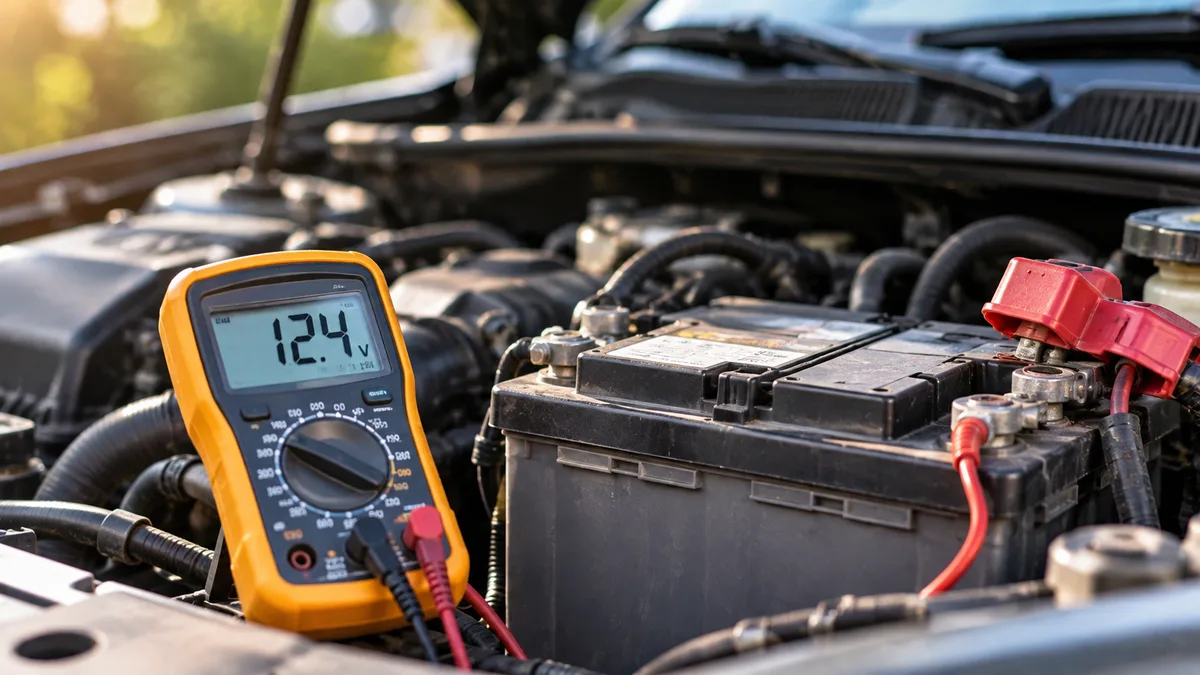
A resting voltage check can help assess charge, although voltage alone cannot establish battery health.
Approximate resting voltage | General interpretation for a conventional 12V lead-acid battery |
Around 12.6–12.8V | Typically well charged |
Around 12.4V | Partially discharged |
Around 12.2V | Significantly discharged |
Around 12.0V or lower | Very low charge |
These are broad reference values, not universal specifications for every battery technology or vehicle. Temperature, recent charging, surface charge, battery type, and measurement conditions can affect the result.
A battery showing normal voltage can still fail under starter load. A professional battery tester can evaluate its ability to deliver current and may reveal deterioration that a simple voltage reading misses.
Can a Bad Alternator Cause the Battery to Keep Dying?
A failing alternator or charging-system component can leave the battery undercharged even after the engine has been running. The battery then supplies power that should normally be replenished, eventually causing starting difficulties or electrical failures.
Possible warning signs include a battery or charging-system warning light, fluctuating electrical performance, and repeated discharge shortly after driving.
For many conventional vehicles, charging voltage may be approximately 13.5–14.8V under suitable conditions. However, modern smart-charging systems can intentionally vary voltage, so a single reading outside that range does not automatically prove an alternator failure.
A technician should evaluate charging behavior using the vehicle manufacturer's procedure. The diagnostic process may include checking the alternator, belt, wiring, grounds, fuses, and battery-management system.
What Is Parasitic Battery Drain?
Parasitic battery drain occurs when electrical components continue consuming excessive power after the vehicle is parked and its systems should have entered their normal low-power state. Every modern car uses some standby electricity for systems such as security, memory, and remote-access functions, but abnormal demand can discharge the battery.
Possible causes include:
- An interior, trunk, or glove-box light that remains on.
- An aftermarket dashcam or audio accessory.
- A faulty electronic module that fails to enter sleep mode.
- A malfunctioning relay.
- Incorrectly installed aftermarket electrical equipment.
- An issue with the vehicle's battery-management or communication systems.
A parasitic-draw test measures current after the vehicle has completed its normal shutdown cycle. The acceptable current depends on the vehicle, and some modules may take considerable time to enter sleep mode.
Owners should avoid disconnecting or probing unfamiliar electrical circuits without appropriate knowledge. Modern vehicles may have sensitive control systems, and hybrid or electric vehicles introduce additional high-voltage safety risks.
Why Short Trips Can Leave a Battery Undercharged
Short trips can prevent a battery from recovering the energy used during engine starting. The problem becomes more noticeable during cold weather, when batteries produce less available starting power and heaters, defrosters, and other electrical systems increase demand.
A vehicle driven only a few minutes at a time may not provide enough operating time to restore the battery's charge. This does not necessarily mean the alternator is faulty; the overall energy balance may simply be unfavorable.
A compatible smart battery maintainer may help vehicles that remain parked for extended periods. Owners should select a device appropriate for the battery chemistry and follow both the vehicle and charger manufacturers' instructions.
Why a New Car Battery May Still Go Dead
A new battery that repeatedly loses charge suggests that the replacement may not have addressed the original fault. However, an incorrect battery specification, incomplete installation, or inadequate initial charging can also cause problems.
Some modern vehicles require battery registration or adaptation after replacement. Failing to follow the manufacturer's procedure may affect charging behavior or battery-management calculations.
Before replacing another battery, have the charging system, standby electrical consumption, connections, and battery installation checked.
How to Diagnose a Repeatedly Dead Battery
A logical diagnostic sequence helps avoid replacing parts without evidence.
- Record when the failure occurs. Note whether the vehicle was parked overnight, driven recently, or left unused for several days.
- Inspect accessible connections. Look for visible corrosion, loose terminals, or obvious accessory problems.
- Check battery state of charge. Use an appropriate meter or have the battery tested professionally.
- Perform a battery health test. Evaluate the battery's capacity to deliver starting current.
- Test the charging system. Check alternator performance using vehicle-specific procedures.
- Check for parasitic drain. Investigate unusual electrical demand while the vehicle is parked.
- Confirm the repair. Verify that the battery maintains adequate charge after the suspected fault is corrected.
A shop should explain which tests identify a failed component and why replacement is recommended.
Should You Replace the Battery or the Alternator?
The correct replacement depends on which component fails the appropriate tests. A weak battery with a healthy charging system may only need a battery, while a healthy battery that remains undercharged may require charging-system repair.
Replacing both components without testing can unnecessarily increase repair costs. Some situations do require multiple repairs, but the need should be supported by measurements and diagnostic findings.
Long-term vehicle expenses can also be reviewed with Eagle Post Daily's Total Cost of Ownership Calculator, while drivers preparing for cold weather should keep appropriate emergency supplies in their cars.
How to Prevent the Problem From Returning
A reliable battery depends on good electrical connections, proper charging, and a vehicle that does not draw excessive current while parked. Avoid leaving aftermarket electronics connected without understanding their standby power use, and investigate recurring low-voltage warnings promptly.
Battery problems can become more noticeable in winter, but the cause may have developed months earlier. When a battery repeatedly dies, test the complete charging and electrical system before buying another replacement.
Spotted an error? Tell our editors. Read our corrections policy.