FTC Stream Auto Settlement Targets Hidden Fees: What Car Buyers Should Know
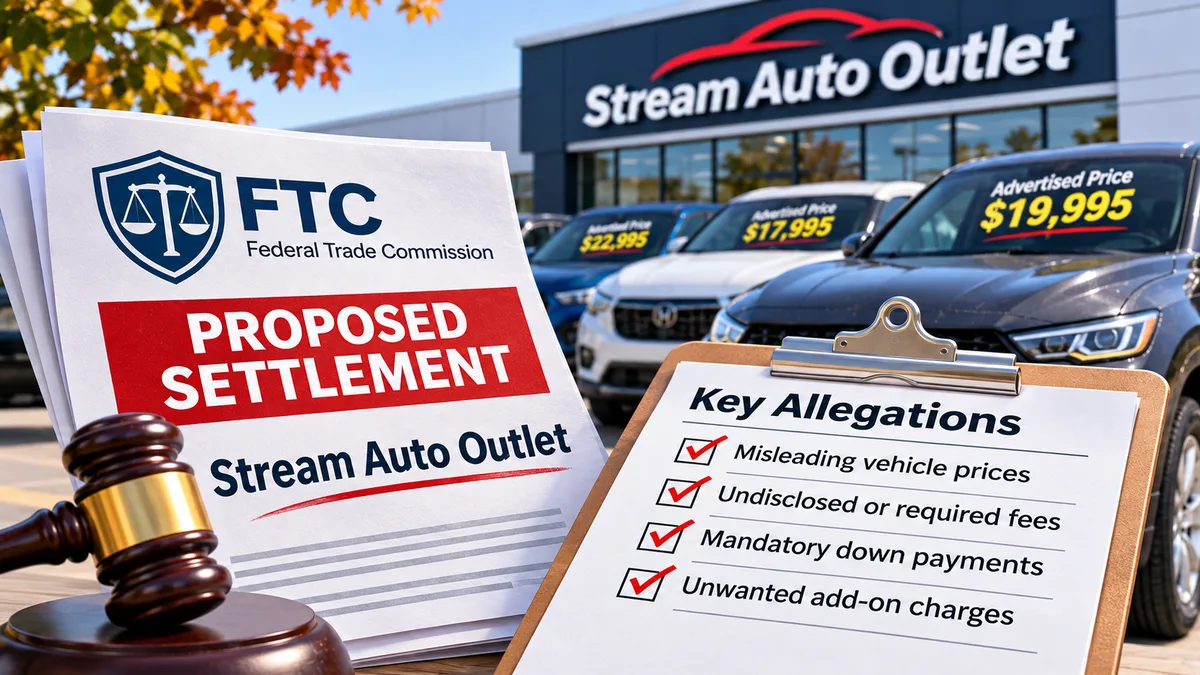
The FTC says Stream Auto Outlet advertised vehicle prices that did not reflect what consumers actually had to pay. The proposed settlement targets misleading price claims and required charges.
This article is general information, not financial advice. Rates, prices and rules change; check the details with a qualified professional or the lender before you decide.
In this article
- What Is the FTC Stream Auto Settlement About?
- Key Facts About the Stream Auto Case
- What Did the FTC Say Stream Auto Did?
- How Can a Required Down Payment Make an Advertised Price Misleading?
- What Is an Out-the-Door Car Price?
- What Does the Proposed FTC Order Require?
- Did the FTC Warn Stream Auto Before Filing the Case?
- What Types of Dealer Fees Should Car Buyers Watch For?
- A Hypothetical Example: Advertised Price vs. Actual Price
- Why Monthly Payments Can Hide the Real Cost of a Car
- How to Avoid Unexpected Dealer Charges
- What if You Already Bought a Car With Hidden Fees?
- Does the Settlement Mean Stream Auto Customers Will Receive Refunds?
- Is the Proposed Settlement Final?
- What This Case Means for Car Buyers Nationwide
- Frequently Asked Questions
- The Bottom Line
The FTC Stream Auto settlement announced on November 9, 2026, addresses allegations that a Long Island, New York, dealership group advertised vehicles at prices substantially below what customers were actually required to pay. The Federal Trade Commission says the alleged practices included required down payments, dealer fees, and unwanted add-on charges that undermined the advertised price.
The FTC filed a complaint and a proposed stipulated final order in federal court. The proposed order would restrict misleading price representations and require qualifying advertisements to display the actual price consumers must pay for a vehicle, excluding only specified government-required charges.
The proposed order is not yet equivalent to a final court judgment. It obtains legal force when approved and signed by the appropriate federal judge.
What Is the FTC Stream Auto Settlement About?
The case concerns alleged deceptive advertising and price disclosures in vehicle sales. According to the FTC, Stream Auto Outlet advertised unusually low prices online but then allegedly required consumers to pay substantially more to obtain the advertised vehicles.
The agency says certain additional requirements were difficult to discover because important conditions were placed in small print or behind additional website interactions.
The matter concerns specific Stream Auto dealership entities. It should not be interpreted as proof that every dealership in the United States engages in the same practices.
Key Facts About the Stream Auto Case
Detail | Confirmed information |
FTC announcement | November 9, 2026 |
Dealership group | Stream Auto Outlet |
Location | Long Island, New York |
Federal court | Eastern District of New York |
FTC case number | 2623078 |
Civil action | 2:26-cv-07217 |
Main allegations | Deceptive prices and additional required payments |
Proposed remedy | Restrictions on misrepresentations and required price disclosures |
Legal status | Proposed stipulated order awaiting court approval |
The FTC's action focuses on the accuracy of advertising and the clarity of the purchase price. A separate question is whether individual consumers may have their own remedies under applicable contracts or consumer protection laws.
What Did the FTC Say Stream Auto Did?
The FTC alleges that Stream Auto promoted vehicles at artificially low advertised prices and then declined to honor those prices without additional required payments.
According to the agency, customers allegedly encountered required down payments, various dealer fees, and add-on charges when attempting to purchase the vehicles.
The FTC also alleges that certain important price conditions were obscured in small-print disclosures or on secondary website pages.
These are the government's allegations. A final legal determination requires the applicable court process.
How Can a Required Down Payment Make an Advertised Price Misleading?
A down payment is ordinarily part of the amount paid toward purchasing a vehicle, not an extra amount added above its actual purchase price. However, advertising can be misleading if it presents a figure as the vehicle's total price while separately requiring an additional payment not reflected in that figure.
For example, consider a hypothetical advertisement displaying a price of $19,995. If a dealership actually required the customer to pay an additional $2,995 above that advertised amount as a condition of buying the vehicle, the real mandatory price would be different from what the advertisement appeared to promise.
This example illustrates the general pricing issue. It is not a claim that Stream Auto charged this exact amount on any specific vehicle.
The key is whether the advertised number accurately communicates the price a consumer is required to pay, rather than presenting a lower figure that omits mandatory charges.
What Is an Out-the-Door Car Price?
An out-the-door price is the total amount the buyer will pay to acquire the vehicle, including the agreed vehicle price and applicable taxes, title charges, registration, dealer fees, and other required amounts.
A buyer should obtain the full price in writing before visiting the dealership or agreeing to financing.
Component | Should buyers check it? |
Advertised vehicle price | Yes |
Government-required taxes | Yes |
Registration and title charges | Yes |
Dealer documentation or processing fees | Yes |
Mandatory add-on products | Yes |
Optional products | Yes, and whether they can be declined |
Trade-in allowance | Yes, separately |
Financing APR and term | Yes |
Total amount financed | Yes |
Total amount paid over the loan | Yes |
A clear price quote should show which charges are required and which products or services are optional.
What Does the Proposed FTC Order Require?
The proposed order would prohibit Stream Auto from making misleading representations about the costs or terms of obtaining a vehicle. It would also require advertisements containing a vehicle price to prominently display the actual price consumers must pay, apart from qualifying government-required charges.
The settlement is directed at the named defendants and the specific provisions of the proposed order. It should not be described as a newly enacted, comprehensive federal statute that automatically changes every dealership's obligations in identical ways.
The FTC retains broader authority to challenge deceptive business practices, but the precise legal responsibilities of other dealers depend on applicable laws and circumstances.
Did the FTC Warn Stream Auto Before Filing the Case?
The FTC reports that it had sent Stream Auto a warning letter in March 2026. The letter identified advertising a price that did not reflect required fees as an example of potentially illegal pricing conduct.
According to the agency, the dealerships continued certain challenged practices after that warning.
This history matters because the November enforcement announcement was not the first government interaction involving the allegedly misleading advertisements.
What Types of Dealer Fees Should Car Buyers Watch For?
Dealer fees vary by state, dealership, and transaction. Some charges are imposed by government authorities, while others are set by the dealership or represent optional products.
Common items to inspect include:
- Documentation and processing fees.
- Dealer preparation or reconditioning charges.
- Extended service contracts.
- GAP products.
- Vehicle protection packages.
- VIN etching or theft-prevention products.
- Appearance protection services.
- Financing-related fees.
- Trade-in and payoff adjustments.
A charge's name does not, by itself, establish whether it is lawful or optional. The buyer should ask whether it is required to obtain the vehicle at the advertised price and request a written explanation.
A Hypothetical Example: Advertised Price vs. Actual Price
Consider a used vehicle advertised at $19,995. A buyer requests a detailed quote and discovers several additional amounts.
Component | Hypothetical amount |
Advertised vehicle price | $19,995 |
Dealer processing fee | $695 |
Required protection package | $1,495 |
Government taxes and registration | $1,650 |
Illustrative out-the-door total | $23,835 |
In this illustration, the buyer's total is $3,840 higher than the displayed vehicle figure.
The example does not establish that all these charges are unlawful. It demonstrates why the buyer must distinguish government taxes from dealer-imposed charges and confirm whether a product is genuinely optional.
A written itemization makes comparisons across dealerships more meaningful.
Why Monthly Payments Can Hide the Real Cost of a Car
A low monthly car payment does not necessarily mean the car is inexpensive. Extending the term, increasing the down payment, or financing add-ons can make the monthly amount appear manageable while increasing the overall transaction cost.
For example, two financing offers may have the same monthly payment but very different terms and total interest expenses.
Buyers should request the APR, number of payments, total amount financed, finance charge, and total of payments. They should compare these figures alongside the out-the-door price rather than focus exclusively on monthly affordability.
How to Avoid Unexpected Dealer Charges
The strongest protection begins before visiting a dealership. A buyer can ask for a written itemized quote tied to a specific VIN and confirm whether the advertised vehicle is available at that price.
A practical process is:
- Save a copy of the original advertisement.
- Request the vehicle's VIN and complete purchase price.
- Ask which fees are government-required and which are dealer-imposed.
- Identify optional products and confirm they can be declined.
- Separate the vehicle purchase price from financing terms.
- Read the retail installment contract and purchase agreement.
- Compare the final documents with the written quote before signing.
If terms change unexpectedly, the buyer should ask for an explanation and avoid signing documents that do not reflect the agreed transaction.
What if You Already Bought a Car With Hidden Fees?
A consumer who discovers questionable charges should review the signed agreement, advertising, purchase quote, financing documents, and add-on product contracts.
Some optional products may contain cancellation or refund provisions. Those rights depend on the agreement and applicable law, so a request to cancel an add-on should be evaluated separately from a claim of misleading advertising.
Consumers may also submit complaints to the FTC or relevant state consumer protection authorities when they believe they were deceived.
Document the complaint clearly, including the advertised price, actual required charges, and communications with the dealership.
Does the Settlement Mean Stream Auto Customers Will Receive Refunds?
The November 9 announcement does not, by itself, establish an automatic consumer refund program. Any particular compensation mechanism would have to be supported by the approved order or a subsequent official announcement.
Consumers should not assume that everyone who previously purchased a vehicle from the dealership qualifies for a payment.
Be cautious of third-party messages requesting an upfront fee or bank account access in exchange for supposed settlement compensation.
Is the Proposed Settlement Final?
The FTC filed a proposed stipulated final order in the U.S. District Court for the Eastern District of New York. The agency explains that stipulated orders have the force of law when approved and signed by the court.
Until that step, it is accurate to describe the agreement as proposed rather than a final enforceable judgment.
The FTC's case page is the appropriate place to review subsequent filings and changes in status.
What This Case Means for Car Buyers Nationwide
Although the proposed order applies to the named parties, the case illustrates a broader consumer problem: advertised vehicle prices may fail to reflect the amount a buyer is required to pay.
Consumers benefit from comparing complete transaction prices rather than promotional numbers. A dealership offering the lowest advertised price may not offer the lowest final price.
The most useful practice is to obtain a detailed written out-the-door quote and review the financing agreement separately.
Frequently Asked Questions
What is the FTC Stream Auto case about?
The FTC alleges that Stream Auto Outlet advertised vehicle prices lower than the amounts consumers were required to pay, including through allegedly undisclosed or obscured mandatory charges.
When was the settlement announced?
The FTC announced the proposed settlement on November 9, 2026.
Has a court approved the agreement?
The FTC described the order as proposed. Its enforceable legal status depends on approval and signature by the federal court.
Does the settlement apply to all U.S. car dealers?
No. The proposed stipulated order concerns the named defendants. Other dealerships remain subject to applicable consumer protection laws.
What should a buyer request before purchasing a car?
A written, itemized out-the-door price tied to the specific vehicle, along with separate documentation of financing terms and any optional products.
The Bottom Line
The FTC's proposed Stream Auto settlement focuses on whether advertised vehicle prices accurately reflected what consumers were required to pay. The agency challenges practices involving allegedly hidden charges and misleading advertising, while the court process determines the legal effect of the proposed order.
For car buyers, the practical lesson is straightforward: verify the total purchase price, identify required and optional fees, and compare the final contract with the original advertisement before signing.
Spotted an error? Tell our editors. Read our corrections policy.