Debt Validation Letter: How to Dispute a Debt You Don't Owe
A debt collector says money is owed, but the account may not belong to the person being contacted. Learn what a validation notice must contain, how to challenge inaccurate debt information, and what happens after a dispute.
This article is general information, not financial advice. Rates, prices and rules change; check the details with a qualified professional or the lender before you decide.
In this article
- What Is a Debt Validation Letter?
- What Information Must a Debt Collector Provide?
- How Long Do You Have to Dispute a Debt?
- How to Dispute a Debt You Don't Owe
- Sample Debt Validation Letter
- What Happens After You Send a Debt Dispute?
- What if the Debt Belongs to Someone Else?
- What if the Debt Has Already Been Paid?
- Can a Collector Continue Calling After a Dispute?
- Can a Debt Collection Affect Your Credit Score?
- What if the Collector Threatens a Lawsuit?
- Where to Report a Debt Collection Problem
- Frequently Asked Questions
- The Bottom Line
A debt validation letter is commonly understood as a written request asking a debt collector to verify a debt or correct information about it. Under federal debt collection rules, a collector generally must provide validation information, while a consumer has important rights to challenge a debt that is unfamiliar, inaccurate, already paid, or attributed to the wrong person.
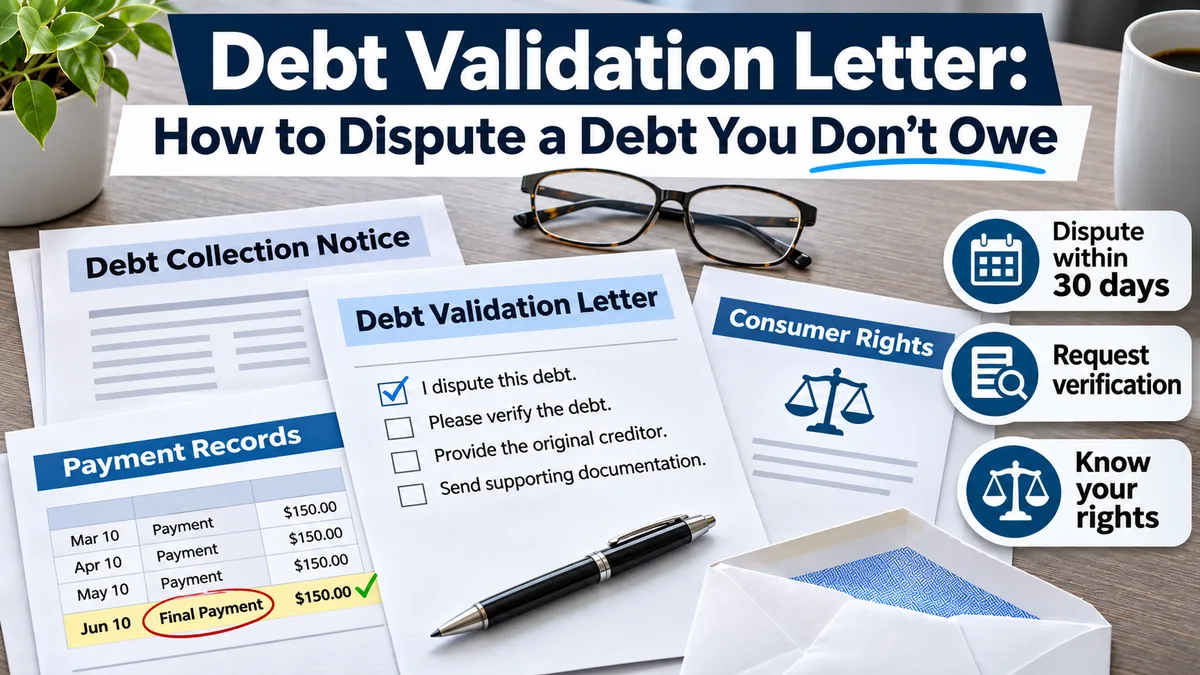
The timing of the dispute matters. When a consumer sends a qualifying written dispute within the validation period—generally 30 days after receiving the validation notice—the debt collector must stop collection activity on the disputed debt until it provides verification responding to the dispute.
Disputing a debt is not an admission that it is valid. It is an opportunity to require the collector to address the disputed information before proceeding.
What Is a Debt Validation Letter?
A debt validation letter is a consumer's written communication disputing a debt or requesting information about the debt being collected. The phrase is often used interchangeably with debt verification request, although the formal validation notice is generally a document the collector provides to the consumer.
The two documents serve different purposes:
Document | Usually sent by | Purpose |
Debt validation notice | Debt collector | Identifies the debt and explains dispute rights |
Debt dispute letter | Consumer | Challenges whether the debt or its amount is correct |
Debt verification response | Debt collector | Responds to the qualifying dispute |
Credit report dispute | Consumer to a credit bureau or furnisher | Challenges inaccurate credit reporting |
Cease-contact request | Consumer | Restricts certain further collection communications |
A credit report dispute is not a substitute for a timely dispute sent to the debt collector. Both procedures may be appropriate when the same inaccurate debt appears in a collection notice and on a consumer report.
What Information Must a Debt Collector Provide?
A debt collector generally must supply information sufficient to help the consumer identify and assess the debt. The Consumer Financial Protection Bureau's Regulation F specifies content and timing requirements for validation information.
A typical notice includes the collector's name, creditor information, account identification, the amount of the debt, and information explaining how that balance was calculated. It must also explain how to dispute the debt and identify the end of the applicable validation period.
The exact notice can include additional details or a response form. Consumers should not assume that a demand for immediate payment is sufficient verification merely because it contains a dollar amount.
How Long Do You Have to Dispute a Debt?
A consumer generally has 30 days after receiving the required validation information to submit a written dispute that triggers the federal collection-pause protection. The notice should identify the relevant deadline.
For example, if a person receives validation information on November 12 and the notice identifies a December dispute deadline, sending a qualifying written dispute by that deadline can preserve important procedural protections.
A dispute may still be submitted later, but the automatic collection-pause rule may no longer apply in the same way. State law and other federal rights can provide additional remedies depending on the circumstances.
The safest practice is to send the dispute promptly and retain evidence of when and how it was submitted.
How to Dispute a Debt You Don't Owe
Disputing an unfamiliar debt begins with identifying the collector and documenting the information being challenged. Consumers should avoid giving unnecessary sensitive information to an unverified caller.
A practical sequence includes:
- Obtain the collector's name, mailing address, and identifying account information.
- Review the validation notice and its dispute deadline.
- Compare the debt with personal records, including payments and account statements.
- Send a written dispute clearly explaining what is contested.
- Request verification and, where appropriate, information about the original creditor.
- Keep copies of the letter, attachments, and delivery evidence.
- Review the response before deciding whether additional action is necessary.
A consumer who does not recognize the collector should verify the business independently. Fraudulent collection operations may impersonate legitimate companies or claim to have authority they do not possess.
Sample Debt Validation Letter
The following example is a general consumer correspondence template, not an individualized legal document.
Subject: Dispute of Debt and Request for Verification
To: [Debt Collector Name]
Re: [Collection Reference Number]
I dispute the debt identified in your collection notice because I do not recognize the account or believe that the information provided is inaccurate.
Please provide verification of the disputed debt, including the creditor's identity, the amount being collected, and information sufficient to identify the account and assess the claimed obligation.
This letter is not an acknowledgment that I owe the debt. Please communicate any verification and response in writing.
Sincerely,
[Consumer Name]
[Mailing Address]
[Date]
The letter should be tailored to the actual problem. A consumer who believes the balance is wrong may identify the amount being disputed, while someone with proof of payment can reference relevant receipts without unnecessarily disclosing additional financial details.
What Happens After You Send a Debt Dispute?
A qualifying timely written dispute requires the collector to pause collection activity on the disputed debt until it provides verification responding to the dispute. This does not automatically erase the debt, permanently prohibit collection, or determine the underlying legal validity of the claim.
Situation | What it means |
Timely written dispute submitted | Covered collection activity must pause pending appropriate verification |
Collector sends verification | Collection activity may resume if otherwise lawful |
Collector does not respond | It cannot simply resume covered collection without satisfying the verification requirement |
Consumer disputes after the validation period | Other rights remain, but automatic pause protections may differ |
Debt also appears on credit report | Separate credit reporting dispute rights may apply |
Consumers should examine any verification response rather than assuming that any document sent by the collector conclusively establishes the claim.
What if the Debt Belongs to Someone Else?
A debt may be attributed to the wrong person because of similar names, incorrect records, identity theft, or mistaken account transfers. The dispute should clearly state that the consumer does not recognize or does not owe the account.
If identity theft is suspected, additional steps may include reviewing credit reports, considering fraud alerts or security freezes, and filing an identity theft report through appropriate official channels.
Do not send full Social Security numbers or copies of sensitive identification documents to an unverified collector merely to prove identity.
What if the Debt Has Already Been Paid?
A debt already paid may remain in a collector's records because of processing errors, incorrect account information, or a disputed remaining balance. The consumer should preserve payment confirmations and request an explanation of any claimed outstanding amount.
If records show a prior settlement, review the settlement agreement and evidence that its conditions were satisfied. A settlement for less than the original balance may have different effects from payment in full.
The dispute should accurately identify which obligation was paid and why the requested amount is contested.
Can a Collector Continue Calling After a Dispute?
A timely qualifying written dispute limits collection activity until verification is provided. Separate federal provisions also govern harassment, repeated calls, misleading statements, and certain communication restrictions.
A consumer can make a written request that a debt collector stop contacting them. However, that does not itself extinguish a legitimate debt or prevent every lawful collection action, including certain legal proceedings.
It is therefore important to distinguish between disputing a debt's accuracy and asking a collector to cease communications.
Can a Debt Collection Affect Your Credit Score?
A debt collection may affect credit reporting if the collection account is reported and the information is eligible to appear on a consumer report. The effect depends on the circumstances and the scoring model.
Disputing a collection notice does not necessarily remove an entry from credit reports. If information is inaccurate, a consumer may need to submit separate disputes to the credit reporting companies and relevant furnishers.
Federal consumer reporting law gives consumers additional rights regarding accuracy and investigation of disputes.
What if the Collector Threatens a Lawsuit?
A debt collection lawsuit should not be ignored, even when the debt is disputed. Court documents establish their own response deadlines, which are separate from the validation period.
A timely debt dispute is not a substitute for responding to a summons or other court filing. Consumers should review the court instructions, applicable law, and any available legal assistance.
Threats of legal action that a collector cannot lawfully take may violate consumer protection rules. Keep records of communications and seek appropriate advice when legal proceedings are threatened.
Where to Report a Debt Collection Problem
Consumers can submit complaints to the CFPB when they believe a debt collector is violating applicable consumer financial laws. The FTC and state attorneys general may also receive reports of deceptive collection practices.
A useful complaint contains the collector's identity, a clear timeline, copies of notices, details of the dispute, and an explanation of the alleged misconduct.
Avoid including unrelated account credentials or private information that is not necessary to explain the issue.
Frequently Asked Questions
Does a debt validation letter make the debt disappear?
No. It challenges the information being collected and can trigger verification and collection-pause requirements. It does not automatically cancel a legitimate obligation.
Do debt collectors have to provide the original signed contract?
Not necessarily in every case. Federal verification requirements do not impose one identical documentary response for all debts. The sufficiency of verification depends on applicable rules and circumstances.
What happens if the collector never verifies the debt?
A collector subject to the relevant pause cannot resume collection of the disputed debt without satisfying the verification requirement. The underlying debt is not automatically eliminated solely because no response arrives.
Can you dispute a debt after 30 days?
Yes, a consumer can raise concerns later, but the automatic statutory collection-pause protection may differ. Other legal and credit reporting rights may remain.
Should a consumer pay a debt before verification?
Someone who does not recognize a debt should verify the collector and the claim before making a payment. Payment can have legal consequences in some situations, particularly for older debts.
The Bottom Line
A debt validation letter is a practical way to challenge unfamiliar or inaccurate collection information. The strongest approach is to act within the validation period, dispute the debt clearly in writing, and preserve evidence of every communication.
Federal debt collection rules provide important protections, but they do not guarantee that every disputed debt will disappear. Consumers should also use credit reporting disputes or legal procedures when necessary.
Spotted an error? Tell our editors. Read our corrections policy.