How Much Does a Space Heater Cost to Run?
The cost to run a space heater depends on watts, actual heating time and your electric rate. A few calculations show what one warm room adds to the bill.
This article is general information, not financial advice. Rates, prices and rules change; check the details with a qualified professional or the lender before you decide.
In this article
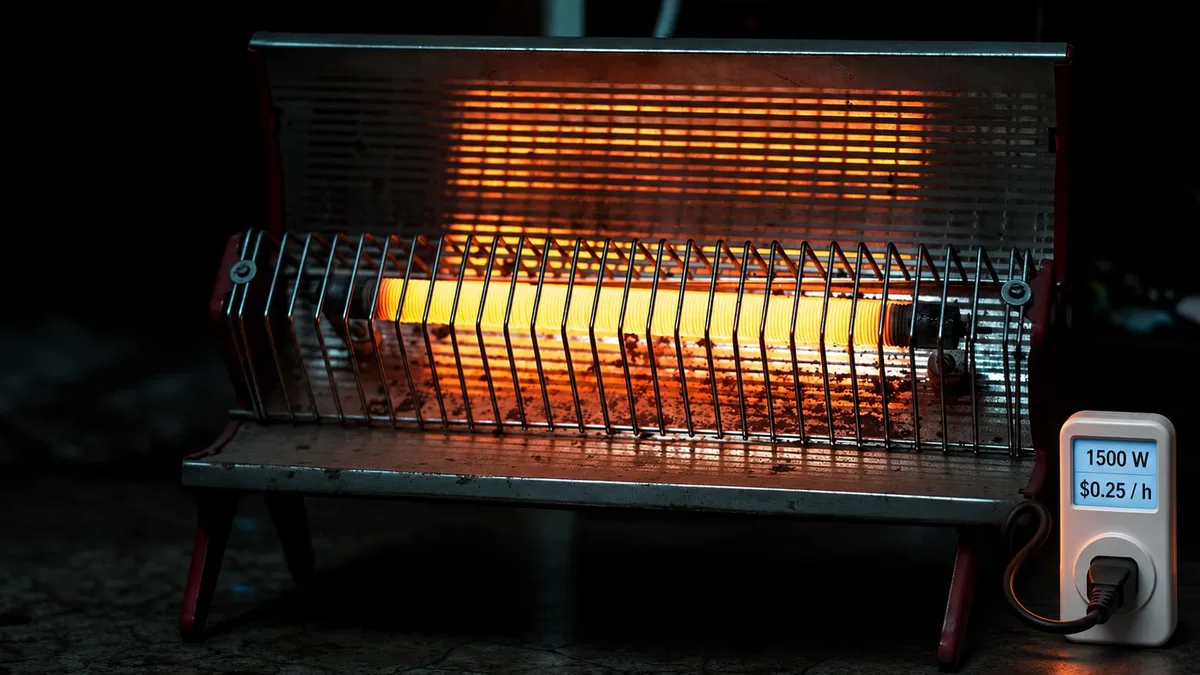
The cost to run a space heater equals its power in kilowatts multiplied by its operating hours and your electricity price per kilowatt-hour. A 1,500-watt heater drawing full power for one hour uses 1.5 kWh. At an illustrative rate of $0.20 per kWh, that costs $0.30 an hour, or $36 for four full-power hours a day over 30 days.
Those figures are examples, not a national average or a quote for your utility. Your result changes with the heater setting, thermostat cycling and electricity tariff. Start with the label on your own appliance and the usage charges on your bill before deciding whether supplemental heat fits your budget.
How to calculate the cost to run a space heater
Calculate operating cost by converting watts to kilowatts, multiplying by hours, then multiplying by the applicable rate. The U.S. Energy Information Administration explains that 1 kilowatt equals 1,000 watts and that kWh measures energy used over time. A heater’s purchase price does not enter this electricity-use formula.
Cost = watts ÷ 1,000 × operating hours × dollars per kWh
For a 1,500-watt heater used at full power for four hours:
- Convert power: 1,500 ÷ 1,000 = 1.5 kW.
- Calculate energy: 1.5 × 4 = 6 kWh.
- Apply an example rate: 6 × $0.20 = $1.20.
For the same use on 30 days, multiply $1.20 by 30: $36. This assumes four hours of full-power operation every day. It excludes the cost of buying the heater and any bill items that do not change with electricity consumption.
What does a 1,500-watt heater cost at different rates?
The hourly space heater running cost rises in direct proportion to the electricity rate when power and operating time stay the same. The following table uses hypothetical rates so you can see that relationship. Substitute the rate that applies to your home and the hours when you use the heater.
Illustrative electricity rate | One full-power hour | Four full-power hours | Four hours daily for 30 days |
|---|---|---|---|
$0.10 per kWh | $0.15 | $0.60 | $18 |
$0.20 per kWh | $0.30 | $1.20 | $36 |
$0.30 per kWh | $0.45 | $1.80 | $54 |
$0.40 per kWh | $0.60 | $2.40 | $72 |
Two identical heaters used for the same number of hours would double those electricity costs. A second unit in a bedroom is a separate load, even if the first heater is already warming the home office. Calculate each heater separately when settings or schedules differ.
An electric heater does not necessarily draw its maximum rating continuously. Use the nameplate and manual to identify the selected setting rather than assuming every portable unit uses 1,500 watts.
Find the right electricity rate on your bill
Use the consumption-dependent charges that apply to the additional kWh when estimating the cost to run a space heater. A bill may separate electricity supply, delivery and other usage-based charges. Ask the utility which charges apply to an extra kWh if the tariff is unclear.
Dividing the entire bill by its total kWh gives an average that can include fixed monthly charges. That average may be useful for a rough household comparison, but it is not always the price of the next unit of electricity. A service charge you pay with or without the heater should not be counted as a new heater expense.
Time-of-use pricing adds another step. Suppose the hypothetical rate is $0.15 for two of your heating hours and $0.30 for the other two. A 1.5 kW heater costs $0.45 for the first period and $0.90 for the second, totaling $1.35. Applying the lower rate to all four hours would underestimate the cost.
Check tiered rates, seasonal changes and any applicable usage-based taxes as well. The utility’s current tariff is more useful than an old advertised rate or a neighbor’s bill.
Account for low settings and thermostat cycling
Your actual space heater running cost depends on how much energy it draws, not simply how long it remains switched on. A thermostatically controlled heater may stop heating after reaching its set temperature and resume later. The Holland Board of Public Works guide describes thermostat control and the same watts-hours-rate calculation.
For planning, distinguish elapsed time from equivalent full-power time. A heater connected for four hours but drawing its full 1,500 watts for a total of two hours uses approximately 3 kWh for that heating operation, plus any other device consumption. At the example $0.20 rate, that heating energy costs $0.60. Do not assume a 50% cycle unless you have evidence for it.
Lower wattage does not automatically produce a lower total bill if the heater runs much longer. A hypothetical 750-watt setting used for eight continuous hours consumes the same 6 kWh as 1,500 watts used for four hours. Whether those settings provide the comfort you need depends on the room and appliance.
Compare electricity use rather than expecting a particular shape, fan style or marketing label to change the arithmetic. At the same actual watts, operating hours and rate, the calculated electricity cost is the same.
Will supplemental heat save money overall?
A space heater saves money overall only if the heating expense it avoids exceeds its added operating and ownership costs. If the central system runs exactly as before, the portable heater adds consumption rather than creating an automatic saving. A warmer chair or office can still be useful, but comfort and savings are separate results.
For a hypothetical monthly budget, compare the added $36 heater expense with any demonstrated reduction in other heating charges. A $20 reduction leaves the household paying $16 more overall; a $50 reduction leaves $14 less, before the heater’s purchase cost. Changes in weather, occupancy or utility rates can make a simple comparison between two bills misleading.
Address an unusually cold room as well as its immediate comfort problem. Eagle Post Daily’s winter home preparation checklist covers drafts, heating checks and freeze precautions. Do not shut off heat needed to protect plumbing just to improve a portable-heater calculation.
Set a spending limit without compromising safety
Turn your space heater cost estimate into a budget by dividing your allowed spending by the cost per full-power hour. At the illustrative $0.30 hourly cost, a $30 budget buys 100 full-power hours. Spread over 30 days, that is about three hours and 20 minutes a day; it is a mathematical allowance, not a recommendation for unattended operation.
Safety requirements still control how the heater is used. The Consumer Product Safety Commission advises keeping portable heaters at least three feet from combustible materials, plugging electric units directly into a wall outlet and turning them off while sleeping. Follow the manufacturer’s instructions and do not use an extension cord or power strip to reach a preferred location.
Do not run a heater with a damaged cord, plug or connection. Saving a few cents is not a reason to continue using an unsafe appliance or overloaded outlet. Ask a qualified professional about an electrical problem rather than repeatedly resetting a breaker.
FAQ
These space heater cost questions help turn the calculation into a realistic estimate.
Does a 1,500-watt heater use 1.5 kWh every hour?
Yes, if it draws 1,500 watts continuously for that hour. Thermostat cycling or another setting can change the energy used over an elapsed hour. Calculate from actual operating conditions rather than treating the maximum label rating as a measured daily average.
What if the electricity rate is shown in cents?
Convert cents to dollars before using the formula. A rate of 20 cents per kWh is $0.20, not $20. A misplaced decimal would make the estimate 100 times too large.
Does the purchase price show how cheap a heater is to operate?
No. Estimate electricity separately using watts, time and rate, then add the purchase cost when comparing total spending. The cost to run a space heater should be recalculated when your tariff, usage or heating setting changes.
Spotted an error? Tell our editors. Read our corrections policy.