How Long Does It Take to Buy a House? From Search to Keys
Buying a house rarely happens in a few weeks. A realistic timeline can stretch from several months of preparation and searching to another 30-60 days after an accepted offer, depending on financing, inspections, appraisal, title, and the property itself.
This article is general information, not financial advice. Rates, prices and rules change; check the details with a qualified professional or the lender before you decide.
In this article
- How Long Does It Take to Buy a House From Start to Finish?
- How Long Does It Take to Get Financially Ready to Buy a House?
- How Long Does Mortgage Preapproval Take?
- How Long Does It Take to Find a House?
- How Long Does It Take to Make an Offer on a House?
- How Long Does a Home Inspection Take?
- How Long Does an Appraisal Take?
- How Long Does Mortgage Underwriting Take?
- How Long Do Title Work and Insurance Take?
- How Long Does It Take to Get a Loan Estimate?
- Why Does the Closing Disclosure Add at Least Three Business Days?
- How Long Does the Final Walk-Through and Closing Take?
- How Long Does It Take to Buy a House With a Mortgage?
- How Long Does It Take to Buy a House With Cash?
- How Long Does It Take to Buy a House for a First-Time Buyer?
- What Can Make Buying a House Take Longer?
- Can You Speed Up the Home-Buying Process?
- A Realistic Home-Buying Timeline Example
- The Bottom Line
How long does it take to buy a house? For a U.S. buyer who is financially ready and using a mortgage, a realistic end-to-end planning range is often about three to six months, although the process can be shorter or much longer. The home search is usually the least predictable part, while the period from an accepted offer to closing commonly takes roughly 30 to 60 days.
That timeline is not a deadline or national guarantee. A buyer who finds the right home immediately, already has financing organized, and encounters no appraisal, inspection, title, or underwriting problems may move much faster, while another buyer may spend months searching or lose several offers before getting under contract. Cash purchases can also move more quickly because mortgage underwriting is removed from the process.
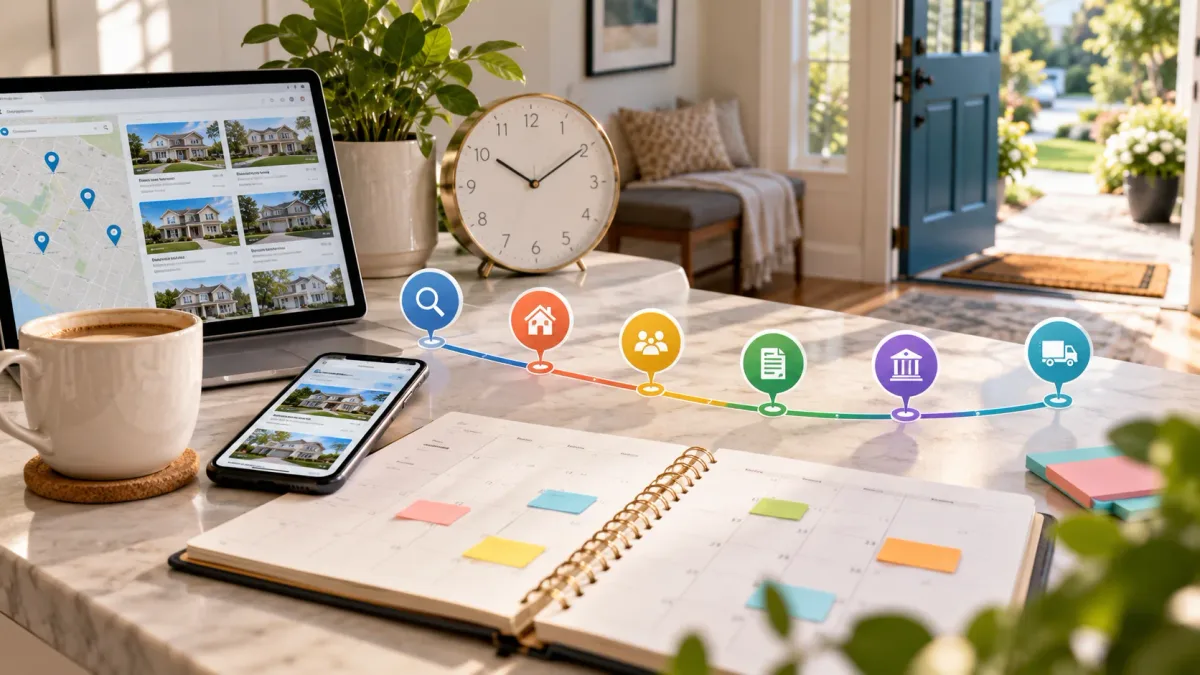
The most useful way to answer how long does it take to buy a house is to separate the journey into stages. Financial preparation, mortgage shopping, house hunting, the offer, inspection, appraisal, underwriting, title work, insurance, final review, and closing all have their own timelines. Some can happen at the same time, while others must wait for the previous step to finish.
How Long Does It Take to Buy a House From Start to Finish?
How long does it take to buy a house from start to finish depends mainly on how ready the buyer is before shopping begins. Someone who already has savings, stable income, acceptable credit, documents prepared, and a mortgage preapproval can move directly into the home search, while another buyer may need months or longer to improve credit or build a down payment. That is why timelines that start at “preapproval” can look much shorter than the actual path to homeownership.
A practical timeline for a mortgage buyer can look like this:
How long does it take to buy a house from financial preparation and preapproval through home search, underwriting, and closing
Stage | Typical planning range |
|---|---|
Financial preparation | A few weeks to many months |
Mortgage research and preapproval | Several days to about 2 weeks |
Finding the right home | A few weeks to several months |
Offer and negotiation | About 1–7 days, sometimes longer |
Inspection and negotiations | Several days to about 2 weeks |
Appraisal, title, and underwriting | Often 2–5 weeks |
Final approval and closing preparation | Several days to about 2 weeks |
Accepted offer to closing | Commonly about 30–60 days |
Total once financially ready | Often about 3–6 months |
These ranges overlap rather than stacking perfectly one after another. A lender can be underwriting while title work, insurance, and appraisal are also moving forward, which is why adding every row together would overstate the total time. The home search and mortgage closing period usually have the biggest influence on the final timeline.
How Long Does It Take to Get Financially Ready to Buy a House?
Financial preparation can take almost no additional time for a buyer who already has strong savings and organized finances, or it can take months or years when credit, debt, income, or the down payment need work. This stage happens before the visible part of the home-buying process, but it often determines how smoothly everything else moves. Buyers who rush past it may discover financing problems only after they have already found a house.
HUD describes homeownership readiness as including affordability, rights, shopping for a home, financing, inspection, insurance, and closing. Its housing-counselor training also emphasizes reviewing income, expenses, spending habits, home values, and credit before moving into the purchase itself.
A buyer who needs to improve credit, pay down debt, document irregular income, or save more cash should not treat that extra time as a delay in the negative sense. Preparation before making an offer is usually easier than solving a financial problem while a contract deadline is running. The fastest home purchase is not necessarily the safest one.
How Long Does Mortgage Preapproval Take?
Mortgage preapproval can take anywhere from a relatively quick process to several days or longer depending on the lender and borrower. A lender may review income, assets, debts, credit, and employment information before issuing a preapproval, and incomplete documentation can slow the process. Buyers with self-employment income, variable compensation, recent job changes, or complex assets may need additional review.
Preapproval is different from final mortgage approval. The lender still needs to evaluate the actual property, appraisal, title information, updated borrower documents, and the complete transaction after an offer is accepted. A preapproval saves time because major financial questions are addressed early, but it does not remove underwriting later.
When asking how long does it take to buy a house, this is one stage where preparation can make a real difference. Having recent pay records, tax documents, bank statements, and identification ready reduces back-and-forth with the lender. It also lets the buyer focus on the property instead of scrambling for financial paperwork after finding the right home.
How Long Does It Take to Find a House?
Finding the right property is usually the hardest part of the timeline to predict. Some buyers find a suitable home during their first weekend of serious shopping, while others search for several months because of price, location, inventory, competition, or specific property requirements. Current U.S. home-buying timelines commonly allow several weeks to months for this stage.
The search can take longer when the buyer has a narrow geographic area, limited inventory, a strict budget, or requirements such as a large lot, specific school area, accessible layout, or particular commute. Losing an offer in a competitive situation can also effectively restart part of the search. Buyers should therefore avoid scheduling a lease termination or move solely around an optimistic guess about when they will find a house.
This is why there is no reliable answer such as “buying a house takes exactly 60 days.” Sixty days may describe part of the mortgage and closing process, but it does not account for the weeks or months a buyer may spend finding a property worth buying. The search ends only when the right home and an acceptable contract come together.
How Long Does It Take to Make an Offer on a House?
Preparing an offer can happen within hours once a buyer decides to pursue a property, but negotiation can extend the process. The seller may accept, reject, or counter the offer, and the parties may negotiate price, concessions, closing date, contingencies, included property, or other terms. In a competitive market, offer deadlines can compress the decision into a very short window.
A straightforward offer may be resolved in one or two days, while more complicated negotiation can last several days or longer. The buyer should understand expiration times and deadlines written into the offer rather than assume that every seller must respond within a standard national period. Contract practice varies by market and state.
The accepted offer is an important turning point when calculating how long does it take to buy a house. Before that moment, the timeline is dominated by search and negotiation, while afterward the transaction becomes much more deadline-driven. For mortgage buyers, accepted offer to closing is commonly the 30–60 day portion of the process.
How Long Does a Home Inspection Take?
The physical inspection itself usually takes only a few hours, but the full inspection stage can occupy several days or longer. Scheduling the inspector, receiving the report, arranging specialist evaluations, obtaining repair estimates, and negotiating with the seller can all extend the process. The purchase contract determines how much time the buyer has to complete inspection-related decisions.
A house with straightforward findings may move through inspection quickly. A property with roof concerns, foundation movement, sewer problems, well or septic issues, moisture, pests, or electrical concerns may require additional professionals before the buyer can understand the risk. The extra few days can be valuable when the alternative is accepting an expensive problem without enough information.
Inspection should also not be confused with appraisal. The inspection evaluates the home for the buyer, while the appraisal primarily helps the lender assess the property’s value as collateral. Those processes can occur around the same part of the timeline, but they answer different questions.
How Long Does an Appraisal Take?
The appraisal process can take several days to a couple of weeks depending on scheduling, property complexity, location, lender workflow, and whether additional review is needed. The appraiser evaluates the property and comparable sales, then provides a report used by the lender during underwriting. A straightforward appraisal can move quickly, while a rural, unusual, or difficult-to-compare property can require more time.
A low appraisal can also extend the purchase beyond the original timeline. The buyer and seller may need to renegotiate the price, the buyer may need to bring additional cash, the appraisal may be reviewed or challenged, or the transaction may proceed according to an appraisal contingency in the contract. The appraisal itself may be relatively short, but resolving an appraisal problem can add days or weeks.
This is another reason how long does it take to buy a house cannot be reduced to the number of days required for one task. The important variable is not just how quickly each step starts, but whether it produces a problem that requires another decision. A clean appraisal keeps the schedule moving, while a valuation dispute can change the entire deal.
How Long Does Mortgage Underwriting Take?
Mortgage underwriting usually takes place during the period between accepted offer and closing and can span several weeks. The lender verifies the borrower’s financial information, reviews the appraisal and property, checks loan-program requirements, and may request updated or additional documentation. Current mortgage timelines commonly place the overall financed closing process around 30 to 60 days, with underwriting making up a significant part of that period.
A borrower can help reduce avoidable delays by responding quickly to legitimate lender requests and keeping finances stable. Changing jobs, taking out a new vehicle loan, opening credit accounts, or moving large amounts of money without documentation can create additional underwriting questions. The lender may verify important information again shortly before closing.
Underwriting does not always proceed in one smooth sequence. A file can move from review to a request for conditions, back to the borrower for documents, and then back to underwriting for final approval. “Clear to close” usually comes only after the lender is satisfied that the borrower, property, and loan meet the required conditions.
How Long Do Title Work and Insurance Take?
Title review and homeowners insurance usually happen alongside the mortgage process rather than after underwriting is finished. The title or settlement professionals review property ownership and recorded interests according to the local closing process, while the buyer arranges homeowners insurance that satisfies both personal needs and lender requirements. Starting these tasks early helps prevent them from becoming last-minute problems.
Title issues can slow a transaction when records reveal unresolved liens, ownership questions, errors, estate issues, or other matters that must be addressed before the property can transfer cleanly. Insurance can also delay a deal when a property is difficult to insure because of its roof, condition, claims history, or location. A house can be affordable on paper but still encounter closing problems if acceptable insurance cannot be arranged.
When calculating how long does it take to buy a house, buyers should remember that these less-visible tasks are happening in the background. They may not require daily involvement from the buyer, but they are part of what makes a 30–60 day closing window necessary. A fast appraisal alone does not mean the transaction is ready to close.
How Long Does It Take to Get a Loan Estimate?
For most covered mortgages, federal rules require the lender to provide a Loan Estimate within three business days after receiving the information that constitutes an application. The document summarizes important estimated terms and costs so borrowers can compare mortgage offers.
The Loan Estimate arrives near the beginning of the mortgage process rather than at closing. Buyers can use it to compare interest rates, projected payments, closing costs, and other loan terms before deciding which lender and mortgage to proceed with. Comparing offers early can take a few additional days but may be much more valuable than rushing into the first available loan.
A Loan Estimate is also not final approval. The lender still needs to underwrite the borrower and property before closing. The early document helps establish expectations, while later disclosures show how the actual transaction developed.
Why Does the Closing Disclosure Add at Least Three Business Days?
For most covered mortgages, the borrower must receive the Closing Disclosure at least three business days before closing. That federal review period gives the buyer time to compare final loan terms with the earlier Loan Estimate, ask questions, and address unexpected differences before signing.
This rule means the final mortgage stage cannot always be compressed simply because everyone wants to close tomorrow. In limited circumstances, important changes to the loan can require a new Closing Disclosure and another three-business-day review period.
The three-day period should be treated as review time rather than dead time. Buyers should verify the interest rate, monthly payment, loan amount, closing costs, cash to close, escrow details, and other major terms. Discovering an error before signing is far easier than trying to solve it after the transaction is complete.
How Long Does the Final Walk-Through and Closing Take?
The final walk-through is typically scheduled shortly before closing and usually does not require a large block of time. Its purpose is to confirm that the property is still in the expected condition, that agreed repairs were completed, and that items meant to remain are still present. A serious problem discovered during the walk-through can delay closing while the parties decide how to resolve it.
The closing appointment itself may take a few hours or less depending on the state, documents, transaction, and closing method. HUD’s homebuyer training describes closing as the stage where ownership transfers and the buyer receives the keys, with substantial paperwork involved.
A buyer should not assume that receiving the keys is guaranteed at the exact moment documents are signed in every state. Funding and recording practices vary by jurisdiction, and possession terms can also depend on the purchase contract. Closing day is the final stage of the transaction, but local procedure determines exactly when ownership and possession become effective.
How Long Does It Take to Buy a House With a Mortgage?
How long does it take to buy a house with a mortgage? Once an offer is accepted, about 30 to 60 days is a realistic planning range for many financed transactions, although some close faster and others take longer. Current 2026 U.S. purchase timelines consistently place the financed offer-to-close period around that range.
The reason is that financing introduces several processes that need to be completed or verified before funds are released. Underwriting, appraisal, title work, insurance, documentation, closing disclosures, and property-related conditions all need to move toward completion. Government-backed or unusually complex loans may also have additional program requirements.
The buyer should therefore avoid treating a 30-day closing date as guaranteed simply because it appears in the contract. The target closing date assumes that financing and due diligence remain on schedule. A missing document or property issue can push that date back.
How Long Does It Take to Buy a House With Cash?
A cash purchase can close much faster because there is no mortgage underwriting process. In a straightforward transaction, cash buyers may sometimes close in roughly two weeks, although title work, inspections, contract deadlines, insurance, and other due diligence can still require time.
Paying cash does not mean the buyer should skip the same property investigation simply to close faster. Inspection, title review, insurance research, final walk-through, and careful contract review can remain important even without a lender. Removing the mortgage removes one major source of delay, not every reason to perform due diligence.
The timeline can also depend on what the seller wants. A seller who still needs time to move may prefer a later closing even when the buyer could technically close sooner. Contract timing therefore remains a negotiation point regardless of how the purchase is financed.
How Long Does It Take to Buy a House for a First-Time Buyer?
A first-time buyer may take longer overall because more of the process is unfamiliar. Comparing mortgage products, understanding contracts, deciding what compromises are acceptable, and learning how inspections, appraisal, title, insurance, and closing work can naturally add time. That is not necessarily a problem because many of those decisions have long-term financial consequences.
The search phase can also take longer when the buyer is shopping in a more affordable price range with limited inventory. At the same time, first-time buyers who have prepared their financing and documents in advance can move just as efficiently through underwriting as repeat buyers. Experience matters less than preparation once a complete, accurate file reaches the lender.
For a first-time buyer asking how long does it take to buy a house, planning around several months rather than several weeks is usually more realistic. That provides room for a thoughtful home search and normal mortgage processing without assuming every offer will succeed immediately. A tighter timeline can happen, but it should be treated as the favorable scenario rather than the only plan.
What Can Make Buying a House Take Longer?
Delays usually happen because information changes, a problem needs investigation, or one party cannot complete a required step on time. Some delays are within the buyer’s control, while others involve the seller, lender, property, appraiser, title records, or market conditions. Knowing the common causes makes it easier to distinguish a normal slowdown from a serious transaction problem.
Common reasons a purchase takes longer include:
- Difficulty finding a suitable home.
- Losing one or more offers.
- Incomplete mortgage documents.
- Employment or income changes.
- New debt during underwriting.
- Appraisal scheduling delays.
- A low appraisal.
- Major inspection findings.
- Additional specialist inspections.
- Repair negotiations.
- Title problems or unresolved liens.
- Difficulty obtaining homeowners insurance.
- HOA document delays.
- Seller-related closing issues.
- Changes to important mortgage terms.
- Problems discovered during the final walk-through.
Not every delay threatens the purchase. A two-day wait for an updated bank statement is very different from an unresolved title defect or inability to insure the property. The key is understanding what is causing the delay, who is responsible for the next step, and whether the contract contains a deadline related to it.
Can You Speed Up the Home-Buying Process?
Some parts of the timeline can be made more efficient through preparation, but buyers should not speed up the process by skipping important due diligence. Having financing organized, documents ready, a clear home search, and responsive professionals can remove unnecessary waiting. Inspection, appraisal, title review, and contract protections still deserve enough time to do their jobs properly.
Steps that can help keep the process moving include:
- Prepare Mortgage Documents Before Shopping. Keep recent income, asset, tax, and identification records organized.
- Get Preapproved Before Serious Home Tours. Address basic financing questions before an offer deadline appears.
- Choose a Responsive Lender. Ask how quickly the lender typically handles documents, appraisal, underwriting, and closing.
- Know Your Must-Haves. A focused search can reduce time spent touring unsuitable properties.
- Respond Quickly to Lender Requests. Underwriting can pause while the lender waits for information.
- Avoid New Debt. Do not create unnecessary financial changes before closing.
- Schedule Inspection Promptly. Contract deadlines can be short after the offer is accepted.
- Shop for Insurance Early. Do not wait until the final days to discover that coverage is unusually expensive or difficult to obtain.
- Review Closing Documents Immediately. Raise unexpected fees or terms as soon as the Closing Disclosure arrives.
- Keep Communication Clear. Know which person is responsible for the next transaction step.
Efficiency should come from preparation rather than cutting corners. A few extra days spent understanding a structural issue or loan term can prevent years of financial consequences. The best fast closing is one where nothing important was rushed.
A Realistic Home-Buying Timeline Example
A hypothetical buyer who is already financially prepared can see how several months pass even when nothing goes seriously wrong. The home search takes the longest variable period, while the post-offer stage becomes much more structured around contract and lender deadlines. This example is designed as a planning model rather than a guaranteed schedule.
Example of how long it takes to buy a house in the U.S. from preapproval through closing
Week | What may be happening |
|---|---|
Week 1 | Compare lenders and obtain preapproval |
Weeks 2–9 | Search, tour homes, research neighborhoods |
Week 10 | Make an offer and negotiate |
Week 11 | Offer accepted, inspection begins |
Week 12 | Inspection follow-up, appraisal ordered, title work begins |
Weeks 13–14 | Mortgage underwriting, appraisal, insurance, title review |
Week 15 | Resolve remaining lender or property conditions |
Week 16 | Final loan approval and closing preparation |
Week 17 | Receive and review Closing Disclosure |
Week 18 | Final walk-through and closing |
This example produces a little over four months from preapproval to keys, which fits comfortably inside the broader three-to-six-month planning range. A buyer who finds a house in the first week could finish much sooner, while a three-month home search would push the total well beyond this example. The timeline is driven less by the number of formal steps than by how long it takes to find the right property and resolve unexpected issues.
The Bottom Line
How long does it take to buy a house? For many U.S. mortgage buyers, about three to six months from serious preparation and shopping to receiving the keys is a useful planning range, while the accepted-offer-to-closing portion commonly takes around 30 to 60 days. Buyers who need more time to save, improve credit, or find the right property can take considerably longer, while organized cash buyers may move much faster.
The home search is usually the hardest stage to predict because no lender, agent, or buyer can guarantee when the right property and acceptable offer will come together. After the contract is signed, the timeline becomes more structured around inspection, appraisal, underwriting, title, insurance, disclosures, and closing. Those processes can overlap, but a problem in any one of them can move the target date.
The safest timeline is therefore one with room for due diligence rather than one built around the fastest possible closing. Buying a house quickly is useful only when the financing is understood, the property has been properly evaluated, and the buyer is comfortable with the contract before signing. The keys matter, but getting them a week earlier is rarely worth accepting a problem that could last for years.
Frequently asked questions
How long does it take to buy a house on average?
A practical U.S. planning range is about three to six months once a buyer is financially ready, although individual purchases vary widely. The period after an accepted offer often takes around 30 to 60 days when mortgage financing is involved. The home search can add several weeks or months before that closing timeline even begins.
How long does it take to buy a house after an offer is accepted?
With mortgage financing, buyers commonly plan for roughly 30 to 60 days from accepted offer to closing. During that time, inspection, appraisal, underwriting, title, insurance, final loan conditions, and closing preparation usually occur. Any significant problem in one of those areas can extend the scheduled closing date.
Can you buy a house in 30 days?
Yes, some financed purchases can close in around 30 days when the buyer is well prepared, the lender moves quickly, and there are no major property or title issues. A 30-day closing becomes harder when appraisal, inspection, underwriting, insurance, or document problems require additional work. Buyers should treat 30 days as possible rather than guaranteed.
Can you buy a house in two weeks?
A cash purchase can sometimes close in roughly two weeks when the contract, title work, inspections, and other due diligence move quickly. A financed purchase is much harder to complete that fast because mortgage underwriting and federal disclosure requirements add steps that cannot always be compressed. Buyers should not waive important protections simply to achieve an unusually short closing.
How long does mortgage underwriting take when buying a house?
Underwriting usually takes place during the broader 30–60 day mortgage closing window rather than having one fixed national duration. The lender reviews the borrower, property, appraisal, and supporting documents and may request additional information before issuing final approval. Complex income, missing documentation, new debts, appraisal issues, or property conditions can extend the process.
How long does it take to close after the appraisal?
There is no fixed number of days because appraisal is only one part of the closing process. The lender may still need final underwriting conditions, title work, insurance, updated borrower documents, and the required Closing Disclosure review period. A clean appraisal can keep the transaction moving, but it does not automatically mean the loan is ready to close.
Why does closing on a house take so long?
Closing requires several organizations to verify different parts of the transaction. The lender reviews financing, the appraisal addresses value, title work addresses ownership records, insurance must be arranged, contract conditions must be satisfied, and final mortgage documents must be prepared. The process takes time because the buyer is taking ownership of a major asset while the lender is funding a long-term secured loan.
How long before closing do you get the Closing Disclosure?
For most covered U.S. mortgages, the borrower must receive the Closing Disclosure at least three business days before closing. That period gives the buyer time to review final mortgage terms and costs before signing. Certain important loan changes can require a new disclosure and another review period.
What is the fastest way to buy a house?
A prepared cash buyer can often move faster because mortgage underwriting is removed from the transaction. For mortgage buyers, having preapproval, organized documents, stable finances, prompt inspection scheduling, and responsive professionals can reduce avoidable delays. Speed should come from preparation rather than skipping inspection, title review, insurance research, or other important due diligence.
How long does it take to buy a house for the first time?
A first-time buyer can follow the same general timeline as any other buyer, but the search and preparation stages may take longer because the process is new. Planning for several months from financial readiness to closing is more realistic than assuming the purchase will be completed within a few weeks. Once an offer is accepted, a financed first purchase commonly falls into the same roughly 30–60 day closing window as other mortgage transactions.
Sources
- Consumer Financial Protection Bureau, Loan estimate explainer
- Consumer Financial Protection Bureau, Closing disclosure explainer
- Consumer Financial Protection Bureau, Preparing to shop for your mortgage
Spotted an error? Tell our editors. Read our corrections policy.