How Much Does a Car Depreciate Per Year? What Happens After 1, 3 and 5 Years
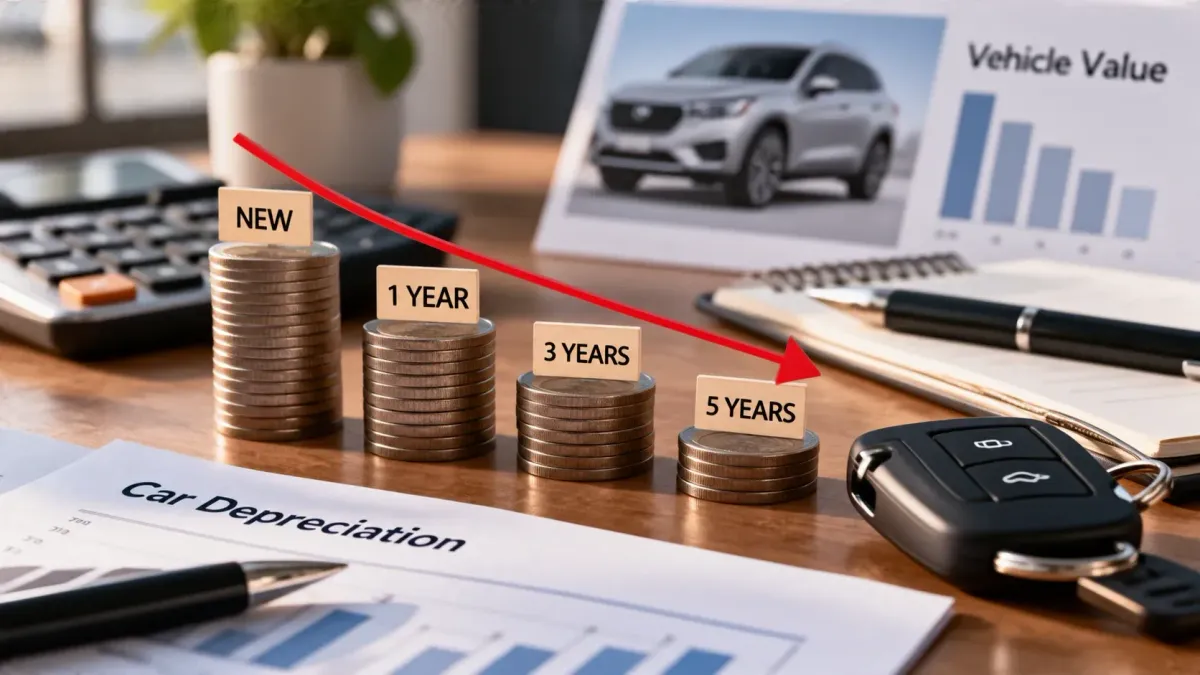
Car depreciation is not evenly spread across ownership. A typical new vehicle can lose about 16% of its original value in the first year and retain only about 45% after five years, making depreciation one of the largest hidden costs of buying new.
This article is general information, not financial advice. Rates, prices and rules change; check the details with a qualified professional or the lender before you decide.
The Short Answer
- A useful benchmark: about 16% of the original value in Year 1, then 12%, 11%, 9% and 7% in Years 2 through 5.
- By Kelley Blue Book's model, an average car keeps about 84% of its value after one year, 61% after three and 45% after five.
- On a $50,000 new car that is roughly $8,000 lost in Year 1 and $27,500 after five years.
- Model, mileage, condition and demand can move the result by thousands of dollars.
In this article
- How Much Does a Car Depreciate Per Year? The 2026 Breakdown
- What Car Depreciation Looks Like on a $50,000 Vehicle
- How Much Does a Car Depreciate After One Year?
- How Much Does a Car Depreciate After Three Years?
- How Much Does a Car Depreciate After Five Years?
- Why Cars Depreciate Fastest in the First Few Years
- How Is Car Depreciation Calculated?
- Car Depreciation Per Year Is Not the Same for Every Vehicle
- Do Trucks Depreciate Less Than Cars?
- Do Hybrids Depreciate Faster or Slower?
- Do Electric Cars Depreciate Faster?
- New vs. Used: Who Takes the Bigger Depreciation Hit?
- What Makes a Car Depreciate Faster?
- Can You Reduce Car Depreciation?
- When Does Car Depreciation Start to Slow Down?
- Why Depreciation Matters Even if You Never Plan to Sell Soon
- The Bottom Line
How much does a car depreciate per year? A useful 2026 benchmark is about 16% of the original value in Year 1, another 12% in Year 2, 11% in Year 3, 9% in Year 4 and 7% in Year 5. Kelley Blue Book's current depreciation model leaves an average vehicle with roughly 45% of its original value after five years.
That does not mean every vehicle loses exactly the same percentage each year. Trucks, hybrids, EVs, luxury cars and high-demand models can follow dramatically different depreciation curves, while mileage, condition, incentives and the used-car market can move resale values up or down. Car depreciation is fastest early in ownership, then usually slows in dollar terms as the vehicle itself becomes less valuable.
The cost is also much larger than many owners realize because depreciation never arrives as a monthly bill. AAA's 2026 Your Driving Costs analysis found that depreciation remained the largest single vehicle ownership cost, averaging $4,422 per year across the vehicles in its five-year, 75,000-mile study.
How Much Does a Car Depreciate Per Year? The 2026 Breakdown
Car depreciation per year is best understood as a curve rather than a fixed annual percentage. The first owner generally absorbs the largest dollar losses because the vehicle begins with its highest value, while depreciation tends to moderate as the vehicle ages. Kelley Blue Book's current calculator provides a useful general model for the first five years.
Vehicle age | Approx. value lost during year | Approx. value remaining |
|---|---|---|
New | – | 100% |
After 1 year | 16% | 84% |
After 2 years | 12% | 72% |
After 3 years | 11% | 61% |
After 4 years | 9% | 52% |
After 5 years | 7% | 45% |
These percentages are measured against the vehicle's original value in KBB's simplified model, which is why the residual-value column declines from 100% to 45% over five years. They should be treated as planning benchmarks rather than a guaranteed appraisal for an individual VIN. A specific car can depreciate much faster or retain far more value depending on model, market conditions and how it has been used.
The overall result is the more important number. Kelley Blue Book projects that an average 2026 model-year vehicle will retain approximately 45% of its original MSRP after five years, meaning roughly 55% of the original value can disappear during that period.
What Car Depreciation Looks Like on a $50,000 Vehicle
Percentages become much easier to understand when converted into dollars. Consider a new vehicle with an original value of $50,000 and apply Kelley Blue Book's general five-year depreciation curve. This is an illustrative calculation rather than a prediction for a specific $50,000 model.
Year | Approx. value | Loss during that year | Cumulative loss |
|---|---|---|---|
New | $50,000 | – | – |
After Year 1 | $42,000 | $8,000 | $8,000 |
After Year 2 | $36,000 | $6,000 | $14,000 |
After Year 3 | $30,500 | $5,500 | $19,500 |
After Year 4 | $26,000 | $4,500 | $24,000 |
After Year 5 | $22,500 | $3,500 | $27,500 |
A $50,000 vehicle following this generic pattern loses approximately $19,500 in its first three years and about $27,500 after five. That means the owner's depreciation cost can exceed fuel, routine maintenance or many other highly visible ownership expenses. Kelley Blue Book uses the same $50,000 example when explaining that an average 2026 vehicle may be worth only about $22,500 after five years.
The curve also explains why buying a relatively young used car can sometimes be financially attractive. Someone buying the example vehicle around Year 3 is purchasing an asset already valued around $30,500 rather than absorbing the entire decline from $50,000. The second owner can still lose money to depreciation, but fewer original-value dollars remain available to lose.
How Much Does a Car Depreciate After One Year?
A new vehicle can lose about 16% of its original value during the first year under Kelley Blue Book's current generic depreciation model. On a $30,000 vehicle, that represents approximately $4,800; on a $50,000 vehicle, about $8,000; and on a $70,000 vehicle, roughly $11,200.
The first-year loss is important because a nearly new vehicle can still look, drive and function almost exactly like a new one while already being worth materially less in the resale market. Part of that difference reflects the transition from a new vehicle to a used one, but actual resale value also depends on supply, incentives and demand for that particular model. A heavily discounted new vehicle can put additional pressure on the value of nearly new examples because used buyers compare them with what a brand-new replacement currently costs.
This is also one reason negative equity can develop early in an auto loan. If the loan balance declines more slowly than the vehicle's market value, the borrower can temporarily owe more than the car would bring in a sale or trade. A meaningful down payment can reduce that risk because the loan starts below the full purchase price.
How Much Does a Car Depreciate After Three Years?
Using KBB's current model, an average vehicle has approximately 61% of its original value remaining after three years. That translates into a cumulative depreciation loss of about 39%, meaning the hypothetical $50,000 vehicle would be worth around $30,500.
Three years is an important point for both new- and used-car shoppers. The original owner has already absorbed a substantial portion of early depreciation, yet a three-year-old vehicle can still have modern safety technology, relatively moderate mileage and, depending on the manufacturer and mileage, some original warranty coverage. Those factors help explain why late-model used cars can command much stronger values than older used inventory.
However, three years does not automatically represent the lowest-cost buying point. High-demand vehicles can retain unusually strong values, leaving only a small price difference between new and three-year-old examples. The amount a car depreciates per year matters only when the used price is compared with the actual price available on a new version.
How Much Does a Car Depreciate After Five Years?
An average 2026 model-year vehicle is projected by Kelley Blue Book to retain approximately 45% of its original value after five years. That represents about 55% depreciation from the original price, which would reduce a $30,000 vehicle to around $13,500 and a $50,000 vehicle to around $22,500 under the same broad assumption.
Five-year resale values vary enormously by model. KBB's 2026 Best Resale Value winners are projected to retain approximately 55% or more of their original MSRP after five years, compared with roughly 45% for the average vehicle. Toyota's 2026 lineup, for example, received the highest mainstream brand award with an average projected resale value of 53%, while Lexus led luxury brands at 47%.
That difference becomes meaningful on an expensive vehicle. A $50,000 car retaining 55% would still be worth roughly $27,500 after five years, compared with around $22,500 at 45% retention. Ten percentage points of resale value equal $5,000 on a $50,000 purchase.
Why Cars Depreciate Fastest in the First Few Years
Cars usually depreciate fastest early because a brand-new vehicle carries advantages that disappear as soon as it becomes used. The buyer gets the newest model year, full warranty period, untouched condition and the ability to choose a precise trim, color and configuration. The used market generally does not value those benefits at their full original cost once another owner has already taken possession.
New-car pricing also affects used-car depreciation. If manufacturers introduce large incentives or price cuts, a lightly used example must compete with a cheaper new vehicle, which can force its resale price downward. Conversely, limited new-car inventory or unusually strong demand can support used values and temporarily slow depreciation.
Mileage then compounds the effect over time. A vehicle approaching five years with 75,000 miles has a different resale profile from the same model with 30,000 miles, even if both have identical maintenance histories. Car depreciation per year reflects age, but resale value ultimately reflects the entire vehicle.
How Is Car Depreciation Calculated?
At its simplest, car depreciation is the difference between what the vehicle originally cost and what it is worth later. If a car was purchased for $40,000 and its current market value is $28,000, it has lost $12,000, or 30% of the original value. The calculation becomes more complicated when buyers want to forecast future depreciation because resale value depends on a market that has not happened yet.
A basic formula looks like this:
Depreciation percentage = (Original value – Current value) ÷ Original value × 100
Suppose a $40,000 vehicle is worth $24,000 after several years. It has lost $16,000, which equals 40% depreciation, and retains 60% of its original value. The same calculation can be used with an actual purchase price, MSRP or historical transaction value, but those starting points can produce different answers.
Professional residual-value forecasts are much more sophisticated. Kelley Blue Book says its residual values use statistical models built on millions of transactions along with analyst review, supply and demand, market conditions and other vehicle-specific factors.
Car Depreciation Per Year Is Not the Same for Every Vehicle
A single 16%-12%-11%-9%-7% curve is useful for planning, but actual depreciation differs dramatically by vehicle type. Resale demand, reliability reputation, production volume, original pricing and powertrain all influence how rapidly a vehicle loses value. That means buyers comparing two $50,000 vehicles can face very different five-year ownership costs even when both have the same purchase price.
A 2026 iSeeCars analysis of more than 950,000 five-year-old vehicles found an average observed five-year depreciation rate of 41.8% among the vehicles in its study. Trucks depreciated 34.2%, hybrids 35.4%, SUVs 44.9% and EVs 57.2%.
Those numbers should not be mixed directly with KBB's 45% projected five-year residual value as though they measure exactly the same thing. KBB is projecting future values for 2026 model-year vehicles under its residual-value methodology, while iSeeCars analyzed actual five-year-old vehicles sold from March 2025 through February 2026. Different data sets can produce different averages, but both show the same core fact: vehicle choice has a major effect on depreciation.
Do Trucks Depreciate Less Than Cars?
Many trucks currently retain value well, although that should not be treated as a permanent rule for every pickup. The 2026 iSeeCars study found 34.2% average five-year depreciation for trucks, which was substantially lower than the study's 41.8% overall vehicle average.
Strong demand, utility and a large U.S. buyer base help certain trucks maintain resale values. Kelley Blue Book's 2026 Best Resale Value list also includes the Ford Maverick, Ford Ranger, Toyota Tacoma and Toyota Tundra among its top 10 vehicles for projected five-year resale performance.
However, purchase price still matters. A vehicle can retain a strong percentage of its value while losing a large number of dollars if its original price was high. Always look at both percentage depreciation and actual dollar loss.
Do Hybrids Depreciate Faster or Slower?
Current data are favorable for many hybrids. iSeeCars found that hybrids in its 2026 study lost an average of 35.4% over five years, meaning they retained considerably more value than the overall vehicle average in that analysis.
Demand is an important part of that story. Hybrids can appeal to buyers who want better fuel efficiency without relying entirely on charging infrastructure, which can support used-market demand. Toyota models were particularly prominent among the strongest-retaining hybrids in the study, while Kelley Blue Book named the Toyota Prius its 2026 Best Resale Value winner in the hybrid category.
That does not guarantee strong depreciation performance for every hybrid. Battery condition, model reputation, original pricing and future fuel prices can all influence resale values. Powertrain is one factor in car depreciation per year, not a substitute for researching the exact model.
Do Electric Cars Depreciate Faster?
EV depreciation remains substantially higher than the broader market in current data. iSeeCars found an average 57.2% five-year depreciation rate for EVs in its 2026 analysis, compared with 41.8% for all vehicles in the same study.
AAA's 2026 ownership-cost analysis found a similar financial pressure in some categories. Medium-size EV sedans in its study experienced roughly twice the depreciation of comparable gas-powered models, contributing to annual ownership costs that were 29.1% higher in that category despite much lower charging costs.
There are several reasons EV values can behave differently, including fast technology development, new-vehicle price changes, incentives, charging and range expectations, and used-buyer perceptions of battery life. Individual EVs still vary considerably, so the segment average should not be used to predict the resale value of one model. For an EV shopper, expected depreciation deserves as much attention as fuel or charging savings.
New vs. Used: Who Takes the Bigger Depreciation Hit?
The first owner usually absorbs the largest dollar depreciation because the vehicle begins at its highest value. In KBB's generic curve, a $50,000 new car loses about $8,000 in the first year alone and roughly $19,500 during the first three years. A buyer entering at Year 3 starts with a much lower vehicle value and therefore has fewer dollars exposed to subsequent depreciation.
This does not mean used is always cheaper overall. Used-car financing can carry higher APRs, older vehicles can need more repairs and some high-demand late-model cars depreciate so slowly that their prices remain close to new ones. The depreciation advantage has to be considered alongside financing, warranty, maintenance and insurance.
The largest depreciation savings generally appear when a used vehicle has already passed through part of its steep early decline but still has substantial useful life remaining. That is one reason three- to five-year-old cars can be attractive, provided the actual used price reflects the depreciation that has already occurred.
What Makes a Car Depreciate Faster?
Some factors are outside the owner's control, while others can be managed. New-vehicle price cuts, changing consumer demand and the arrival of a redesigned model can weaken resale value regardless of how carefully the current car has been maintained. Vehicle-specific problems such as poor reliability or weak market demand can have an equally large effect.
Several factors commonly increase car depreciation:
- Weak resale demand. A vehicle that few used buyers want generally requires a lower price to sell.
- High mileage. More miles usually reduce market value, particularly when mileage is unusually high for the vehicle's age.
- Accidents and title problems. Structural damage, salvage history and other title brands can materially reduce resale value.
- Poor condition. Body damage, worn interiors, neglected maintenance and mechanical problems reduce what buyers will pay.
- Heavy new-car incentives. Large discounts on new examples can push comparable used values lower.
- Rapid technology changes. This can be particularly important in technology-heavy segments such as EVs.
- Expensive ownership reputation. Models known for costly maintenance, poor reliability or high repair costs can face weaker used demand.
- Unusual modifications. Highly personalized vehicles appeal to a smaller resale audience.
These factors often interact. A high-mileage version of a model with strong reliability can still command good money, while a low-mileage luxury vehicle with weak resale demand can depreciate rapidly. How much a car depreciates per year ultimately depends on what the next buyer is willing to pay for that exact vehicle.
Can You Reduce Car Depreciation?
Depreciation cannot be eliminated, but buyers can reduce their exposure to it. The biggest decision is made before purchase because choosing a model with strong historical and projected resale value can save thousands of dollars later. Keeping a vehicle longer can also spread the steep early depreciation across more years of ownership rather than restarting the process with another new vehicle every two or three years.
Practical ways to limit depreciation include:
- Choose a Model With Strong Resale Demand. Compare projected residual values before buying.
- Avoid Overpaying Initially. Depreciation hurts more when the starting purchase price is unnecessarily high.
- Maintain the Vehicle Properly. Keep service records and follow the manufacturer's maintenance schedule.
- Keep Mileage Reasonable. Excessive mileage relative to vehicle age generally reduces resale value.
- Repair Significant Damage Properly. Poor body repairs and neglected cosmetic damage can hurt trade-in offers.
- Avoid Extreme Modifications. Changes that appeal to one owner may reduce the pool of future buyers.
- Keep the Car Longer. Once the steepest depreciation years have passed, replacing the vehicle simply restarts the early-loss cycle.
There is still no guarantee that a carefully maintained car will retain a certain percentage. Market conditions can move quickly, and manufacturer pricing decisions can change used values across an entire model line. The goal is not to stop depreciation but to avoid taking more of it than necessary.
When Does Car Depreciation Start to Slow Down?
Car depreciation generally slows after the first several years because there is less value left to lose. KBB's generic curve falls from a 16-percentage-point loss in Year 1 to 12 points in Year 2, 11 in Year 3, 9 in Year 4 and 7 in Year 5.
Beyond five years, the pattern becomes less predictable because condition, mileage, reliability and local demand increasingly distinguish one vehicle from another. A well-maintained eight-year-old Toyota truck and an eight-year-old luxury sedan can have completely different resale trajectories even if their original prices were similar. Age alone becomes less useful as a forecast.
The annual dollar loss can also become much smaller. Losing 10% of a $50,000 vehicle represents $5,000, while losing 10% of a $15,000 vehicle represents only $1,500. This is why keeping a reliable older vehicle can produce relatively inexpensive years of ownership even when its resale value continues declining.
Why Depreciation Matters Even if You Never Plan to Sell Soon
Depreciation can feel theoretical when an owner expects to keep a vehicle for many years, but it still affects the financial position tied to the car. A rapidly depreciating vehicle is more likely to become worth less than the outstanding loan balance, particularly when purchased with little money down or financed for a long term. That can become important after an accident, unexpected sale or early trade-in.
Depreciation also changes the true cost of comparing vehicles. A $45,000 model that retains 60% of its value after five years can cost less in depreciation than a $40,000 model that retains only 40%, even though the second vehicle was cheaper to buy. Purchase price alone does not show the complete ownership cost.
AAA's 2026 analysis reinforces that point by identifying depreciation as the largest single ownership expense, with a weighted average of $4,422 per year in its study. Resale value is therefore not merely a concern for sellers – it is part of what the car costs from the day it is purchased.
The Bottom Line
How much does a car depreciate per year? A useful 2026 benchmark is roughly 16% of original value in the first year, followed by 12%, 11%, 9% and 7% in Years 2 through 5. Under Kelley Blue Book's general model, an average vehicle retains about 84% after one year, 61% after three years and only 45% after five.
For a $50,000 new vehicle, that generic curve translates into roughly $8,000 lost in Year 1, $19,500 lost after three years and $27,500 lost after five years. Those numbers explain why depreciation can be more expensive than many of the ownership costs drivers monitor much more closely. AAA's 2026 analysis confirms that depreciation remains the single largest vehicle ownership cost in its methodology.
The average is only the beginning of the decision. Current data show trucks and hybrids retaining considerably more value than average in some studies, while EVs continue to experience much steeper five-year depreciation as a segment. Model choice, mileage, condition, reliability and market demand can therefore change the result by thousands or even tens of thousands of dollars.
The most important lesson is that car depreciation per year is front-loaded. Buying new gives the first owner the newest vehicle and full new-car benefits, but it also exposes that owner to the steepest early value loss. Buyers who understand what happens after one, three and five years can compare new and used vehicles on the cost that never appears on the monthly payment – how much of the purchase price will still be there when it is time to sell.
Frequently asked questions
How much does a car depreciate per year?
There is no fixed annual rate, but Kelley Blue Book's current general model estimates losses of about 16% of original value in Year 1, 12% in Year 2, 11% in Year 3, 9% in Year 4 and 7% in Year 5. The average 2026 model-year vehicle is projected to retain around 45% of its original value after five years. Actual depreciation varies substantially by model, mileage and market conditions.
How much does a new car depreciate in the first year?
A useful current benchmark is approximately 16% of the original value during the first year. That would represent about $4,800 on a $30,000 vehicle, $8,000 on a $50,000 vehicle and $11,200 on a $70,000 vehicle. Individual models can perform materially better or worse than the average.
How much does a car depreciate after three years?
Kelley Blue Book's general depreciation curve leaves approximately 61% of original value after three years, which corresponds to a cumulative loss of about 39%. A $50,000 vehicle following that model would therefore be worth approximately $30,500. The actual result depends on model, mileage, condition and the used-car market.
How much does a car depreciate after five years?
Kelley Blue Book projects that the average 2026 model-year vehicle will retain about 45% of its original value after five years, meaning approximately 55% will be lost to depreciation. A $50,000 vehicle would therefore be worth roughly $22,500 under that broad assumption. KBB's strongest resale-value models are projected to retain around 55% or more.
How much value does a $30,000 car lose after five years?
Using KBB's average 45% residual-value projection, a $30,000 vehicle would be worth roughly $13,500 after five years, representing about $16,500 in depreciation. That is an illustrative average rather than a guaranteed resale value. A strong-resale model could be worth considerably more, while a fast-depreciating model could be worth less.
Do used cars depreciate slower than new cars?
They generally lose fewer dollars per year because the vehicle is already worth less and the steepest early depreciation has usually occurred. Used cars still depreciate, and some models can fall rapidly if market demand changes or mechanical problems emerge. Buying used reduces exposure to early depreciation but does not eliminate depreciation itself.
Which vehicles depreciate the least?
Current 2026 data show particularly strong value retention among certain trucks and hybrids. iSeeCars found average five-year depreciation of 34.2% for trucks and 35.4% for hybrids, compared with 41.8% across all vehicles in its study. Kelley Blue Book's 2026 top resale-value list includes models such as the Toyota Tacoma, Toyota Tundra, Ford Maverick and Toyota 4Runner.
Do electric cars depreciate faster?
On average, current data say yes. iSeeCars found 57.2% average five-year depreciation for EVs in its 2026 analysis, substantially above its 41.8% overall vehicle average. Individual electric vehicles vary, so buyers should research the specific model rather than applying the segment average to every EV.
Is depreciation a bigger cost than maintenance?
For many new-car owners, yes. AAA's 2026 analysis identified depreciation as the largest single ownership expense, averaging $4,422 per year across the vehicles and mileage assumptions in its study. Maintenance remains important, but it is usually far more visible because owners receive repair and service bills directly.
Sources
- Kelley Blue Book, Car Depreciation Calculator
- AAA, Your Driving Costs
Spotted an error? Tell our editors. Read our corrections policy.