How Much Should You Put Down on a Car? The 2026 Numbers
A 20% down payment is still a useful target for a new car and 10% for a used one, but buyers are putting down less in 2026. Here’s how to choose the right amount without draining your savings or starting the loan underwater.
This article is general information, not financial advice. Rates, prices and rules change; check the details with a qualified professional or the lender before you decide.
The Short Answer
- Start with about 20% down on a new car and at least 10% on a used car. These are guidelines, not lender requirements.
- On a $30,000 vehicle that means $6,000 down for new and $3,000 for used.
- Q3 buyers put down an average of $5,554 on new vehicles and $3,865 on used ones.
- Put down enough to keep the loan manageable, but not so much that it drains your emergency savings.
In this article
- How Much Down Payment on a Car Is Recommended?
- What 10% and 20% Down Actually Mean in Dollars
- How a Bigger Down Payment Changes Your Monthly Payment
- How Much Down Payment on a $20,000 Car?
- How Much Down Payment on a $30,000 Car?
- How Much Down Payment on a $40,000 Car?
- Is 10% Down on a Car Enough?
- Is 20% Down on a Car Better?
- When More Than 20% Down Can Make Sense
- When a Smaller Down Payment Can Make Sense
- Is Zero Down on a Car a Bad Idea?
- Your Trade-In Can Count Toward the Down Payment
- A Bigger Down Payment Helps Prevent Negative Equity
- Does a Bigger Car Down Payment Help With Bad Credit?
- Do Not Drain Your Emergency Fund for a Car Down Payment
- How to Decide Exactly How Much Down Payment on a Car to Make
- How Much Are Buyers Actually Putting Down in 2026?
- The Bottom Line
How much down payment on a car is enough in 2026? A practical starting point is around 20% for a new vehicle and at least 10% for a used vehicle, but those percentages are guidelines rather than requirements. The right car down payment is the amount that keeps the loan manageable, limits the risk of negative equity, and still leaves enough cash for emergencies and the other costs of owning the vehicle.
The current market makes that decision particularly important. Edmunds reported that buyers financing new vehicles put down an average of $5,554 in Q3 2026, while financed used-vehicle purchases averaged $3,865 down. At the same time, average amounts financed reached $44,664 for new vehicles and $30,703 for used vehicles, showing that buyers are borrowing substantial amounts even after making a down payment.
A larger down payment on a car immediately reduces the amount that has to be financed. The Consumer Financial Protection Bureau also notes that increasing a down payment lowers the loan-to-value ratio and may reduce both total borrowing costs and, depending on the lender, the interest rate offered.
How Much Down Payment on a Car Is Recommended?
For many buyers, 20% down on a new car and 10% down on a used car remain useful starting points. Experian uses those figures as general targets because a larger car down payment reduces the amount borrowed, lowers the monthly payment, and can help prevent the loan balance from getting too far ahead of the vehicle's value.
That does not mean a $40,000 new vehicle automatically requires $8,000 in cash before it can be purchased. Lenders may approve loans with much smaller down payments or even no money down, especially for borrowers with strong credit. The guideline is about creating a healthier loan, not meeting a universal legal or lending requirement.
The type of car matters as well. New vehicles generally face more depreciation early in ownership, so putting more money down can create an equity cushion from the beginning. A used vehicle has already experienced part of that depreciation, which is one reason a smaller percentage may still produce a reasonable loan-to-value ratio.
What 10% and 20% Down Actually Mean in Dollars
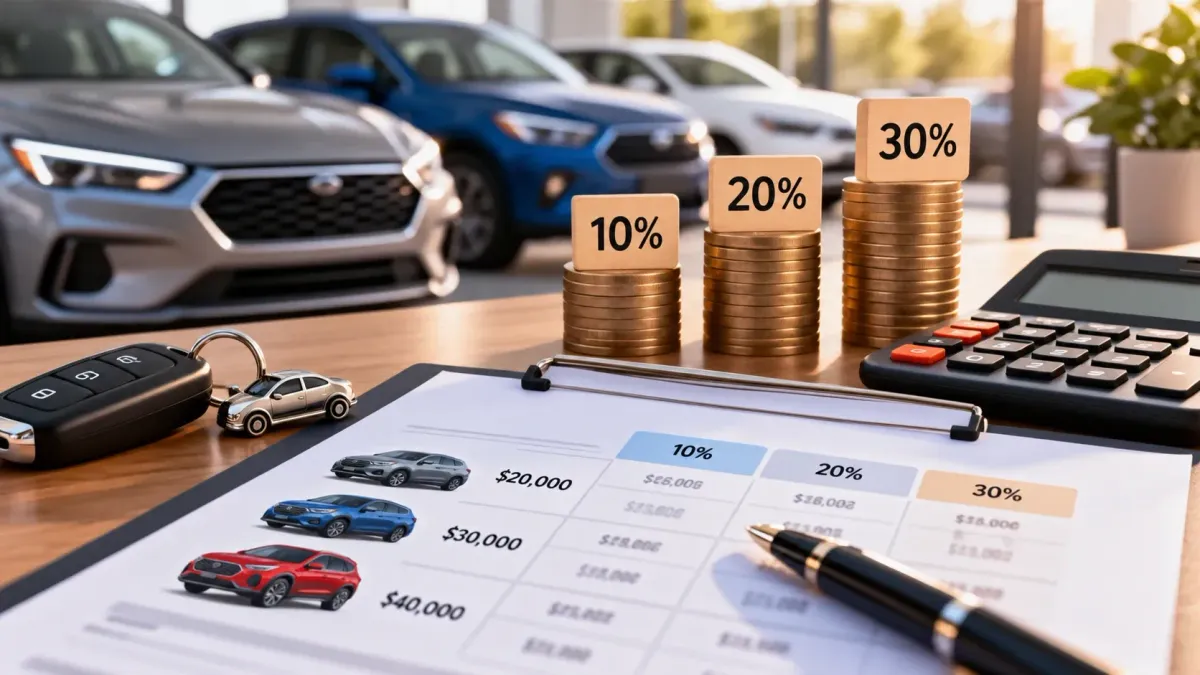
Percentages sound simple until they are converted into cash. A 20% car down payment is only $4,000 on a $20,000 vehicle, but it becomes $8,000 on a $40,000 vehicle and $10,000 on a $50,000 vehicle. That is why the answer to how much down payment on a car makes sense should consider both the percentage and how much money will remain afterward.
Car price | 10% down | 20% down | Amount financed after 20% down* |
|---|---|---|---|
$20,000 | $2,000 | $4,000 | $16,000 |
$25,000 | $2,500 | $5,000 | $20,000 |
$30,000 | $3,000 | $6,000 | $24,000 |
$35,000 | $3,500 | $7,000 | $28,000 |
$40,000 | $4,000 | $8,000 | $32,000 |
$50,000 | $5,000 | $10,000 | $40,000 |
*Before taxes, fees, optional products, trade-in adjustments, and other amounts that may be included in financing.
For someone buying a $30,000 car, the difference between 10% and 20% down is another $3,000 upfront. On a $40,000 vehicle, it is another $4,000. The important question is whether using that extra cash meaningfully improves the loan without leaving the household short of savings.
How a Bigger Down Payment Changes Your Monthly Payment
The easiest way to see what a down payment on a car actually does is to hold the vehicle price, APR, and loan term constant. Consider a hypothetical $30,000 vehicle financed for 60 months at 7% APR, with taxes and fees excluded so the effect of the down payment is easy to see. These figures are calculations rather than market averages.
Down payment | Cash down | Amount financed | Approx. monthly payment | Approx. total interest |
|---|---|---|---|---|
0% | $0 | $30,000 | $594 | $5,642 |
10% | $3,000 | $27,000 | $535 | $5,078 |
20% | $6,000 | $24,000 | $475 | $4,514 |
Putting 20% down instead of nothing cuts the payment by about $119 per month in this example. It also reduces interest by roughly $1,128 over the five-year loan because interest is being charged on $6,000 less principal. The result would change with a different APR or term, but the basic relationship remains the same.
That difference becomes more important when rates are high. Current financing costs are not trivial: Edmunds reported average Q3 2026 APRs of 7.0% on financed new vehicles and 10.6% on used vehicles.
How Much Down Payment on a $20,000 Car?
A 10% down payment on a $20,000 car is $2,000, while 20% is $4,000. For a used vehicle with a fair purchase price and no negative equity being rolled into the loan, $2,000 can be a reasonable starting point if the resulting payment and loan-to-value ratio are comfortable. A larger payment of $4,000 provides more equity and reduces the amount financed to $16,000 before taxes and fees.
A buyer should not automatically reach for $4,000 simply because 20% is available. If that would use most of the household emergency savings, a smaller down payment and less expensive vehicle may produce a safer overall financial position. The car down payment should improve the loan without making the rest of the budget fragile.
The condition of a used $20,000 vehicle matters too. Cash may also be needed shortly after purchase for registration, insurance, tires, maintenance, or repairs. Putting every available dollar into the initial transaction can leave no buffer for those predictable ownership expenses.
How Much Down Payment on a $30,000 Car?
For a $30,000 vehicle, 10% equals $3,000 and 20% equals $6,000. The table above shows how dramatically that difference can affect a five-year loan: at the illustrative 7% APR, moving from zero to $6,000 down reduces a $594 payment to about $475. It also creates more equity from the first day of the loan.
For a new $30,000 vehicle, getting reasonably close to 20% can provide useful protection against early depreciation. For a used vehicle, a 10% down payment may be enough if the car is fairly valued, the loan term is reasonable, and no old debt is being added to the financing. The percentage should support the transaction rather than dictate it.
A trade-in can also supply some or all of that amount. CFPB guidance states that a down payment can consist of cash, the net proceeds from a trade-in, or a combination of both.
How Much Down Payment on a $40,000 Car?
A 10% down payment on a $40,000 car is $4,000, while 20% requires $8,000. At this price level, blindly following a percentage rule can involve a substantial transfer of cash, so the buyer should compare what the additional $4,000 accomplishes against what that money is needed for elsewhere. A stronger equity position is useful, but an empty emergency account is not.
A bigger down payment becomes more attractive when the interest rate is high. Reducing a loan balance by $8,000 saves much more interest at 12% than it does at a promotional 0% or 1.9% APR. The higher the borrowing cost, the more financially valuable each additional dollar of down payment becomes.
The loan term also matters. Current buyers are stretching financing unusually far: Edmunds reported an average 70.5-month term on financed new vehicles in Q3 2026, while 25.5% of new-car buyers financing purchases selected terms of 84 months or longer. A larger down payment can reduce risk on a long loan, but it does not make an unnecessarily expensive vehicle affordable by itself.
Is 10% Down on a Car Enough?
Ten percent can be enough, particularly for a used car with a fair market value and a manageable loan. It immediately reduces the amount financed and the loan-to-value ratio, while preserving more cash than a 20% down payment. For a $30,000 purchase, 10% means bringing $3,000 instead of $6,000.
The weakness of 10% becomes more apparent when a new vehicle is heavily financed over a long term. Vehicles depreciate while loan balances decline gradually, so a relatively small down payment can leave the borrower owing more than the car is worth. The CFPB specifically identifies high loan-to-value ratios as a risk because negative equity can become a problem if the owner needs to sell, trade, or replace a totaled vehicle.
There is therefore no universal answer that 10% is either too little or enough. It is enough when the resulting loan remains affordable and the buyer has a reasonable equity position; it is too little when the transaction starts with excessive debt relative to the vehicle's value.
Is 20% Down on a Car Better?
Twenty percent down is a strong target because it reduces the loan immediately and provides an equity cushion. On a $40,000 car, an $8,000 down payment means borrowing $32,000 before taxes and other financed charges rather than the full $40,000. That difference lowers the monthly payment and the amount of interest that can accumulate.
However, 20% is not automatically better if achieving it requires draining savings. A buyer with $9,000 in liquid savings probably should not assume that putting $8,000 into a depreciating vehicle is required simply because a rule of thumb says 20%. Cash reserves for emergencies, insurance deductibles, repairs, housing costs, and other obligations still have value after the car is purchased.
This is particularly relevant in 2026 because average vehicle financing amounts remain high. Buyers are already putting down thousands of dollars and still financing an average of $44,664 on new vehicles and $30,703 on used vehicles in the latest Q3 data.
When More Than 20% Down Can Make Sense
Putting more than 20% down on a car can be reasonable when the buyer has ample savings and the alternative is borrowing at a high APR. Each additional dollar paid upfront reduces principal, and the CFPB notes that a larger down payment may also help a borrower qualify for more favorable financing terms because it lowers the lender's loan-to-value risk.
A larger car down payment deserves consideration when:
- The available APR is high.
- The vehicle depreciates quickly.
- The proposed loan term is long.
- The lender requires more cash down for approval.
- The buyer wants a significantly lower monthly payment.
- There is ample emergency savings left after the purchase.
- The vehicle will be kept for many years.
- The buyer wants to minimize the chance of negative equity.
Those conditions explain why “more down” can be useful without making it universally correct. A buyer financing at 12% has a much stronger mathematical reason to reduce the loan than someone receiving manufacturer financing at 0%. The cost of the debt should influence the car down payment just as much as the price of the car.
When a Smaller Down Payment Can Make Sense
A smaller down payment can make sense when financing is unusually cheap and keeping cash available is financially important. Manufacturer-backed 0% or low-APR offers can change the calculation because the interest savings created by a larger down payment become much smaller. A household may also need to preserve cash for an emergency fund, moving costs, medical expenses, or another near-term obligation.
That does not make zero or minimal down automatically attractive. A smaller car down payment means borrowing more and can increase the chance that the loan balance exceeds the car's value. Low interest solves the financing-cost problem, but it does not eliminate depreciation.
The buyer should therefore check both sides of the decision. Calculate what an additional $2,000 or $5,000 down actually saves in payment and interest, then compare that benefit with the value of keeping the cash available. That is more useful than following either “put everything down” or “never put money down” as a universal rule.
Is Zero Down on a Car a Bad Idea?
Zero-down financing is not automatically a bad deal, but it creates less room for error. Financing the full vehicle price means a higher monthly payment, more total interest when the APR is above zero, and a higher starting loan-to-value ratio. Taxes, fees, add-ons, or old negative equity can push the amount borrowed above the vehicle's actual value from the beginning.
That risk matters because negative equity is already widespread. Edmunds found that 29.6% of trade-ins used toward new-vehicle purchases in Q2 2026 were underwater, with an average negative-equity amount of $6,884. Buyers carrying that old debt into another loan faced substantially higher monthly payments and borrowing costs.
Zero down is easiest to justify when the APR is exceptionally low, the borrower has strong cash reserves, and the resulting payment fits comfortably within the budget. It becomes much harder to justify when zero down is the only way an expensive vehicle can be made to appear affordable.
Your Trade-In Can Count Toward the Down Payment
A down payment on a car does not have to be entirely cash. The CFPB states that the net value of a trade-in can form part or all of the down payment, which can substantially reduce the amount a buyer has to bring to the dealership.
For example, suppose a trade-in is worth $12,000 and the remaining loan balance is $7,000. That creates $5,000 of positive equity that can effectively be applied toward the next vehicle. A buyer purchasing a $30,000 car would therefore already have the equivalent of more than 16% down before adding any additional cash.
The situation reverses when the trade-in has negative equity. If the car is worth $12,000 but the payoff is $17,000, that $5,000 shortfall does not become a down payment – it is old debt that must be paid or potentially rolled into the new loan. Always calculate trade equity before deciding how much additional cash to put down.
A Bigger Down Payment Helps Prevent Negative Equity
Avoiding negative equity is one of the strongest reasons to make a meaningful down payment on a car. A lender's loan-to-value ratio compares the loan amount with the vehicle's value, and a larger down payment lowers that ratio immediately. The CFPB gives a simple example: borrowing the full $20,000 on a $20,000 car creates a 100% LTV, while putting $5,000 down reduces the loan to $15,000 and the LTV to 75%.
Negative equity is more than an accounting problem. If a borrower needs to trade the car, the shortfall has to be covered somehow, and rolling it into another auto loan increases the new loan balance. If a vehicle is totaled, the difference between the insurance settlement and the loan balance can also create a financial problem depending on the coverage in place.
Current data show how large that problem can become. The average underwater trade-in in Edmunds' Q2 2026 analysis carried nearly $6,900 in negative equity, and buyers rolling that debt into new purchases were projected to pay an average of $16,270 in interest over the resulting loan.
Does a Bigger Car Down Payment Help With Bad Credit?
A larger down payment can strengthen an auto-loan application because it reduces how much the lender is being asked to finance relative to the vehicle's value. The CFPB says lenders consider loan-to-value alongside factors such as credit history, income, and debt-to-income ratio, and a lower LTV reduces lender risk.
That does not mean a large down payment erases poor credit. Credit history remains an important factor in approval and pricing, and a lender can still offer a high APR even when substantial cash is brought to the transaction. The down payment can improve the structure of the loan, but it should not be treated as a substitute for comparing multiple financing offers.
Borrowers with expensive financing should calculate whether waiting, improving credit, purchasing a cheaper vehicle, or putting down more money produces the lowest realistic cost. The right choice depends on how urgently the vehicle is needed and how much cash can be used without creating another financial problem.
Do Not Drain Your Emergency Fund for a Car Down Payment
One of the easiest mistakes is focusing so heavily on reducing the car payment that there is no cash left after the purchase. Cars create expenses immediately: insurance premiums, registration, fuel, tires, maintenance, deductibles, and unexpected repairs do not disappear because the vehicle has a smaller loan. A down payment on a car should therefore come from money that can safely be committed to the purchase.
Suppose a household has $10,000 in accessible savings and is considering putting $8,000 down on a $40,000 vehicle. The resulting $32,000 loan looks better than financing $36,000 or $40,000, but the household would be left with only $2,000 for everything else. Reducing an auto loan is useful, but maintaining a workable cash reserve is usually more important than hitting an arbitrary 20% target.
A cheaper vehicle can solve both problems at once. Instead of choosing between an overly small emergency fund and an overly large loan, lowering the purchase price may allow the buyer to make a healthy down payment while still retaining cash.
How to Decide Exactly How Much Down Payment on a Car to Make
The best car down payment can be calculated before entering the dealership. Start with the amount of cash that can safely be used, then compare several loan scenarios instead of letting the salesperson build the transaction around a desired monthly payment. The objective is to find a combination of purchase price, down payment, APR, and term that works without financial strain.
Use this process:
- Set Aside Emergency Savings First. Decide how much cash cannot be used for the vehicle.
- Find the Real Out-the-Door Price. Include the car, taxes, required fees, and only the optional products actually wanted.
- Calculate Trade-In Equity. Subtract the payoff amount from the trade-in value.
- Run 10%, 20%, and One Higher Down Payment. Compare how each changes the monthly payment and interest.
- Compare Several Loan Offers. A better APR can sometimes matter as much as another few thousand dollars down.
- Check the Loan Term. Do not use an unnecessarily long term simply to offset a small down payment.
- Check Loan-to-Value. Avoid beginning the transaction deeply underwater.
- Choose the Lowest-Cost Option That Preserves Adequate Cash. The largest possible down payment is not always the best one.
This process gives a better answer to how much down payment on a car is appropriate than using one percentage in every situation. It also makes it easier to spot when the real problem is not the down payment but the vehicle price itself. If even a large down payment cannot produce a comfortable loan, the car may simply cost too much for the current budget.
How Much Are Buyers Actually Putting Down in 2026?
Actual buyers are generally putting down less than the traditional 20% guideline on new vehicles. Edmunds' newest Q3 2026 data show an average $5,554 down payment on financed new vehicles, down from $6,021 in Q3 2025. Average used-car down payments fell to $3,865, compared with $3,973 a year earlier.
At the same time, borrowing is moving in the opposite direction. New-car buyers financed a record average of $44,664 in Q3, while the average term reached 70.5 months and the average monthly payment climbed to a record $787. More than one in four financed new-car purchases now use terms of 84 months or longer.
Those numbers do not mean consumers should copy the average. They show why the size of the car down payment matters more in 2026: buyers are putting less cash down while financing more money for longer periods. A household choosing its own down payment should use affordability and total borrowing cost rather than market averages as the target.
The Bottom Line
How much down payment on a car makes sense in 2026? About 20% for a new car and 10% for a used car remain useful starting points, but the best amount is the one that produces a manageable loan without draining emergency savings. On a $20,000 vehicle those benchmarks equal $4,000 and $2,000; on a $30,000 vehicle they equal $6,000 and $3,000; and on a $40,000 vehicle they equal $8,000 and $4,000.
The latest market data make the decision particularly relevant. Q3 buyers put down an average of $5,554 on new vehicles and $3,865 on used vehicles, while average financed amounts climbed to $44,664 and $30,703 respectively. New-car loan terms also reached an average 70.5 months, with 84-month-or-longer financing accounting for a record 25.5% of financed new purchases.
A larger car down payment can lower the monthly payment, reduce interest, improve loan-to-value, and decrease the chance of becoming upside down. But the goal is not to put down the largest amount possible – it is to borrow an amount that makes sense while keeping the rest of the household finances intact. If reaching an affordable payment requires emptying savings or financing the car for seven years, the stronger move may be choosing a less expensive vehicle rather than forcing a larger down payment.
Frequently asked questions
How much down payment on a car is normal?
Current financed purchases averaged $5,554 down on new vehicles and $3,865 on used vehicles in Q3 2026, according to Edmunds. Those are market averages rather than recommended amounts, and they vary significantly with vehicle price, trade equity, credit, and financing structure. A useful planning guideline remains about 20% for a new car and 10% for a used car.
Is $5,000 a good down payment on a car?
It depends on the vehicle price. A $5,000 down payment equals 25% of a $20,000 car, about 16.7% of a $30,000 car, and only 10% of a $50,000 car. The better test is whether $5,000 produces a manageable loan and leaves enough emergency savings after the purchase.
How much should you put down on a $30,000 car?
Ten percent would be $3,000 and 20% would be $6,000. For a new car, getting closer to $6,000 can create a stronger equity position, while $3,000 may be a reasonable starting point for many used-car purchases. The final amount should depend on APR, loan term, trade equity, savings, and the vehicle's actual value.
How much should you put down on a $40,000 car?
A 10% car down payment is $4,000, while 20% is $8,000. Putting $8,000 down reduces the amount financed to $32,000 before taxes, fees, add-ons, or trade adjustments. A buyer should still avoid using the full $8,000 if doing so would leave insufficient emergency savings.
Is 20% down on a car too much?
Not necessarily. Twenty percent can lower the payment, reduce interest, improve loan-to-value, and protect against negative equity, especially on a new vehicle or high-interest loan. It becomes too much when using that cash weakens the rest of the household finances more than the smaller loan improves them.
Can I buy a car with no down payment?
Yes, some borrowers can qualify for zero-down auto financing. That structure requires borrowing more, usually produces a higher monthly payment, and can increase negative-equity risk because the loan begins with little or no equity cushion. A zero-down offer should therefore be judged by APR, term, vehicle value, and total loan cost rather than by the absence of upfront cash alone.
Does a trade-in count as a down payment?
Yes. The CFPB says a down payment can consist of cash, net trade-in proceeds, or both. If the trade-in has an outstanding loan, only the equity remaining after the payoff contributes positively to the next purchase.
Does putting more money down lower the interest rate?
It can, but it is not guaranteed. The CFPB says a larger down payment lowers the loan-to-value ratio and may help reduce the interest rate a lender offers because less money is being borrowed relative to the vehicle's value. Credit profile, income, debt, loan term, and lender pricing still affect the final APR.
Is it better to put money down or pay extra after getting the loan?
Putting money down reduces the balance from the first day, so interest is never charged on that portion of the vehicle price. Paying principal early after purchase can also reduce interest on many loans, but borrowers should first check the contract for how additional payments are applied and whether any prepayment restrictions exist. If the same cash is definitely going toward the loan, applying it upfront generally produces the clearest immediate reduction in loan-to-value and payment.
Sources
- Edmunds, New-Car Financing Records Pile Up in Q3 (Q3 2026 data)
- Experian, Average Car Payment in 2026
- Consumer Financial Protection Bureau, Auto Loans
Spotted an error? Tell our editors. Read our corrections policy.