Car Warranty vs. Service Contract: What Drivers Actually Pay For
A dealer may offer thousands of dollars in added repair protection just as you're finishing your car purchase. But what does it cover that your existing warranty doesn't? Compare the contracts, estimate real costs, and spot the exclusions before signing.
This article is general information, not financial advice. Rates, prices and rules change; check the details with a qualified professional or the lender before you decide.
In this article
- Car Warranty vs. Service Contract: The Main Differences
- Is an Extended Car Warranty Actually a Service Contract?
- What Repairs Are Usually Excluded From Car Service Contracts?
- How Much Does a Car Service Contract Really Cost?
- Is a Vehicle Service Contract Worth It for a Used Car?
- What Should You Check Before Signing a Service Contract?
- Can a Dealer Require an Extended Warranty to Approve Financing?
- Can You Cancel an Extended Car Warranty?
- How to Recognize Car Warranty Scams
- How to Handle a Denied Service Contract Claim
- Frequently Asked Questions About Car Warranties and Service Contracts
- The Bottom Line
The difference between a car warranty vs. service contract is that a warranty generally comes with a vehicle as part of the purchase, while a vehicle service contract is an optional agreement purchased separately to cover certain repairs or services. Both can reduce out-of-pocket repair expenses, but they are not interchangeable, and neither guarantees that every mechanical problem will be covered.
That distinction matters when a dealership offers what it calls an extended warranty. The product may actually be a separately priced service contract administered by a third-party company, with deductibles, exclusions, repair authorization requirements, and cancellation provisions that differ substantially from a manufacturer's warranty.
According to the Federal Trade Commission, an auto service contract is not a warranty under federal warranty law merely because a seller markets it as an extended warranty. The actual agreement determines which repairs qualify, who pays the mechanic, and which expenses remain the vehicle owner's responsibility.
Car Warranty vs. Service Contract: The Main Differences
A car warranty vs. service contract comparison should begin with who provides the protection, whether the owner pays separately, and exactly which repairs qualify. A manufacturer warranty typically covers specified defects for a defined time or mileage, while a service contract provides only the additional obligations described in its written terms.
Feature | Manufacturer warranty | Vehicle service contract |
Purchase cost | Generally included with new vehicle | Separate optional charge |
Provider | Vehicle manufacturer or stated warrantor | Manufacturer, dealer or independent provider |
Coverage | Specified defects and failures | Components and services listed in agreement |
Duration | Time or mileage limit | Contract-specific term and mileage |
Deductible | Depends on warranty | Often applies per claim or visit |
Repairs | Authorized warranty procedures | May require advance approval |
Routine maintenance | Generally excluded unless specifically included | Usually excluded unless plan includes maintenance |
Cancellation | Warranty rights follow applicable terms | Cancellation and refunds governed by contract and law |
Transfer | Often available within original limits | Varies by contract |
The comparison explains why purchasing more coverage does not necessarily mean receiving better protection. A vehicle may already have several years of remaining powertrain warranty, while an expensive service contract covers many of the same components.
What Does a Manufacturer's Car Warranty Cover?
A manufacturer's car warranty generally covers defects in specified materials or workmanship within the warranty period. Coverage commonly includes a limited basic warranty, a longer powertrain warranty, and separate protections for certain components, subject to the vehicle's specific documents.
A basic limited warranty may cover many mechanical and electrical defects, whereas a powertrain warranty focuses on components such as the engine, transmission, and related drivetrain systems. Neither should be assumed to cover every component simply because the car remains under warranty.
The controlling information is the warranty booklet for the exact make, model, model year, and vehicle identification number. Warranty coverage can also depend on the vehicle's original in-service date rather than the date a later owner purchases it.
What Does a Vehicle Service Contract Cover?
A vehicle service contract covers repairs or services specifically included in the agreement, subject to exclusions and claims procedures. Some contracts emphasize expensive mechanical failures, while others include additional electronics, air-conditioning components, towing reimbursement, rental transportation, or roadside assistance.
The wording matters because different plans can provide dramatically different protection. A contract covering named components may exclude anything not expressly listed, while an exclusionary contract generally covers qualifying components except those specifically excluded.
An exclusionary service contract is not the same as unlimited coverage. A provider may still restrict repairs caused by overheating, neglect, preexisting conditions, commercial use, or failures involving excluded parts.
Is an Extended Car Warranty Actually a Service Contract?
An extended car warranty sold separately is commonly a vehicle service contract, even when the sales presentation uses the word warranty. The FTC and Consumer Financial Protection Bureau both distinguish manufacturer warranties from optional repair agreements purchased for an additional price.
However, product labels are not enough to determine the legal arrangement. A manufacturer-backed extended protection plan, an independent administrator's contract, and prepaid maintenance coverage can have different structures and obligations.
Before buying, identify the legal provider responsible for paying claims. The dealership selling the agreement may not be the company administering it, and the insurer or reimbursement guarantor, if any, may be another entity.
Bumper-to-Bumper vs. Powertrain Coverage
A bumper-to-bumper warranty is a broad term for a basic limited warranty, not a promise that everything between the bumpers is protected. Maintenance items, glass, tires, cosmetic damage, and damage resulting from misuse may be excluded or covered separately.
Powertrain coverage is narrower and generally addresses specified engine, transmission, and drivetrain components. It may provide important protection against costly failures without covering air conditioning, infotainment systems, sensors, or many other vehicle systems.
For a car warranty vs. service contract decision, compare the named components rather than marketing labels. A service contract advertised as comprehensive may still provide less useful coverage than a manufacturer warranty already in force.
What Repairs Are Usually Excluded From Car Service Contracts?
A car service contract commonly excludes ordinary wear, routine maintenance, accident damage, and problems attributable to misuse or insufficient maintenance. Exclusions vary, and the contract's definition of a mechanical breakdown can be as important as its coverage list.
The following table illustrates the questions buyers should ask before purchasing protection.
Repair or expense | What to verify |
Engine failure | Covered causes and excluded damage |
Transmission repair | Named components and failure conditions |
Brake pads and tires | Normal wear exclusions |
Oil changes | Whether maintenance coverage is separate |
Air conditioning | Compressor, controls and refrigerant coverage |
Electronics | Specific modules and diagnostic limits |
Battery | Conventional or high-voltage battery restrictions |
Accident damage | Usually handled separately through insurance |
Diagnostic work | Whether testing is paid if claim is denied |
Rental vehicle | Daily reimbursement and maximum duration |
Towing | Distance, dollar limits and authorized providers |
These are categories to investigate, not promises of coverage. If the agreement does not clearly cover a particular failure, buyers should not assume a salesperson's verbal explanation will be enforceable.
Can a Claim Be Denied Because of Maintenance?
A service contract may require owners to follow the vehicle manufacturer's maintenance schedule and retain adequate records. Failure to satisfy relevant contractual obligations can become the basis for a disputed claim, depending on the agreement and circumstances.
Manufacturer warranty rights are different. The FTC explains that a dealer generally cannot void a manufacturer's warranty merely because routine maintenance was performed by an independent repair shop or because aftermarket parts were used.
A particular repair can nevertheless be denied when a defective aftermarket part or improper service causes the covered damage. Keep invoices, maintenance logs, and inspection records to establish what work was performed.
How Much Does a Car Service Contract Really Cost?
The true cost of a car service contract includes its purchase price, financing charges if added to an auto loan, deductibles, uncovered repairs, and limitations on reimbursement. Comparing only the advertised monthly cost can disguise a substantial long-term expense.
For example, suppose a buyer purchases a hypothetical $2,400 service contract and finances it within a 60-month car loan at 8% APR. The added principal produces a monthly payment of approximately $48.66 and total payments of about $2,920, including roughly $520 in interest attributable to the contract.
If the plan also carries a $100 deductible for each qualifying repair visit, the owner may pay substantially more before receiving any reimbursement. The exact cost depends on financing terms and the number of claims.
Car Warranty vs. Service Contract: A Repair Cost Example
Consider a vehicle owner choosing whether to purchase a $2,400 service contract for an older car. Assume the contract has a $100 deductible per repair visit and that the owner pays cash for the agreement.
Scenario | Covered repairs | Contract plus deductible costs | Paying repairs directly |
No covered failure | $0 | $2,400 | $0 |
One covered repair | $1,800 | $2,500 | $1,800 |
Two covered repairs | $4,500 | $2,600 | $4,500 |
In the last scenario, the illustration assumes two covered visits with one $100 deductible each and full payment of otherwise eligible repairs. In practice, exclusions, authorization decisions, reimbursement limits, and component depreciation may change the result.
A service contract is a risk-transfer purchase, not a guaranteed money-saving investment. Buyers are paying for protection against certain potentially expensive events, including the possibility that they never need to make a claim.
Is a Vehicle Service Contract Worth It for a Used Car?
A vehicle service contract may be worth considering for a used car when a major covered repair would severely disrupt the owner's finances, the provider is dependable, and the plan protects components likely to create substantial costs. It becomes less attractive when there is strong existing warranty coverage, the contract excludes common failures, or the owner expects to sell the vehicle soon.
The specific car matters more than a generic statement about used-car reliability. Vehicle age, mileage, maintenance history, known technical problems, and the cost of replacement parts should all influence the decision.
Drivers shopping for a used vehicle can begin with a vehicle history check, then arrange an independent mechanical inspection. Neither a clean report nor a service contract eliminates the need to understand the vehicle's actual condition.
Three Situations Where Extra Coverage May Make Sense
Additional coverage can be useful when vehicle reliability risk and household financial vulnerability are both meaningful. It is also more relevant when the buyer expects to keep the vehicle long enough to benefit from the protection period.
Examples include an expensive used vehicle with complex components, a household that could not readily absorb a large covered repair, or a vehicle with limited remaining manufacturer protection. In each case, the proposed plan still needs to cover the repair category creating the concern.
The financial comparison should account for the possibility of paying less overall by maintaining an emergency repair fund. A contract is not automatically preferable simply because repairs might be expensive.
When Paying for Repairs Yourself May Be Better
Self-funding repairs can be attractive when the vehicle has a strong maintenance history, replacement parts are reasonably priced, and adequate savings are available. The owner retains control over which repairs are performed and does not have to satisfy a separate contract administrator's claims requirements.
However, an emergency fund must actually exist to provide protection. A driver without accessible savings may face financing costs or transportation disruption if a large repair occurs unexpectedly.
The key is to compare the protection being purchased with both probable repair expenses and the consequences of a particularly expensive failure.
What Should You Check Before Signing a Service Contract?
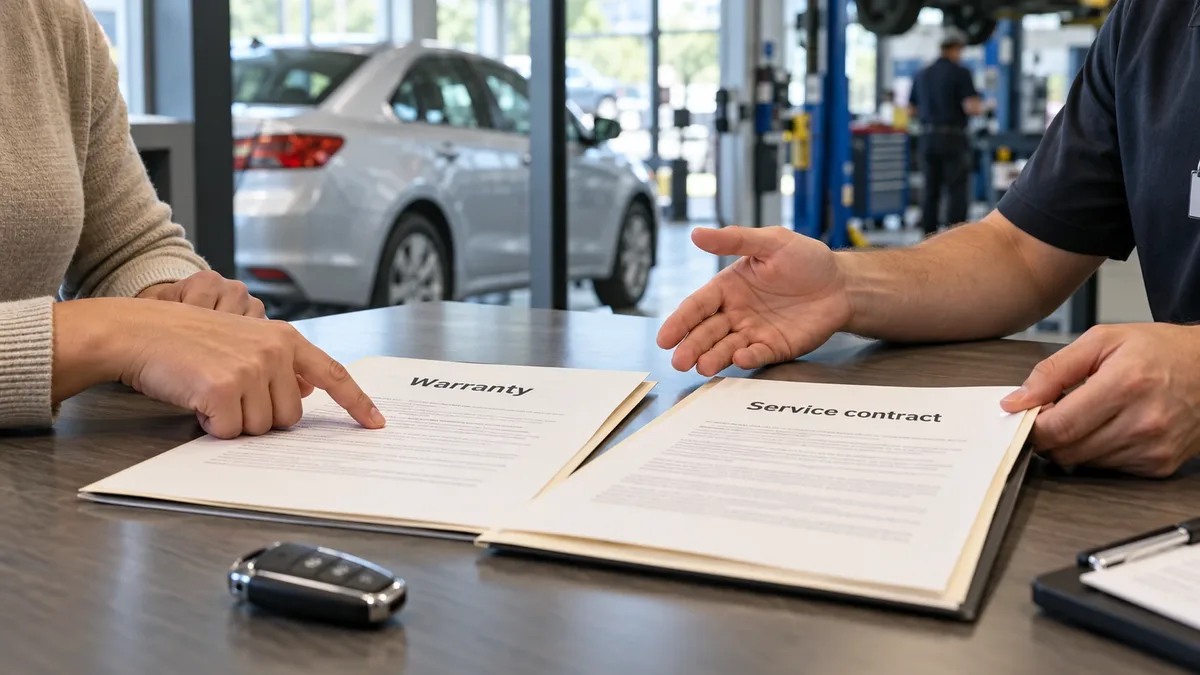
Before signing, obtain the entire service contract and review its coverage, exclusions, payment limits, and administrator obligations. A sales brochure is not a substitute for the agreement that determines whether a claim will be paid.
Use the following checklist during the dealership's final paperwork review.
- Confirm the administrator's identity. Identify which company pays claims and where it is registered.
- Check existing warranties. Determine whether the service contract duplicates protections already included with the vehicle.
- Read all exclusions. Look for preexisting conditions, maintenance-related denials, and excluded components.
- Verify the deductible. Determine whether it applies per repair, per visit, or through another calculation.
- Check repair authorization. Find out whether a mechanic must obtain approval before beginning work.
- Review reimbursement limits. Identify caps on labor, parts, towing, rental cars, and total benefits.
- Confirm cancellation provisions. Understand refund calculations, administrative charges, and applicable state protections.
- Check transfer provisions. Determine whether the contract can transfer when the vehicle is sold.
- Compare cash and financed prices. Include interest if the contract is added to a loan.
- Keep the signed documents. Retain the complete agreement, payment records, and claims contact information.
An unanswered question is a reason to postpone the purchase, not a reason to sign quickly. A reputable seller should be able to explain the contract before payment.
Can a Dealer Require an Extended Warranty to Approve Financing?
A dealership generally should not present an optional service contract as mandatory without a legitimate contractual or legal basis. Buyers should review the final purchase and financing documents carefully because optional add-ons can substantially increase the amount borrowed.
If a seller claims the lender requires a service contract, ask for that requirement in writing and verify it directly with the lender. The CFPB warns consumers to evaluate add-on products separately from their auto loans.
For a clear comparison, use an auto loan calculator to see how financing a protection agreement changes monthly payments and total interest. A modest monthly increase can add up over a long repayment term.
Can You Cancel an Extended Car Warranty?
Optional service contracts can generally be canceled, but the refund amount and cancellation procedure depend on the agreement and applicable law. Refund calculations may account for elapsed time, mileage, administrative fees, or claims already paid.
The CFPB explains that consumers can cancel optional extended warranty or vehicle service contract coverage. Drivers should request written cancellation instructions and retain proof of submission.
If the contract was financed, any refund may be credited to the outstanding auto loan rather than issued directly to the driver. Such a credit can reduce the balance without automatically lowering the scheduled monthly payment.
What Happens When a Car Is Sold or Traded In?
Selling or trading a vehicle may create a right to transfer or cancel a remaining service contract. Some plans allow transfer to a new owner for a fee, while others provide a prorated refund under specified conditions.
Drivers considering a car lease buyout should similarly review whether the original manufacturer's coverage remains active after the purchase. A lease buyout does not automatically create a new full warranty.
Check coverage using the vehicle identification number and original warranty start date rather than assuming a fresh warranty begins upon transfer.
How to Recognize Car Warranty Scams
A car warranty scam may use urgent calls, letters, emails, or texts that falsely imply the recipient's manufacturer warranty is expiring. The purpose is often to sell an expensive service contract or obtain sensitive financial information.
The FTC specifically warns about notices that impersonate manufacturers or dealerships, use alarming language, and pressure people to pay before seeing complete contract terms. These offers should not be treated as official simply because they mention a vehicle's make or model.
Contact the manufacturer or dealer through an independently verified phone number if an expiration warning seems credible. Avoid giving payment information to an unsolicited caller who refuses to provide a complete written agreement.
How to Handle a Denied Service Contract Claim
A denied service contract claim should be reviewed against the specific contractual reason for denial. The most useful first step is to request the decision and relevant contract provision in writing rather than relying on a phone conversation.
Collect the repair estimate, diagnostic report, maintenance history, contract documents, and correspondence with the administrator. Ask whether the decision can be reconsidered and whether additional technical evidence would change the evaluation.
If the dispute remains unresolved, contact the appropriate state consumer protection agency or service-contract regulator. State oversight differs, and the FTC accepts consumer fraud reports at ReportFraud.ftc.gov.
Frequently Asked Questions About Car Warranties and Service Contracts
Is a vehicle service contract the same as an extended warranty?
A vehicle service contract is commonly marketed as an extended warranty, but it is generally a separate, optional contract rather than the original manufacturer's warranty. Coverage and claims rights are determined by its terms. The distinction matters when comparing consumer protections and cancellation provisions.
Does a car service contract cover engine failure?
Some car service contracts cover qualifying engine failures, but exclusions and limitations may apply. Maintenance-related damage, preexisting conditions, or certain components may not qualify. The specific agreement controls the decision.
Are tires and brakes covered?
Ordinary tire and brake-pad wear is generally excluded from conventional repair contracts. Certain component failures or separate maintenance packages may receive different treatment. Buyers should confirm the coverage of each item in writing.
Can you buy a service contract after purchasing a car?
Many providers sell vehicle service contracts after the original purchase, subject to eligibility restrictions. Coverage pricing may change with the vehicle's age and mileage. Waiting periods or inspections may also apply.
Does using an independent mechanic void the manufacturer's warranty?
Routine work performed by an independent mechanic does not automatically void a manufacturer's warranty. However, damage caused by defective parts or improper repairs may be excluded from a particular warranty claim. Maintenance records are important supporting documentation.
Is a car service contract refundable?
Many service contracts provide cancellation and refund provisions, with additional rights potentially established by state law. The refund may depend on elapsed time, mileage, claims, and contractual fees. Always request the calculation in writing.
Is a car warranty vs. service contract comparison different for electric vehicles?
The basic distinction remains the same, but covered components and repair costs can differ. Battery coverage, electric drive units, power electronics, and software-related restrictions deserve particular attention. Manufacturer battery warranties should be reviewed before purchasing overlapping protection.
Should you buy an extended warranty at the dealership?
A dealership can be one source of service contract coverage, but the decision should not be rushed. Obtain the contract, compare providers, and calculate the financed cost if applicable. A lower-pressure comparison can prevent expensive overlapping protection.
The Bottom Line
A car warranty vs. service contract decision is ultimately about the protections already included with the vehicle and the additional risk a driver wants to transfer. A manufacturer warranty generally provides included defect coverage, while a separately purchased service contract promises only the qualifying services defined in the agreement.
The strongest purchase decision comes from comparing actual coverage, total cost, deductibles, claims rules, and likely ownership period. Extra protection is valuable only when its terms address meaningful repair risks at a price the owner can justify.
Spotted an error? Tell our editors. Read our corrections policy.