How to Check Used Car History Before You Buy: What a Clean Report Can Miss
A used car can look spotless and still have a complicated past. Before paying, use the VIN to check title brands, odometer records, total-loss history, theft reports and recalls – then compare the paperwork with the actual car.
This article is general information, not financial advice. Rates, prices and rules change; check the details with a qualified professional or the lender before you decide.
The Short Answer
- Start with the VIN, then review NMVTIS title and brand records and check the mileage history.
- Look for total-loss or salvage history, search NHTSA for open recalls, and use NICB's theft and salvage data.
- No database sees everything: damage can go unreported and a clean title says nothing about today's condition.
- Pair the history check with an independent inspection, as the DOJ and FTC recommend.
In this article
- How to Check Used Car History: Start With the VIN
- 1. Check the Official NMVTIS Title and Brand History
- 2. Read the Odometer Timeline, Not Just the Current Mileage
- 3. Check Whether the Car Was Salvaged, Flooded, or a Total Loss
- 4. Check for Open Safety Recalls Separately
- 5. Look at Accidents and Damage – but Understand the Limits
- 6. Use Service Records to Find Patterns and Gaps
- 7. Compare the Report With the Actual Car and an Independent Inspection
- What a Vehicle History Report Can – and Cannot – Tell You
- Red Flags When You Check Used Car History
- How to Check Used Car History for Free
- The Bottom Line
A used car can look perfect in photos, drive well for 20 minutes, and still carry a history that changes what it is worth. Knowing how to check used car history can uncover a salvage or flood brand, suspicious mileage, a previous total loss, an unrepaired safety recall, or a pattern in the records that deserves a closer inspection. The important part is not simply buying one commercial report and looking for a green checkmark.
For U.S. buyers, the strongest history check uses several sources because no single database tells the complete story. The Federal Trade Commission recommends getting a vehicle history report before buying, but it also makes clear that a history report does not replace an independent mechanical inspection. A report may show past accidents or flood damage while missing current mechanical problems or events that were never reported to its data sources.
The process starts with the vehicle identification number, or VIN. From there, buyers can check federal title data through the National Motor Vehicle Title Information System, open recalls through NHTSA, and certain theft, salvage, and flood records through the National Insurance Crime Bureau. A clean result from one source should be treated as one piece of evidence, not proof that the car has a perfect history.
How to Check Used Car History: Start With the VIN
The first step in how to check used car history is making sure the VIN belongs to the vehicle in front of you. Modern passenger vehicles use a 17-character VIN, and buyers should compare the number shown through the lower windshield with the VIN on the title, registration, dealer paperwork, and any history report. NHTSA also uses the VIN to identify vehicle-specific unrepaired recalls.
A mismatch should stop the transaction until it is explained. Even a simple paperwork error can create title and registration problems later, while a deliberately altered or substituted VIN raises much more serious concerns. Never run the history report from a VIN supplied in an advertisement without also checking that number on the actual car.
Once the VIN matches, use it consistently across every history source. That makes it easier to compare dates, mileage, title status, insurance records, and recall information without accidentally researching a similar vehicle instead of the exact one being purchased.
1. Check the Official NMVTIS Title and Brand History
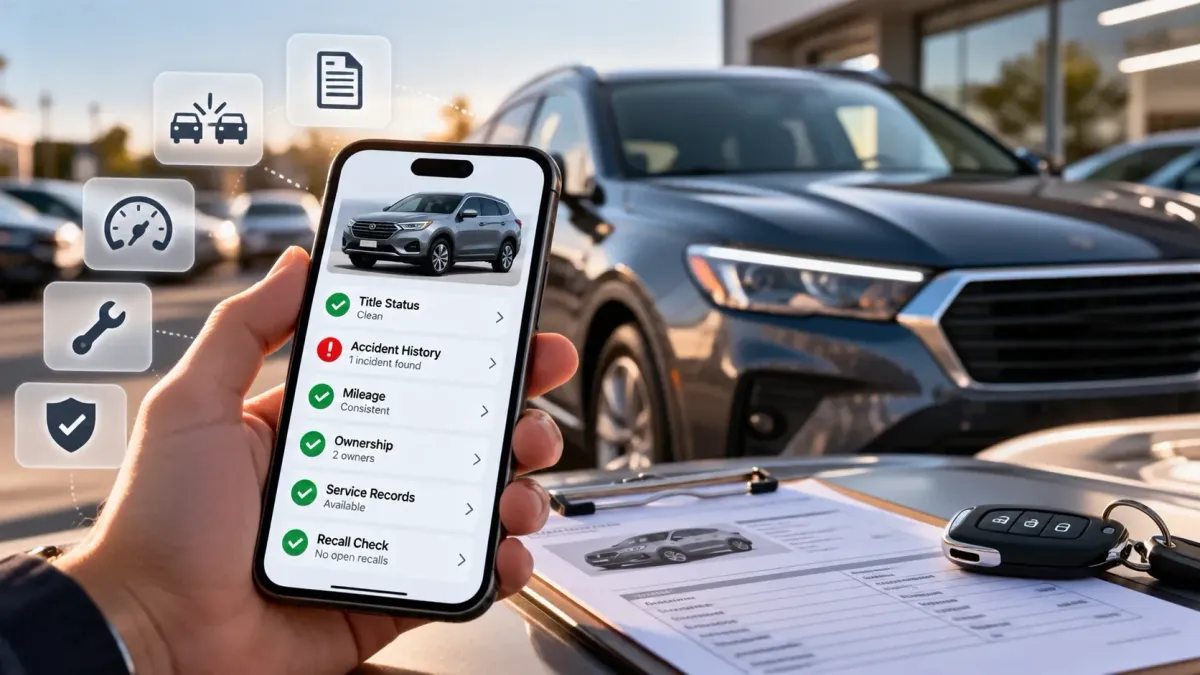
For U.S. buyers, NMVTIS is one of the most important places to check a used car's history. The National Motor Vehicle Title Information System was created to help prevent vehicle fraud and gives consumers access to information about title status, title brands, odometer readings, total-loss history, and salvage history through approved data providers. Federal law requires state titling agencies and certain insurance, junk, salvage, and recycling entities to report relevant information to the system.
An NMVTIS report focuses on five major indicators:
NMVTIS check | What it can reveal |
|---|---|
Current and previous title information | States where the vehicle has been titled and relevant title dates |
Brand history | Labels such as salvage, junk, or flood |
Odometer data | Latest reported mileage and possible inconsistencies |
Total-loss history | Whether an insurer reported the vehicle as a total loss |
Salvage history | Reports from salvage, junk, or recycling sources |
Title brands deserve particular attention because they can permanently affect the value and insurability of a car. NMVTIS explains that brands such as salvage, junk, and flood are assigned by state titling agencies and remain part of the system’s history. A vehicle with one of these records is not automatically impossible to buy, but its condition, repair quality, price, insurance availability, and future resale value need much closer scrutiny.
NMVTIS is intentionally focused on title and fraud-related information rather than providing a complete maintenance biography. The Department of Justice warns that the system may not contain detailed repair history and may not show significant damage that was never declared a total loss or branded by a state. That limitation is why checking used car history should continue beyond the NMVTIS report.
2. Read the Odometer Timeline, Not Just the Current Mileage
A used car's current odometer reading means much more when it is compared with earlier records. NMVTIS can provide the latest reported odometer data, while broader commercial history reports may contain mileage recorded during registration, inspection, servicing, sale, or auction events. Buyers should read those entries chronologically and look for anything that breaks the expected upward pattern.
For example, a car reported at 91,000 miles in one record and 67,000 miles several months later deserves an explanation. Smaller inconsistencies can sometimes come from clerical errors, but the buyer should not simply assume that is what happened. Mileage affects both value and expected maintenance, so unexplained discrepancies can materially change the deal.
Also look for unusually long gaps. A five-year period with no mileage records does not prove that anything is wrong, but it leaves less independent evidence about how heavily the vehicle was used during that time. When checking used car history, gaps should trigger more questions rather than automatically disqualify the vehicle.
3. Check Whether the Car Was Salvaged, Flooded, or a Total Loss
A vehicle can be repaired beautifully after severe damage and still have a history buyers need to understand. NMVTIS contains salvage and total-loss information reported through its required sources, while NICB's free VINCheck can identify certain vehicles reported as stolen and unrecovered or reported as salvage or flood damaged by participating insurers. These tools overlap in places, but they are not identical.
NICB specifically warns that its free VINCheck is not a comprehensive vehicle history report. Its database is limited to records supplied by participating insurers and does not include every stolen or damaged vehicle in the United States. A clean VINCheck result therefore means no matching record was found in the data searched, not that the car has never been seriously damaged.
Flood history deserves extra caution because water damage can affect electrical systems, connectors, airbags, modules, carpeting, corrosion-prone components, and other parts long after the car appears dry. A flood brand or insurance record should lead to a much more detailed inspection and an insurance check before purchase. If the history suggests severe past damage, the selling price should never be the only reason to continue.
4. Check for Open Safety Recalls Separately
A vehicle history report is not the best place to make the final recall decision. NHTSA provides an official recall lookup where buyers can enter the VIN or, for supported searches, the license plate to see whether a specific vehicle has an unrepaired safety recall. If none are found, the system reports that there are zero unrepaired recalls associated with that VIN.
This check takes only a few minutes and should be completed even if a commercial report includes recall information. Government recall data is tied directly to the specific vehicle and can change when a remedy is completed or a new recall is issued. An open recall does not necessarily mean the car should be rejected, but it should be understood before the sale is completed.
If a recall appears, ask whether the repair can be completed before purchase and confirm the remedy with an authorized dealer for that manufacturer. The key is to know that an unresolved safety issue exists rather than discovering it months after becoming the owner.
5. Look at Accidents and Damage – but Understand the Limits
Accident history is one of the main reasons buyers want to know how to check used car history, but accident records require context. Commercial reports may include reported collisions, damage location, repair records, airbag deployment, structural damage, or auction information depending on the provider and available data. The FTC notes that some reports contain accident and repair information beyond what is included in NMVTIS.
A reported accident does not automatically make a car a bad purchase. A properly repaired bumper from a minor collision is very different from structural damage, airbag deployment, or extensive flood repair. The history should help determine what the independent mechanic or body specialist needs to inspect more closely.
The opposite is also true: no accident shown on a report does not prove the car has never been damaged. Repairs paid privately or events that never reached the report provider's data sources may not appear. That is why body-panel alignment, paint differences, welding, corrosion, tire wear, and structural condition still matter during a physical inspection.
6. Use Service Records to Find Patterns and Gaps
Service history can tell buyers how consistently a car was maintained, but it should not be treated as a complete logbook. Some commercial history providers collect maintenance and repair records from participating repair shops and other sources, while work performed at home or at non-reporting facilities may never appear. A missing oil-change record therefore does not necessarily mean the oil was never changed.
What matters is the pattern. A vehicle with regular mileage entries and documented servicing provides more evidence about its past than one with years of silence followed by major repairs just before it was listed for sale. Repeated repairs to the same system can also be more important than one isolated repair event.
Ask the seller for paper or digital maintenance records in addition to the history report. Compare those receipts with the mileage timeline and the manufacturer's maintenance schedule. When the report and service documents support each other, buyers can make a much more informed estimate of what maintenance may be due next.
7. Compare the Report With the Actual Car and an Independent Inspection
The final step in how to check used car history is to see whether the paperwork matches the vehicle's real condition. The FTC explicitly recommends an independent mechanical inspection even when the dealer says the vehicle has already been inspected or certified. A history report can identify past events, while a mechanic evaluates what condition those events and years of use have left the car in today.
This distinction is especially important after accident, flood, salvage, or major repair history. A report may tell the buyer that damage occurred but cannot determine whether every repair was performed correctly or whether there are current suspension, electrical, cooling, braking, structural, or drivetrain problems. The inspection should therefore be informed by what the history report revealed.
Ask the mechanic for a written report when possible. That makes it easier to distinguish normal wear from expensive problems and can provide useful evidence during price negotiations. A clean history report plus a good inspection is much stronger evidence than either one alone.
What a Vehicle History Report Can – and Cannot – Tell You
Understanding the limits of the data prevents a common used-car mistake: treating a clean history report as a warranty. DOJ's NMVTIS guidance states directly that its report is not a substitute for an independent inspection and that significant damage may be absent when a vehicle was never branded or declared a total loss. NICB gives a similar warning about the limits of its VINCheck service.
The practical difference looks like this:
History reports can help reveal | They may not reliably reveal |
|---|---|
Title and brand history | Current engine or transmission condition |
Reported odometer readings | Every unreported accident |
Reported total-loss or salvage history | Quality of every previous repair |
Certain theft records | All privately performed repairs |
Reported accidents and damage | Every electrical or mechanical problem |
Available service history | How the car behaves under load today |
Open recalls through appropriate databases | Whether past damage was repaired correctly |
This is why a seller advertising a car as having a “clean report” should not end the investigation. The phrase usually means that a particular database did not return certain negative records, not that the vehicle has been certified free of all past damage or current defects. A history report is a screening tool, not a guarantee.
Red Flags When You Check Used Car History
A single unusual record does not always mean the buyer should walk away. Some clerical errors can be corrected, minor accidents may be properly repaired, and a car with a complicated past may still be priced appropriately for an informed buyer. What matters is whether the seller can explain the record and whether independent evidence supports that explanation.
The strongest warning signs include:
- A salvage, junk, flood, or other serious title brand that was not disclosed.
- A total-loss record inconsistent with the seller's description.
- Odometer readings that move backward without a credible explanation.
- Different VINs between the car and the paperwork.
- Major accident history combined with poor-quality visible repairs.
- Large unexplained gaps followed by unusually low mileage.
- Repeated repairs involving the same expensive system.
- An unrepaired safety recall the seller dismisses without explanation.
- A seller who refuses to provide the VIN before payment.
- A seller who will not allow an independent inspection.
None of these signs should be ignored simply because the price is attractive. A heavily discounted car can become expensive quickly if its history affects reliability, insurance, resale, or registration. The purpose of checking used car history is not to find a perfect past – it is to understand the risk before agreeing on the price.
How to Check Used Car History for Free
Several important checks cost nothing. NHTSA's recall search is free, and NICB provides free VINCheck searches for certain theft, salvage, and flood records, although NICB limits searches to five per IP address in a 24-hour period. State motor vehicle agencies may also provide title or registration information depending on the state.
A complete NMVTIS consumer report is normally obtained through an approved provider rather than directly from the federal government. DOJ says pricing varies by provider because NMVTIS operates as a fee-supported system, and the system is designed primarily around title, brand, odometer, salvage, and total-loss information rather than full service history.
Free tools are therefore best used as layers rather than replacements for a full report. A buyer can check recalls and certain theft or salvage records for free, then decide whether a broader paid report and independent inspection are justified for the car being considered. For a purchase worth thousands or tens of thousands of dollars, those checks are usually small compared with the financial risk of buying blindly.
The Bottom Line
Knowing how to check used car history means doing more than ordering one report. Start with the VIN, review NMVTIS title and brand information, examine mileage, check for total-loss or salvage history, search NHTSA recalls, use NICB's theft and salvage data, and compare everything with service records and the physical car. Each source answers a different question about the vehicle's past.
The most important limitation is also the easiest to remember: no history database sees everything. Damage can go unreported, service records can be incomplete, and a clean title does not tell buyers whether the transmission is failing today. That is why both DOJ and the FTC recommend an independent inspection alongside the history check.
A used car does not need a flawless history to be a reasonable purchase, but its price and condition should make sense once that history is known. The time to uncover a salvage brand, mileage discrepancy, open recall, or unexplained accident is before the money changes hands – not after the car is already in the driveway.
Frequently asked questions
How do I check a used car's history before buying?
Start by obtaining the vehicle's VIN and making sure it matches the title, registration, and VIN plate on the car. Use an approved NMVTIS provider for title, brand, odometer, total-loss, and salvage history, then check NHTSA for open recalls and NICB for certain theft and salvage records. Finish by comparing the history with seller records and an independent mechanical inspection.
Can I check used car history for free?
Some important parts can be checked for free, including NHTSA safety recalls and NICB's limited theft, salvage, and flood database. A fuller NMVTIS report is obtained through approved providers that charge their own fees. Free checks are useful, but none provides a complete mechanical or ownership history by itself.
Does a clean vehicle history report mean the car is safe?
No. DOJ explicitly says an NMVTIS report is not a substitute for an independent vehicle inspection, and some significant damage may not appear if it was never branded or reported as a total loss. A clean report is positive evidence, but it cannot rule out unreported damage or current mechanical problems.
What does a salvage title mean?
A salvage brand generally indicates that a vehicle experienced severe damage or was treated as a total loss under applicable rules. The exact title terminology and requirements vary by state, and a repaired vehicle may later receive a rebuilt or similar designation depending on local law. Buyers should investigate the original damage, repair quality, insurance availability, and resale implications before purchasing.
Can a vehicle history report miss an accident?
Yes. A history provider can only show events available through its data sources, so privately repaired or otherwise unreported damage may be absent. The FTC therefore recommends combining a history report with an independent inspection rather than treating the report as a substitute for one.
What is the best way to check used car mileage?
Compare the current odometer with historical mileage entries from title, registration, inspection, service, and history-report records. NMVTIS includes latest reported odometer information and can help identify discrepancies in a vehicle's timeline. A later mileage reading that is lower than an earlier one should be investigated before purchase.
Sources
- U.S. Department of Justice, National Motor Vehicle Title Information System
- NHTSA, Check for Recalls: Vehicle, Car Seat, Tire, Equipment
- National Insurance Crime Bureau, VINCheck
- NHTSA, Odometer Fraud
- Federal Trade Commission, Buying a Used Car From a Dealer
Spotted an error? Tell our editors. Read our corrections policy.