What Do Tire Size Numbers Mean? How to Read 225/65R17 and Other Codes
The numbers and letters on a tire reveal its width, sidewall height, construction, wheel diameter and other important specifications. Learn how to decode them before buying replacements.
This article is general information, not financial advice. Rates, prices and rules change; check the details with a qualified professional or the lender before you decide.
In this article
- What Does 225/65R17 Mean?
- What Does the First Number on a Tire Mean?
- What Does the Second Number Mean?
- What Does R Mean in Tire Size?
- What Does the Last Number Mean?
- What Does the P Before Tire Size Mean?
- What Does 102H Mean on a Tire?
- How to Read the Tire DOT Date Code
- What Do M+S, 3PMSF and Other Tire Symbols Mean?
- What Is the Difference Between Tire Size and Tire Pressure?
- Where Can You Find the Correct Tire Size for Your Car?
- Can You Replace 225/65R17 With 225/60R17?
- Does Tire Size Affect Gas Mileage?
- Common Tire Size Mistakes
- Frequently Asked Questions
- The Bottom Line
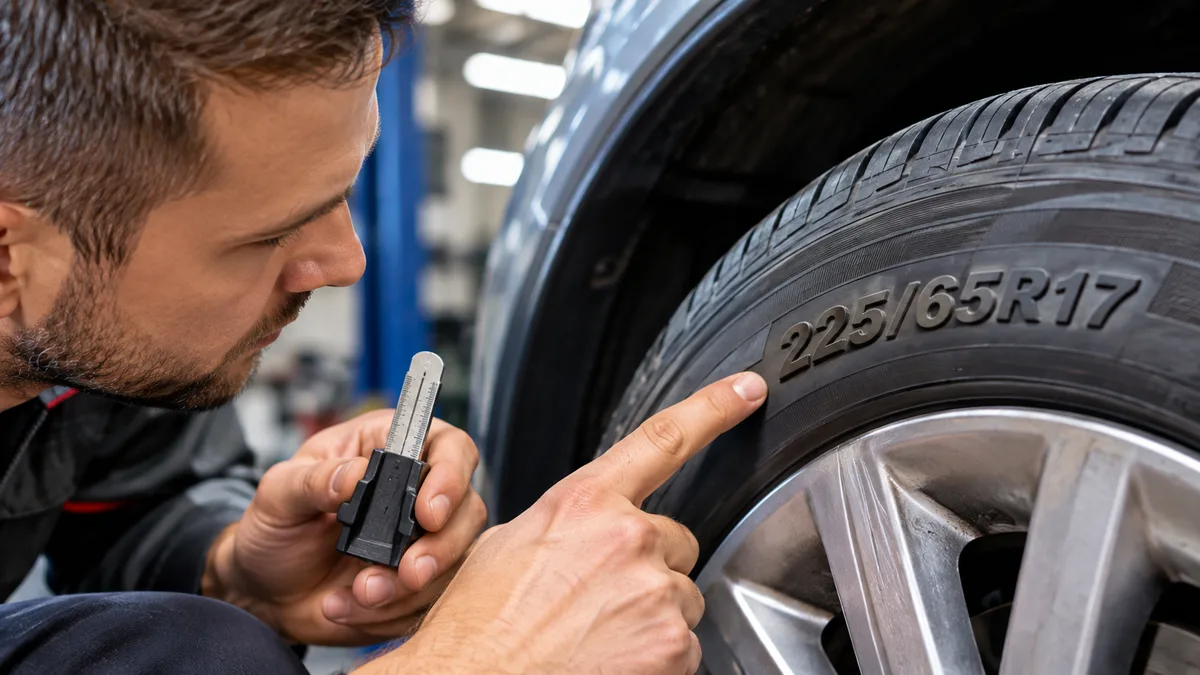
Tire size numbers identify key specifications of a tire, including its width, aspect ratio, construction, and wheel diameter. For example, 225/65R17 describes a tire that is approximately 225 millimeters wide, has a sidewall height equal to 65% of its width, uses radial construction, and fits a 17-inch wheel.
Other letters and numbers on the sidewall indicate load capacity, speed rating, manufacturing information, and specialized service characteristics.
Understanding these markings helps drivers choose appropriate replacement tires, but decoding the numbers is only the first step. The tire must also meet the vehicle manufacturer's specified size, load, speed, and other requirements.
What Does 225/65R17 Mean?
The tire marking 225/65R17 is divided into four main parts.
Marking | Meaning |
225 | Nominal tire section width in millimeters |
65 | Aspect ratio: sidewall height is 65% of section width |
R | Radial tire construction |
17 | Wheel diameter in inches |
This marking is common on certain SUVs and passenger vehicles, but it is not automatically appropriate for every vehicle with 17-inch wheels.
The tire's complete service description may also include a load index and speed symbol, such as 102H. Those characters are essential when choosing a replacement.
What Does the First Number on a Tire Mean?
The first number usually identifies the nominal tire width in millimeters for common passenger-car metric sizing systems.
In 225/65R17, the 225 indicates a nominal section width of 225 millimeters. The measurement refers to the tire's section width under defined measurement conditions, not simply the width of the tread that touches the road.
A 245-width tire is nominally wider than a 225-width tire within the same general sizing framework. However, the exact physical dimensions also depend on the manufacturer's construction and approved wheel width.
Choosing a wider tire without checking vehicle specifications can create clearance or performance problems.
What Does the Second Number Mean?
The second number is the aspect ratio, which expresses the tire's sidewall height as a percentage of its section width.
For a 225/65R17 tire:
225 mm × 0.65 = 146.25 mm
That produces a nominal sidewall height of approximately 146 millimeters.
Compare two sizes with the same nominal width:
Tire size | Aspect ratio | Approximate nominal sidewall height |
225/45R17 | 45% | 101.25 mm |
225/55R17 | 55% | 123.75 mm |
225/65R17 | 65% | 146.25 mm |
These are mathematical illustrations. Actual dimensions can differ among models and manufacturers.
Changing the aspect ratio can affect overall tire diameter, ride characteristics, handling, and speedometer readings.
What Does R Mean in Tire Size?
R means the tire has radial construction. Radial tires are widely used on modern passenger vehicles.
The letter does not mean “radius,” and it is not a speed rating.
Construction codes refer to how internal reinforcement layers are arranged. Drivers should not substitute a different construction type without ensuring that the tire and vehicle requirements permit it.
What Does the Last Number Mean?
The final number in 225/65R17 identifies the wheel diameter in inches. In this example, the tire is designed for a wheel with a 17-inch bead-seat diameter.
That does not mean the tire's outside diameter is 17 inches.
A tire marked 225/65R17 cannot simply be fitted to a 16-inch or 18-inch wheel. The tire and wheel bead-seat diameters must match.
What Does the P Before Tire Size Mean?
Some tires begin with the letter P, such as P225/65R17. P-metric sizing identifies a passenger-vehicle tire category in the relevant sizing system.
Other tires may use LT for light-truck service or a different standardized designation.
A vehicle requiring particular load characteristics may need an approved tire category rather than just a matching width and wheel diameter.
Drivers should consult the vehicle placard, owner's manual, and a qualified tire professional before changing between passenger and light-truck tire types.
What Does 102H Mean on a Tire?
The service description 102H contains a load index and a speed symbol.
102 is a numerical load index corresponding to the tire's rated load capacity under the applicable standards. H is a speed symbol associated with a rated maximum speed under specified test conditions.
Marking | Type | Meaning |
91 | Load index | Index corresponding to a defined load rating |
98 | Load index | Higher indexed capacity than 91 |
102 | Load index | Corresponds to a defined maximum load capacity |
T | Speed symbol | Common passenger-tire speed category |
H | Speed symbol | Common passenger-tire speed category |
V | Speed symbol | Higher speed category under the relevant standard |
For a common passenger-car load index table, 102 corresponds to 1,874 pounds (850 kg) per tire under the applicable rating conditions. H commonly corresponds to a rated speed of 130 mph.
These are technical ratings, not recommendations to drive at those speeds. Legal speed limits, road conditions, temperature, tire condition, and vehicle requirements remain important.
A replacement tire should not have an inadequate load or speed rating merely because its physical dimensions appear to fit.
How to Read the Tire DOT Date Code
A tire's Department of Transportation identification markings help identify manufacturing information. For modern tires, the last four digits of the relevant tire identification number generally show the production week and year.
For example:
DOT date code | Manufacturing date |
1224 | 12th week of 2024 |
3525 | 35th week of 2025 |
0826 | 8th week of 2026 |
The code is not an expiration date. Tire service life depends on age, usage, storage, maintenance, damage, and manufacturer recommendations.
NHTSA notes that some manufacturers recommend replacement after approximately six to ten years regardless of tread wear, but there is no single age rule that applies identically to all tires.
The complete date code may appear on only one side of the tire, so checking the opposite side may be necessary.
What Do M+S, 3PMSF and Other Tire Symbols Mean?
Tire sidewalls may contain additional markings indicating intended service characteristics.
M+S, meaning mud and snow, appears on tires meeting applicable designation criteria. It should not automatically be treated as proof of the same severe-snow performance associated with the three-peak mountain snowflake symbol.
The 3PMSF symbol indicates that a tire meets defined snow-traction performance criteria under the relevant standard.
Other markings may relate to extra load capacity, run-flat construction, tire type, or manufacturer-specific features.
The appropriate choice depends on the vehicle and driving conditions.
What Is the Difference Between Tire Size and Tire Pressure?
Tire size and recommended tire inflation pressure are separate specifications. The number identifying a tire's maximum permissible pressure on the sidewall is not necessarily the correct pressure for normal vehicle operation.
NHTSA advises drivers to use the recommended cold inflation pressure shown on the vehicle's Tire and Loading Information Label or in the owner's manual.
This label is commonly located on the driver's door edge or doorjamb.
For example, a tire might display a higher maximum permissible pressure while the vehicle manufacturer recommends 35 psi for ordinary use. The correct operational pressure comes from the vehicle specification, not from inflating to the tire's maximum marking.
Where Can You Find the Correct Tire Size for Your Car?
The correct tire size is generally listed on the vehicle's Tire and Loading Information Label and in the owner's manual. Some vehicles require different sizes for the front and rear axles.
NHTSA specifically recommends using the manufacturer's specified original tire size or an approved alternative.
Before purchasing, compare:
- Tire size.
- Load index and any load-range requirement.
- Speed rating.
- Tire type and seasonal suitability.
- Wheel dimensions.
- Vehicle-specific requirements.
If the car has aftermarket wheels or modifications, consult a qualified tire specialist.
Can You Replace 225/65R17 With 225/60R17?
These sizes are not identical. The width and wheel diameter match, but the aspect ratio differs, which changes the nominal sidewall height and overall tire diameter.
A tire with a lower aspect ratio may have a smaller overall diameter when other factors are unchanged. This can affect speedometer readings, ground clearance, vehicle electronics, and handling.
The fact that a tire fits onto a wheel does not establish that it is an approved replacement.
Consult the vehicle manufacturer or a qualified tire professional before changing size.
Does Tire Size Affect Gas Mileage?
Tire dimensions, rolling resistance, weight, inflation pressure, and tread design can affect a vehicle's fuel efficiency. However, changing tire size does not produce one predictable mileage increase or decrease for every vehicle.
Incorrect tire pressure can also increase tire wear and affect fuel economy.
For drivers evaluating running costs, regular maintenance is often more useful than selecting an unapproved tire size in pursuit of small efficiency gains.
Eagle Post Daily's Winter Car Emergency Kit Checklist includes tire pressure and condition among the key vehicle checks before winter travel.
Common Tire Size Mistakes
A frequent mistake is choosing replacement tires based only on the wheel diameter. Two tires may fit a 17-inch wheel but have different widths, aspect ratios, load capacities, and overall dimensions.
Other mistakes include confusing the sidewall's maximum inflation pressure with the recommended pressure, overlooking the load index, and assuming all winter-rated markings mean the same thing.
Drivers should also avoid mixing incompatible sizes or constructions without confirming the vehicle's requirements.
Frequently Asked Questions
What does 225/65R17 mean?
It means a nominal 225 mm section width, 65% aspect ratio, radial construction, and 17-inch wheel diameter.
What does 102H mean on a tire?
102 is the load index, and H is the speed symbol. Both must be appropriate for the vehicle.
Is tire width measured in inches?
For common metric passenger tire sizes, width is expressed in millimeters. Wheel diameter is usually expressed in inches.
Can you put a different tire size on your car?
Only when the alternative is appropriate for the vehicle and wheel. Consult the manufacturer's recommendations or a qualified tire specialist.
Is the DOT date code the expiration date?
No. It identifies the manufacturing period. Age-based replacement recommendations depend on tire and vehicle manufacturers and other safety factors.
The Bottom Line
Tire size markings describe width, sidewall proportion, construction, wheel diameter, and associated service ratings. The code 225/65R17 is easy to decode, but understanding it does not automatically establish which tires are safe for a particular vehicle.
Use the manufacturer's tire placard and owner's manual to confirm size, pressure, load requirements, and other specifications before purchasing replacements.
Spotted an error? Tell our editors. Read our corrections policy.