Ceiling Fan Direction in Winter and Summer: How to Set It Correctly
Is your ceiling fan spinning the wrong way? The correct direction changes with the seasons, but the airflow matters more than the switch position. Learn how to check your fan in seconds, reverse it safely, and use it with heating or air conditioning without wasting electricity.
This article is general information, not financial advice. Rates, prices and rules change; check the details with a qualified professional or the lender before you decide.
In this article
- Ceiling Fan Direction: Winter vs. Summer at a Glance
- Which Way Should a Ceiling Fan Spin in Summer?
- Which Way Should a Ceiling Fan Spin in Winter?
- Clockwise vs. Counterclockwise: Why Does Fan Direction Matter?
- How to Reverse Ceiling Fan Direction Step by Step
- Which Way Should the Ceiling Fan Switch Be Up or Down?
- Ceiling Fan Won't Reverse? Common Problems and Fixes
- Does Changing Ceiling Fan Direction Save Money on Electricity?
- Should You Leave a Ceiling Fan Running in an Empty Room?
- Does Ceiling Fan Direction Matter With Air Conditioning?
- Does Ceiling Fan Direction Matter in Rooms With High Ceilings?
- Bedroom Ceiling Fan Direction: Summer, Winter, and Sleeping Comfort
- When Should You Change Ceiling Fan Direction?
- Ceiling Fan Direction Mistakes That Reduce Comfort
- Ceiling Fan Maintenance for New Homeowners
- How to Estimate the Cost of Running Your Ceiling Fan
- Final Checklist: Is Your Ceiling Fan Set Correctly?
- Frequently Asked Questions About Ceiling Fan Direction
- The Bottom Line
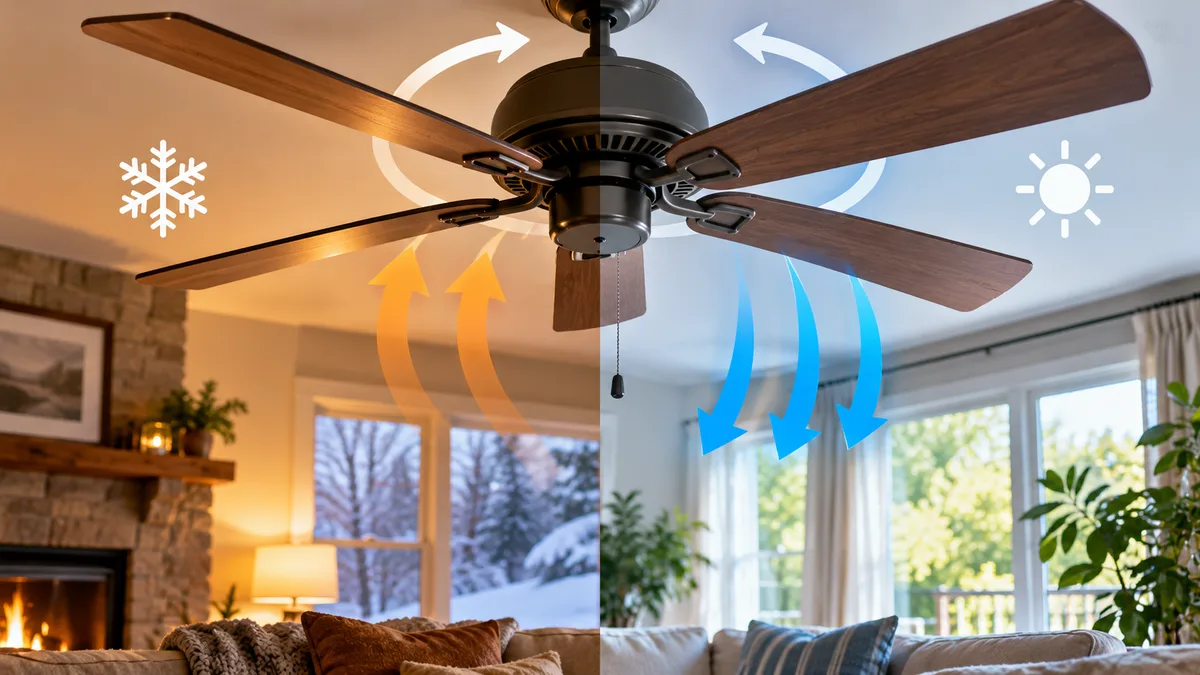
Ceiling fan direction in winter should generally be clockwise on low speed, while ceiling fan direction in summer should be counterclockwise to produce a cooling breeze. Both directions are determined by standing underneath the fan and looking up at the rotating blades.
The difference is simple but important. In summer, the fan pushes air downward, creating a breeze that helps people feel cooler. In winter, reversing a typical ceiling fan creates a gentle upward airflow that helps circulate warm air collected near the ceiling without producing an uncomfortable draft.
The U.S. Department of Energy recommends these seasonal settings for conventional reversible ceiling fans. However, the direction of airflow is more important than memorizing clockwise or counterclockwise, because fan designs and controls can vary.
Ceiling Fan Direction: Winter vs. Summer at a Glance
The correct ceiling fan direction depends on whether the goal is to create a direct cooling breeze or redistribute warm air. Most standard reversible ceiling fans use counterclockwise rotation for summer and clockwise rotation for winter.
Setting | Summer | Winter |
Direction viewed from below | Counterclockwise | Clockwise |
Recommended speed | Medium or high as comfortable | Low |
Airflow | Downward | Upward at the center |
Main purpose | Create a cooling breeze | Redistribute warm ceiling air |
Feel directly underneath | Noticeable breeze | Little or no direct breeze |
Thermostat strategy | Raise AC temperature if comfortable | Lower heating setting if comfort improves |
Empty room | Usually turn off | Usually turn off |
For a quick check, stand under the running fan and feel the airflow. A strong downward breeze indicates the usual summer setting. Gentle circulation without a direct draft indicates the typical winter setting.

Which Way Should a Ceiling Fan Spin in Summer?
Ceiling fan direction in summer should normally be counterclockwise when viewed from below. This pushes air downward and produces a breeze that increases evaporation from the skin, making occupants feel cooler even though the room's actual air temperature does not decrease.
The effect is sometimes called wind chill, although indoor ceiling fans are not cooling the air in the same way an air conditioner does. Instead, moving air improves the body's ability to release heat.
This distinction explains why a ceiling fan can improve comfort without replacing an air-conditioning system.
How to Tell if Your Fan Is in Summer Mode
A summer ceiling fan setting should produce noticeable air movement directly underneath the blades. The amount of airflow depends on fan size, speed, blade design, and installation height.
Use this quick test:
- Stand directly beneath the fan. Keep a safe distance from the blades.
- Run the fan at a comfortable medium speed. Allow it to reach normal operating speed.
- Feel for downward airflow. A noticeable breeze indicates the typical summer setting.
- Look upward to verify rotation. On a standard fan, the blades should move counterclockwise.
- Adjust the speed for comfort. Choose a higher speed only when additional airflow is useful.
A fan that spins counterclockwise but produces very little airflow may have another problem, such as poor placement, insufficient speed, or an unusual blade design.
What Speed Should a Ceiling Fan Run in Summer?
The best summer ceiling fan speed is the lowest setting that provides comfortable cooling. Medium or high speed can be useful in hot conditions, especially when people are seated or working directly beneath the fan.
However, high speed is not always necessary. In bedrooms, home offices, and dining areas, a moderate setting may provide sufficient air movement with less noise and electricity use.
For hot climates, a ceiling fan can help occupants tolerate a higher air-conditioning thermostat setting. It should not be treated as a substitute for adequate cooling when indoor temperatures become unsafe.
Which Way Should a Ceiling Fan Spin in Winter?
Ceiling fan direction in winter should generally be clockwise at low speed when viewed from underneath. This creates a gentle upward airflow that moves air toward the ceiling and helps redistribute warmer air throughout the room.
Warm air naturally tends to collect near the ceiling when a room has temperature differences between the upper and lower occupied spaces. That effect, known as thermal stratification, can be particularly noticeable in rooms with high or vaulted ceilings.
A ceiling fan operating in winter mode helps mix the air so that some of the warmth near the ceiling returns to occupied areas.
Why Winter Ceiling Fans Should Run on Low Speed
A ceiling fan in winter should move air gently rather than create the strong direct breeze desirable in summer. Excessive airflow across the skin can make occupants feel colder, even when the room's measured temperature remains unchanged.
The Department of Energy recommends clockwise rotation at low speed during cold weather for conventional reversible fans.
In rooms with high ceilings, the benefit of winter circulation may be more noticeable because temperature differences can develop between ceiling height and the living area.
How to Check the Winter Setting
The correct winter ceiling fan direction typically creates little noticeable draft directly underneath the fan.
To check the setting, stand beneath the fan at a safe distance and observe whether air is being pulled upward rather than pushed strongly downward. The fan should rotate clockwise when viewed from below on most conventional models.
If a noticeable breeze makes the room feel colder, reduce the speed or reconsider whether the fan is beneficial in that space.
Winter operation is optional. A fan should not be left running simply because the season has changed if it does not improve comfort or reduce heating demand.
Clockwise vs. Counterclockwise: Why Does Fan Direction Matter?
Ceiling fan direction changes the airflow pattern because the blades are angled to move air in a particular direction. Reversing the motor changes how the blades move air relative to the room.
A typical ceiling fan uses angled blades that generate airflow as they rotate. In one direction, the fan sends air downward. When reversed, the same blades create a different airflow pattern.
This difference affects how people experience temperature.
Counterclockwise Rotation Creates a Downdraft
With standard ceiling fan blade geometry, counterclockwise rotation produces a downward column of air. The breeze spreads outward across the room after reaching the occupied space.
The direct movement of air can improve comfort during warm weather. It does not remove heat or moisture from the home, so air conditioning may still be necessary.
Clockwise Rotation Creates an Updraft
With standard reversible ceiling fans, clockwise rotation draws air upward near the center of the room. Air then circulates outward along the ceiling and returns toward the lower occupied space.
The goal is to redistribute existing heat rather than create additional warmth.
This is why the winter setting is usually paired with low fan speed and why it can be particularly useful in rooms with substantial ceiling height.
How to Reverse Ceiling Fan Direction Step by Step
To reverse ceiling fan direction, turn the fan off, wait for the blades to stop completely, and use the reversing switch, remote control, or smart fan settings provided by the manufacturer. The exact procedure depends on the fan's design.
Most conventional models use one of three methods: a mechanical switch on the motor housing, a dedicated remote control, or an electronic control system.
Method 1: Reverse a Ceiling Fan With a Switch
Many traditional ceiling fans have a small reversing switch mounted on or near the motor housing. It may be above the blades, beside the motor, or in another accessible location specified by the manufacturer.
Follow these steps:
- Turn off the fan. Use its wall switch, pull chain, or designated control.
- Wait until the blades stop completely. Never operate a mechanical reversing switch while the fan is spinning.
- Locate the reversing switch. Inspect the motor housing without touching moving or electrical components.
- Move the switch to the opposite position. The switch may slide horizontally or vertically.
- Restore power and restart the fan. Watch the blades from below to verify the new direction.
- Choose the correct seasonal speed. Use a comfortable cooling speed in summer or low speed in winter.
If the switch is difficult to reach, use a stable, appropriate ladder on a level surface. Do not stand on unstable furniture or reach through the fan blades.
There is no universal rule stating that the switch must be up for winter or down for summer. The physical switch position varies among manufacturers and models.
Method 2: Change Ceiling Fan Direction With a Remote
A ceiling fan with remote-controlled reverse functionality can change direction using a dedicated button or manufacturer-defined control sequence. Some models require the fan to stop before the command is accepted.
Look for a button labeled "Reverse," an icon showing rotational arrows, or a seasonal airflow symbol.
A typical procedure is:
- Turn the fan off using the remote.
- Wait for the blades to stop.
- Press the reverse-direction control according to the manufacturer's instructions.
- Restart the fan.
- Confirm rotation and airflow.
Some modern fan controllers perform the stopping and reversing sequence automatically. Follow the product manual rather than assuming that every remote uses the same command.
Method 3: Reverse a Smart Ceiling Fan
Smart ceiling fans may provide airflow direction settings through a companion app, wall controller, or compatible smart-home interface. The control might be labeled "Summer," "Winter," "Forward," or "Reverse."
Open the fan's official control system and locate the direction setting. Select the desired airflow mode and allow the fan to complete its transition.
Not every smart fan supports reversing through voice commands. Some require a specific controller, while others use a physical switch despite offering app-based speed and lighting controls.
Which Way Should the Ceiling Fan Switch Be Up or Down?
The ceiling fan switch position depends on the manufacturer and model. There is no reliable universal rule that up means winter and down means summer, or that left always means clockwise.
Some models identify the seasonal position directly on the motor housing. Others use arrows, abstract symbols, or unmarked switches.
Switch or control | What it means | Best way to confirm |
Up position | Model-dependent | Check manual and airflow |
Down position | Model-dependent | Check manual and airflow |
Left position | Model-dependent | Check manual and airflow |
Right position | Model-dependent | Check manual and airflow |
Forward mode | Often the standard cooling direction | Check for downward breeze |
Reverse mode | Often the winter circulation direction | Check for gentle upward airflow |
Summer or winter label | Intended seasonal mode | Verify actual airflow |
The most reliable test is to observe the airflow after switching directions. A clear downward breeze is typical of summer operation, while gentle upward circulation is the usual winter pattern.
For an unfamiliar ceiling fan, find the model number and consult its installation or operating manual. Product-specific instructions are more dependable than generic switch-position advice.
Ceiling Fan Won't Reverse? Common Problems and Fixes
A ceiling fan that will not reverse may have an incorrectly positioned switch, an incomplete stop-and-restart sequence, a controller issue, or a design that does not support reversing. Start by checking the model's instructions before attempting repairs.
The solution is often simple, but electrical and mechanical work should not be attempted without appropriate knowledge.
The Reversing Switch Does Not Move
A switch may feel stuck because it is difficult to access, partially engaged, or mechanically damaged. Turn off the fan and confirm that the blades have stopped before checking it.
Do not force a damaged switch. If it remains stuck or feels loose, consult the manufacturer or a qualified electrician.
The Remote Has No Reverse Button
Some ceiling fans use a remote to control lighting and speed but still require a physical reversing switch. Others use an alternate button combination or app control.
Check the model's user manual rather than repeatedly trying unfamiliar commands. A remote without an obvious reverse button does not necessarily mean the fan lacks that function.
The Fan Changes Direction but Produces Little Airflow
Low airflow can result from operating at a low speed, incorrect fan sizing, unusual blade geometry, or installation conditions.
Test the fan at a manufacturer-approved speed and compare the airflow in both directions.
If performance has deteriorated unexpectedly, inspect the fan for dust buildup or visible damage after switching it off. Electrical or mechanical problems should be evaluated by a qualified professional.
Can Every Ceiling Fan Reverse Direction?
Not every ceiling fan has a reversible motor or supported reverse setting. Some specialized, outdoor, industrial, or compact models may operate in only one direction.
For a nonreversible fan, do not attempt to modify wiring or blade orientation simply to obtain seasonal airflow. Use the manufacturer's recommended operating settings.
Does Changing Ceiling Fan Direction Save Money on Electricity?
Changing ceiling fan direction can support energy savings when it improves comfort enough to reduce heating or cooling demand. The fan itself consumes electricity, so savings depend on how it is used and whether the thermostat or HVAC system actually operates differently.
During summer, a ceiling fan can help occupants remain comfortable at a higher air-conditioning thermostat setting. The Department of Energy says ceiling fans may allow an increase of about 4°F without reducing comfort for many occupants.
That does not mean the fan lowers the room temperature by 4°F. The benefit comes from air movement across the body.
In winter, gentle air circulation can make heating more effective in spaces where warm air collects near the ceiling. Whether this reduces energy use depends on the room, heating system, thermostat location, and fan operation.
How Much Electricity Does a Ceiling Fan Use?
Ceiling fan electricity consumption depends on motor efficiency, blade size, speed, and whether accessories such as lights are operating.
For a practical calculation, consider a hypothetical fan using 50 watts of electrical power while running. At that power level, operating for eight hours uses:
50 watts × 8 hours ÷ 1,000 = 0.4 kilowatt-hours (kWh).
If electricity costs $0.18 per kWh, the daily operating cost is:
0.4 kWh × $0.18 = $0.072, or 7.2 cents.
This is an illustrative example, not a national electricity price or a measured figure for every ceiling fan.
Ceiling Fan Electricity Cost by Daily Usage
The table below shows estimated electricity costs for a hypothetical 50-watt ceiling fan at $0.18 per kWh. The calculation assumes consistent power use and a 30-day month.
Daily runtime | Daily electricity | Approx. monthly cost |
4 hours | 0.20 kWh | $1.08 |
8 hours | 0.40 kWh | $2.16 |
12 hours | 0.60 kWh | $3.24 |
24 hours | 1.20 kWh | $6.48 |
A more efficient fan may use less electricity, while an older or larger model could use more. Light fixtures attached to the fan may add to electricity consumption when switched on.
Although these operating costs appear modest, leaving a fan running unnecessarily can reduce or eliminate the energy savings it was intended to provide.
Can You Save Money Without Changing the Thermostat?
A ceiling fan may improve comfort even when thermostat settings remain unchanged, but that does not automatically produce lower electricity bills.
The largest opportunity for summer energy savings generally comes from using the fan to tolerate a higher cooling set point.
In winter, savings may occur when improved air circulation allows a lower heating set point or reduces unnecessary heating demand. Results are less predictable than simply counting the fan's electricity consumption.
Ceiling fans save the most energy when their comfort benefit is used to reduce the workload of heating or cooling equipment.
Should You Leave a Ceiling Fan Running in an Empty Room?
Ceiling fans should generally be turned off when nobody is in the room. Unlike air conditioners, fans do not directly cool the room's air, so running one in an empty space usually provides no immediate cooling benefit to occupants.
The Department of Energy specifically recommends turning fans off when a room is unoccupied to avoid unnecessary electricity use.
During winter, the situation can be more nuanced because ceiling fans may help redistribute accumulated heat. Even so, continuous operation is not automatically beneficial and should be justified by the room's actual temperature distribution or comfort needs.
For most households, turning off an unused fan is the simplest energy-saving practice.
Does Ceiling Fan Direction Matter With Air Conditioning?
Ceiling fan direction matters with air conditioning because a downward breeze can make occupants feel cooler at a higher indoor air temperature. In a typical summer setup, counterclockwise rotation provides the desired downdraft.
For example, a household comfortable at a thermostat setting of 72°F without air movement may find a somewhat higher setting comfortable while using an appropriately sized ceiling fan. The actual temperature adjustment depends on humidity, activity, clothing, airflow, and personal preference.
There is no universal thermostat setting that works for every household.
For more practical seasonal home and lifestyle guides, including everyday household efficiency decisions, the important principle is to consider comfort alongside actual operating costs.
Should a Ceiling Fan and Air Conditioner Run Together?
A ceiling fan and air conditioner can operate together effectively when the fan allows the household to raise the cooling thermostat setting. The air conditioner controls indoor temperature and humidity, while the ceiling fan improves the sensation of cooling.
If the air-conditioning thermostat remains unchanged, adding a ceiling fan will consume additional electricity. It can still improve comfort, but energy savings are not guaranteed.
The best result comes from adjusting both systems to meet comfort needs with the least necessary energy use.
Does a Ceiling Fan Reduce Humidity?
A ceiling fan does not remove moisture from indoor air. It moves air and can make evaporation from the skin more effective, but the room's humidity level is not directly reduced.
Air-conditioning systems and dehumidifiers can remove moisture under appropriate operating conditions. A fan may help circulate the air, but it is not a substitute for proper humidity control.
Does Ceiling Fan Direction Matter in Rooms With High Ceilings?
Ceiling fan direction can matter particularly in rooms with high or vaulted ceilings because temperature stratification may be more pronounced. Warm air can accumulate well above the occupied part of the room, especially during the heating season.
Clockwise rotation at low speed may help redistribute that warm air without creating an uncomfortable direct draft.
However, ceiling height, fan diameter, blade performance, and mounting position influence results. A small fan installed far above the occupied zone may circulate less useful air than a correctly sized model.
What About Vaulted Ceilings?
Vaulted ceilings can create large volumes of air above the living space, allowing warmth to collect where occupants receive little benefit.
A properly installed reversible fan may help reduce these differences. Depending on room geometry, the most effective airflow setting may require testing rather than following a rigid seasonal rule.
Fan installation height, mounting hardware, and electrical connections must meet the manufacturer's instructions and applicable building requirements.
Bedroom Ceiling Fan Direction: Summer, Winter, and Sleeping Comfort
Bedroom ceiling fan direction should be selected based on comfort and airflow rather than the season alone. Counterclockwise rotation is usually best for a cooling breeze, while clockwise low-speed rotation is suitable for gentler winter circulation.
During summer, a low or medium speed may provide enough air movement for sleeping without excessive noise or drafts. Strong airflow directly over a bed may feel uncomfortable for some people, particularly in cooler rooms.
In winter, reversing the fan and reducing the speed may help distribute warmth more evenly. If the bedroom already feels comfortable and has little temperature stratification, keeping the fan off may be the more efficient choice.
The safest setting is one that maintains appropriate room temperatures and does not rely on air movement to compensate for inadequate heating or cooling.
When Should You Change Ceiling Fan Direction?
Ceiling fan direction should change when the household's comfort needs shift from cooling to heating, rather than on a fixed calendar date. Spring and fall are convenient reminders, but outdoor temperatures and indoor conditions vary significantly across the United States.
In warmer regions, summer-style circulation may remain useful for much of the year. In colder states, winter circulation can be beneficial during extended heating periods.
A practical seasonal routine is:
- Spring: Check whether the room needs a stronger cooling breeze.
- Summer: Use counterclockwise rotation for direct cooling airflow.
- Fall: Reassess the setting when heating becomes necessary.
- Winter: Try clockwise rotation at low speed where warm air accumulates near the ceiling.
There is no requirement to reverse every ceiling fan twice a year. The right setting is determined by the actual airflow and room conditions.
Ceiling Fan Direction Mistakes That Reduce Comfort
Several common ceiling fan direction mistakes can reduce comfort or increase electricity use. Most involve using the wrong speed, assuming the switch position is universal, or expecting the fan to change room temperature directly.
Running the Winter Setting Too Fast
Clockwise rotation at high speed can still create noticeable drafts or uncomfortable air movement. Winter circulation is generally intended to be gentle.
Lower the speed when the fan makes occupants feel colder.
Leaving the Fan On in Empty Rooms
A cooling ceiling fan benefits people by moving air across their skin. Running it when nobody is present usually adds electricity consumption without delivering that immediate benefit.
Turn it off when the room is unoccupied unless there is a specific, demonstrated reason to maintain circulation.
Assuming Clockwise Always Means Cooling
For most conventional reversible fans, counterclockwise rotation creates summer downdraft cooling. The relationship between direction and airflow can differ for specialized fan designs, so the manufacturer's instructions remain important.
If rotation and airflow do not match generic guidance, verify the model rather than making unsupported modifications.
Reversing the Fan While It Is Moving
Mechanical reversing switches should not be operated while the fan blades are turning unless the manufacturer explicitly provides a different automated procedure.
Stop the fan completely before changing a manual switch. This reduces the risk of equipment damage or injury.
Forgetting to Clean the Fan
Dust accumulation on blades can create an unpleasant mess when the fan starts or changes speed. It can also interfere with balanced, smooth operation when buildup is substantial.
Turn off power as directed by the manufacturer before cleaning. Use a safe method that avoids disturbing electrical components or bending the blades.
Ceiling Fan Maintenance for New Homeowners
Checking ceiling fan direction is a useful part of basic home maintenance, especially after moving into a property with unfamiliar fixtures. New owners may not know when the equipment was installed, whether it is reversible, or whether the controls work correctly.
Along with checking the fan, review the HVAC filter, thermostat operation, smoke alarms, and other important household systems.
A broader new homeowner maintenance checklist can help organize these tasks after closing, when heating, cooling, and electrical equipment may be unfamiliar.
If a fan wobbles excessively, makes unusual noises, has damaged wiring, or appears loose at the ceiling mount, stop using it until the problem is properly evaluated.
How to Estimate the Cost of Running Your Ceiling Fan
To estimate ceiling fan electricity cost, multiply its power consumption in kilowatts by the number of operating hours and the price per kilowatt-hour.
The formula is:
Electricity cost = (Fan watts ÷ 1,000) × Operating hours × Electricity rate.
For example, a fan using 35 watts for six hours per day over 30 days at $0.20 per kWh would cost:
(35 ÷ 1,000) × 6 × 30 × $0.20 = $1.26 per month.
This calculation estimates fan operation only. It does not include changes in air-conditioning or heating costs.
Households tracking electricity expenses alongside other monthly costs can use the site's free budget calculator to review how utility expenses fit into overall household spending.
The important question is not merely how little electricity the fan uses, but whether operating it reduces overall heating or cooling costs while maintaining comfort.
Final Checklist: Is Your Ceiling Fan Set Correctly?
Before leaving a ceiling fan running for the season, verify the airflow and the settings. A quick check can prevent months of unnecessary discomfort or electricity use.
- Summer mode creates a noticeable downward breeze.
- Winter mode creates gentle upward airflow.
- Clockwise or counterclockwise direction is judged from below.
- The fan speed matches the desired comfort level.
- Mechanical reversing switches are operated only after the fan stops.
- The manufacturer's instructions have been checked for unusual controls.
- The fan is turned off when it provides no useful benefit.
- The blades and housing are clean and securely installed.
- Heating or cooling thermostat settings are adjusted only when comfort allows.
- Any unusual vibration or electrical problem is inspected before continued use.
The seasonal rule is easy to remember: counterclockwise for a cooling breeze, clockwise on low for gentle winter circulation.
Frequently Asked Questions About Ceiling Fan Direction
Which way should a ceiling fan turn in winter?
Ceiling fan direction in winter should generally be clockwise at low speed when viewed from underneath. This creates gentle upward airflow that helps circulate warm air collected near the ceiling without producing a strong cooling breeze.
Which way should a ceiling fan spin in summer?
Ceiling fan direction in summer should normally be counterclockwise when viewed from below. This produces a downward breeze that helps occupants feel cooler through increased air movement.
How can you tell if a ceiling fan is clockwise or counterclockwise?
Stand underneath the fan and look upward while it operates at a safe speed. Clockwise rotation follows the movement of clock hands when viewed from below. Counterclockwise rotation moves in the opposite direction.
Does a clockwise ceiling fan make the room warmer?
A clockwise ceiling fan does not create heat. It can help redistribute warm air that has collected near the ceiling, potentially improving comfort in the occupied part of the room.
Does counterclockwise mean the fan blows air down?
For most conventional ceiling fans, counterclockwise rotation creates downward airflow. Some specialized fan designs may differ, so verify the actual breeze and consult the manufacturer's instructions.
Should ceiling fans be on high or low in winter?
Ceiling fans should normally operate on low speed in winter. Gentle circulation is intended to redistribute warm air without creating a strong draft that makes people feel colder.
Can you reverse a ceiling fan without a switch?
Some fans can be reversed using a remote control, smart-home app, or electronic wall controller. If the fan has no visible reversing switch, consult its manual to determine whether another method is supported.
Should the ceiling fan switch be up or down for winter?
There is no universal up-or-down position for winter mode. Switch positions vary by manufacturer and model. Confirm the intended setting using the manual and verify the resulting airflow.
Does reversing a ceiling fan really save energy?
Reversing a ceiling fan can help save energy when it improves comfort and allows the heating or cooling system to work less. Savings are not guaranteed simply because the fan rotates in a different direction.
Does a ceiling fan lower the temperature of a room?
A ceiling fan does not directly lower the room's air temperature. It moves air, which can help people feel cooler. Air conditioning or ventilation is needed to remove heat under suitable conditions.
Should ceiling fans run all day?
Ceiling fans usually should not run continuously in empty rooms because they consume electricity without providing direct cooling benefits to occupants. Run them when useful for comfort or demonstrated air circulation needs.
Can ceiling fan direction affect air conditioning?
Yes. Counterclockwise airflow can make occupants feel cooler, allowing some households to raise the air-conditioning thermostat setting while remaining comfortable. The fan itself does not replace the cooling or dehumidifying function of an air conditioner.
Is ceiling fan direction different in the Southern Hemisphere?
The recommended direction depends on the desired airflow, not the hemisphere. Summer cooling generally calls for a downdraft, while winter circulation may benefit from an updraft. The calendar seasons differ, but the airflow principles remain the same.
Why is my ceiling fan not blowing air downward?
The fan may be set to reverse mode, running too slowly, poorly positioned, or designed differently from a standard reversible model. Check the airflow setting and manufacturer's instructions before assuming the equipment is defective.
Do all ceiling fans have summer and winter settings?
No. Many standard ceiling fans are reversible, but some specialized or older models may not offer a reverse function. Check the product manual and controls before attempting to change the direction.
Should a ceiling fan run clockwise with vaulted ceilings?
Clockwise low-speed operation may help redistribute warm air in vaulted-ceiling rooms during heating season. However, fan size, mounting height, and actual airflow should determine whether the setting improves comfort.
The Bottom Line
Ceiling fan direction in winter and summer affects how air moves through a room and how comfortable people feel. For most conventional reversible ceiling fans, use counterclockwise rotation to create a cooling breeze during warm weather and clockwise rotation at low speed to circulate warm air during cold weather.
The best settings are not necessarily the same for every room. Ceiling height, fan design, speed, heating and cooling equipment, and individual comfort all influence the results.
Use the airflow test whenever the fan's direction is uncertain, follow the manufacturer's reversing instructions, and turn off unnecessary fan operation. Correct airflow combined with sensible thermostat settings offers the greatest opportunity to improve comfort without wasting electricity.
Spotted an error? Tell our editors. Read our corrections policy.