What Credit Score Do You Need for a Car Loan in 2026?
There is no universal minimum credit score for a car loan, but the rate difference is huge. In 2026, average used-car APRs range from 6.29% for top-tier borrowers to 21.62% for the lowest credit tier.
This article is general information, not financial advice. Rates, prices and rules change; check the details with a qualified professional or the lender before you decide.
The Short Answer
- There is no single minimum credit score for a car loan; each lender sets its own standards.
- Experian's prime tier starts at 661. The average 2026 borrower scored 751 for a new-car loan and 688 for a used-car loan.
- Used-car APRs average from 6.29% for super-prime borrowers to 21.62% for deep subprime.
- Check your credit reports and compare several offers within a short rate-shopping window.
In this article
- What Credit Score for a Car Loan Is Considered Good in 2026?
- Car Loan Rates by Credit Score in 2026
- What Credit Score Do You Need for a Used Car Loan?
- What Credit Score Do You Need for a New Car Loan?
- Can You Get a Car Loan With a 600 Credit Score?
- Can You Get a Car Loan With a 500 Credit Score?
- Does a 700 Credit Score Get a Good Car Loan?
- What Credit Score for a Car Loan Gets the Lowest Rates?
- Your Credit Score Is Not the Only Number the Lender Checks
- Check Which Credit Score the Lender Is Actually Using
- How to Improve Your Chances Before Applying for a Car Loan
- Will Shopping for Car Loans Hurt Your Credit Score?
- The Bottom Line
What credit score do you need for a car loan? There is no single minimum score that guarantees approval or automatically disqualifies a borrower in the United States. Banks, credit unions, finance companies, and dealer-arranged lenders set their own standards and can also consider income, existing debt, down payment, loan amount, loan term, and the vehicle itself.
Credit score still matters enormously because it can determine how expensive the loan becomes. Experian's Q2 2026 data show an average credit score of 751 for new-car borrowers and 688 for used-car borrowers, based on VantageScore 4.0. Borrowers with lower scores can still obtain financing, but the average rates rise sharply as the credit tier falls.
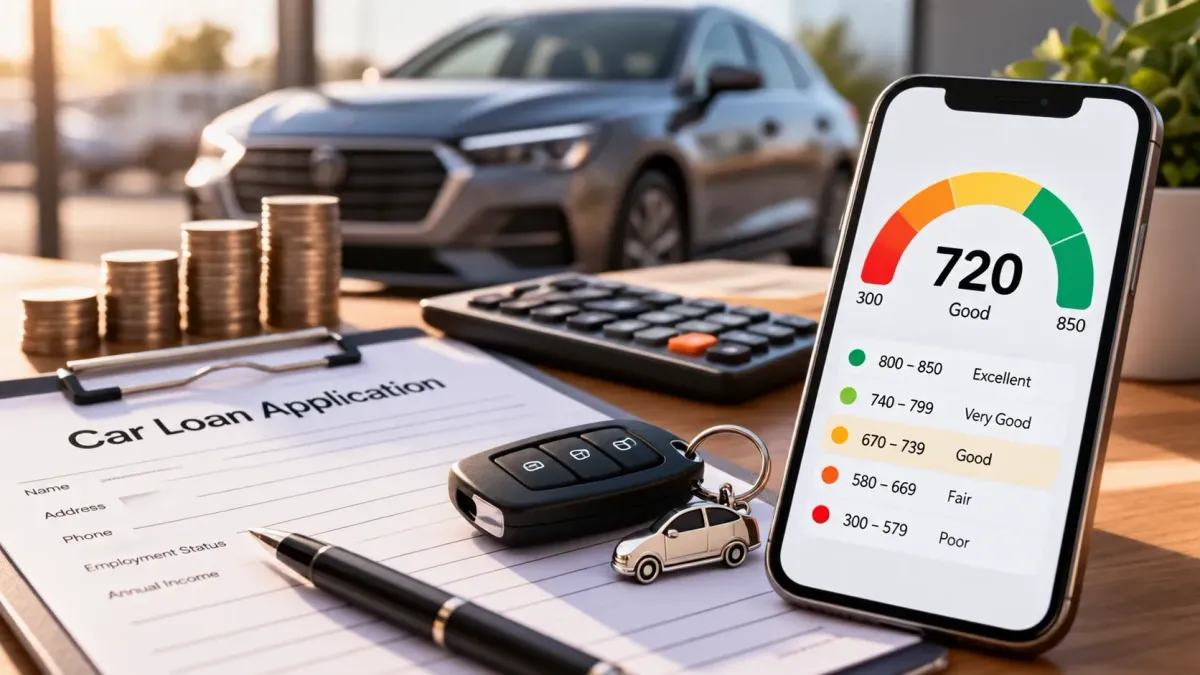
For a buyer wondering what credit score for a car loan is considered competitive, 661 is an important benchmark because Experian places scores from 661 to 780 in its prime tier. That does not mean 660 or lower prevents approval, and it does not guarantee a particular rate above 661. It simply marks the point where current national averages begin to look considerably more favorable.
What Credit Score for a Car Loan Is Considered Good in 2026?
A score in the upper 600s or above generally puts a borrower in a stronger position, while scores above 780 fall into Experian's super-prime tier. Experian notes that a FICO score of 670 or above is generally considered good, but auto lenders may use VantageScore, a standard FICO score, an auto-specific FICO score, or another scoring model. That is one reason the score a lender sees may not exactly match the score shown in a consumer app.
The current credit tiers also show why asking only whether a loan will be approved misses the bigger issue. A borrower with a 620 score and one with a 780 score may both find financing, but they can receive very different APRs. The practical question is often not “Can I get a car loan?” but “How much will this credit score make the loan cost?”
Car Loan Rates by Credit Score in 2026
Experian's Q2 2026 automotive finance data provide a useful picture of how much rates vary by credit tier. These are national averages, not guaranteed offers, and they use VantageScore 4.0 ranges. Individual lenders can price the same borrower differently, which is why comparing offers still matters.
Credit score | Credit tier | Average new-car APR | Average used-car APR |
|---|---|---|---|
781–850 | Super prime | 4.41% | 6.29% |
661–780 | Prime | 6.15% | 8.81% |
601–660 | Near prime | 9.71% | 13.93% |
501–600 | Subprime | 13.52% | 19.10% |
300–500 | Deep subprime | 16.11% | 21.62% |
Source: Experian State of the Automotive Finance Market, Q2 2026.
The difference is especially large for used vehicles. Average used-car APR rises from 6.29% in the super-prime tier to 21.62% in deep subprime, even though both borrowers may be purchasing vehicles from the same market. A lower credit score does not just affect approval – it can substantially increase the total cost of the car.
What Credit Score Do You Need for a Used Car Loan?
What credit score do you need for a car loan on a used vehicle? There is still no universal cutoff, and used-car financing occurs across every major credit tier. In Q2 2026, the average credit score for a financed used vehicle was 688, placing the average borrower within Experian's prime range.
Used-car rates are also higher than new-car rates across every Experian credit tier. The overall average used-car interest rate was 11.19% in Q2 2026, compared with 6.35% for new vehicles. That means a buyer considering a nearly new used car should compare its financing with any promotional or lower-rate financing available on the new version rather than assuming used automatically costs less overall.
A score below the 688 average does not mean a used-car loan is unavailable. It does mean the buyer should pay particularly close attention to APR, loan term, amount financed, and whether a less expensive vehicle or larger down payment would make the loan easier to manage.
What Credit Score Do You Need for a New Car Loan?
The average credit score for new-car financing was 751 in Q2 2026, considerably higher than the 688 average for used vehicles. New-car borrowers also received much lower average interest rates, partly because new vehicles present different collateral risk and because buyers financing new cars tend to have stronger credit profiles.
That does not mean a 751 credit score is required to finance a new car. Borrowers in the near-prime, subprime, and deep-subprime ranges also receive new-car loans, although the average rate increases as credit quality declines. The 751 figure describes the average borrower, not an approval threshold.
Manufacturer-backed lenders may also offer promotional rates to qualifying borrowers with stronger credit. Those offers can make a new vehicle unexpectedly competitive with a late-model used one, especially when the price gap is relatively small. Buyers should compare the actual APR offered rather than assuming a new-car loan will automatically match the national average.
Can You Get a Car Loan With a 600 Credit Score?
Yes, a borrower with a credit score around 600 can potentially qualify for a car loan. A score of 600 sits at the upper end of Experian's subprime range, while 601 begins the near-prime tier under its Q2 2026 automotive data. Approval will still depend on the lender and the rest of the application.
The bigger issue is price. Experian reported average APRs of 13.52% for new loans and 19.10% for used loans among borrowers in the 501–600 tier. Moving into the 601–660 range corresponded with lower averages of 9.71% for new cars and 13.93% for used vehicles.
For someone asking what credit score for a car loan becomes particularly expensive, the current data make the area around 600 worth watching closely. A lender may still approve the loan, but the financing cost can rise enough to justify improving credit first if the purchase is not urgent.
Can You Get a Car Loan With a 500 Credit Score?
A credit score around 500 does not make auto financing impossible, but options may be more limited and expensive. Experian's deep-subprime tier covers scores from 300 through 500, while subprime begins at 501. Average APRs in Q2 2026 reached 16.11% for new cars and 21.62% for used cars in the lowest tier.
Some lenders specialize in borrowers with weak or limited credit, including certain “buy here, pay here” dealerships. The CFPB warns that these arrangements tend to carry higher rates and that some dealers may report negative payment information without necessarily reporting positive on-time payments.
A lower-priced car, larger down payment, co-signer where appropriate, or time spent improving the credit profile can sometimes produce a more manageable alternative. Getting approved should not be confused with getting a loan that is affordable over its full term.
Does a 700 Credit Score Get a Good Car Loan?
A 700 score sits comfortably inside Experian's prime 661–780 range, which averaged 6.15% APR for new cars and 8.81% for used vehicles in Q2 2026. That generally puts a borrower in a much stronger financing position than applicants in near-prime or subprime tiers.
However, a 700 credit score does not guarantee those exact rates. Lenders also consider income, debt, down payment, vehicle value, amount borrowed, loan term, and the rest of the applicant's credit history. The CFPB emphasizes that lenders are not required to offer the lowest rate a borrower might qualify for.
That makes rate shopping worthwhile even with good credit. A borrower with a strong score can still receive noticeably different offers from a bank, credit union, dealer-arranged lender, or manufacturer finance company.
What Credit Score for a Car Loan Gets the Lowest Rates?
Experian's super-prime category begins at 781, and borrowers in that tier received the lowest average rates in its Q2 2026 data. Average APRs were 4.41% on new-car loans and 6.29% on used-car loans. These are market averages rather than guaranteed rates, but they illustrate the benefit of entering the process with a strong credit profile.
Some special manufacturer offers can fall below those averages for qualifying buyers, while other borrowers may receive higher rates despite having an excellent score. Vehicle type, loan length, lender, down payment, and market conditions can all affect the final offer. There is no single score at which every lender suddenly provides its best possible rate.
For buyers with flexibility, moving into a stronger credit tier before applying can be worth considering. The potential benefit becomes larger when the vehicle is expensive or the loan term is long because interest applies to a larger balance for more months.
Your Credit Score Is Not the Only Number the Lender Checks
Credit score is important, but it is only one part of an auto-loan decision. The CFPB says lenders generally also consider credit history, income, debts, loan amount, loan term, down payment, and whether the vehicle is new or used. A strong score therefore helps, but it cannot compensate for every other weakness in an application.
This also explains why two buyers with the same score can receive different rates. One may have a larger down payment, lower debts, shorter loan term, and cheaper vehicle, while another is financing nearly the entire purchase over a longer period. The lender is evaluating the complete risk of the loan rather than pricing the credit score in isolation.
A co-signer can also change the application when a borrower has limited or poor credit. The CFPB notes that a co-signer with good or excellent credit may help reduce the interest rate, but that person becomes contractually responsible for repayment if the primary borrower does not pay.
Check Which Credit Score the Lender Is Actually Using
One reason searching what credit score for a car loan can become confusing is that consumers do not have only one credit score. The CFPB explains that scores can differ because lenders use different scoring models, different credit-report data, and different versions designed for particular types of lending.
Auto lenders may use a VantageScore, regular FICO score, or an auto-specific FICO model. Experian's 2026 automotive rate tables use VantageScore 4.0, so a consumer's FICO score should not be assumed to map perfectly onto those exact ranges.
Before applying, check your credit reports for errors and review whichever consumer scores are available to you. If the lender provides a different score during the application, that difference does not necessarily mean one of the numbers is wrong.
How to Improve Your Chances Before Applying for a Car Loan
Improving the application does not require chasing a particular score overnight. Correct information on credit reports, lower revolving balances, consistent on-time payments, a realistic vehicle budget, and sufficient down payment can all strengthen a borrower's position. The most useful preparation depends on why the current credit profile is weak.
Before applying, focus on:
- Reviewing credit reports for inaccurate information.
- Paying bills on time.
- Reducing outstanding revolving balances where possible.
- Avoiding unnecessary new credit applications before the car loan.
- Saving a larger down payment.
- Choosing a vehicle and loan amount that fit the budget.
- Getting preapproved or prequalified with more than one lender.
- Comparing APR rather than only monthly payment.
The CFPB recommends checking reports before auto-loan shopping and disputing inaccurate information that could be hurting a score. It also recommends obtaining financing offers before visiting the dealer so buyers can compare the dealership's terms with an existing offer.
The goal is not necessarily to reach 800 before buying a car. The goal is to enter the transaction with the strongest realistic application and enough competing offers to know whether the proposed rate is reasonable.
Will Shopping for Car Loans Hurt Your Credit Score?
Comparing several auto loans generally has limited credit impact when the applications are made within a short rate-shopping period. The CFPB says auto-loan inquiries made within roughly 14 to 45 days, depending on the scoring model, are generally treated as a single inquiry for scoring purposes.
That gives buyers room to compare a bank, credit union, online lender, and dealership financing without stretching the search across several months. The CFPB specifically says the potential savings from shopping for an auto loan generally outweigh the small credit effect of the inquiries.
A focused rate-shopping window also makes the offers easier to compare because market conditions are similar. Knowing what credit score for a car loan you have is useful, but knowing what several lenders will actually offer is more useful.
The Bottom Line
What credit score do you need for a car loan? There is no universal minimum, but 661 marks the beginning of Experian's prime tier, while the average 2026 borrower scored 751 for a new-car loan and 688 for a used-car loan. Borrowers with lower scores still receive financing, but the rate difference can be substantial.
The clearest 2026 numbers are the APRs. Used-car averages range from 6.29% for super-prime borrowers to 21.62% for deep-subprime borrowers, while new-car averages range from 4.41% to 16.11%. That makes credit quality a major part of the vehicle's real cost rather than simply an approval question.
Before buying, check the credit reports, understand which score the lender is using, and compare several financing offers within a focused rate-shopping window. The best credit score for a car loan is ultimately the one that gives access to a payment and total borrowing cost the household can comfortably afford – not merely the lowest score a lender is willing to approve.
Frequently asked questions
What credit score do you need for a car loan in 2026?
There is no universal minimum credit score required for a car loan. Experian reported average Q2 2026 scores of 751 for new-car financing and 688 for used-car financing, but borrowers received loans across the full credit spectrum. Your score affects both approval chances and, more importantly, the interest rate you may receive.
Is 650 a good credit score for a car loan?
A 650 score falls within Experian's 601–660 near-prime VantageScore tier. In Q2 2026, borrowers in that range averaged 9.71% APR on new cars and 13.93% on used cars. Actual offers can be higher or lower depending on the lender and complete application.
Is 700 a good credit score to buy a car?
A 700 score falls within Experian's prime 661–780 tier. Prime borrowers averaged 6.15% APR on new vehicles and 8.81% on used vehicles in Q2 2026. A lender may still offer different terms based on income, debt, down payment, vehicle, and loan length.
Can I get a car loan with bad credit?
Yes, auto financing is available to some borrowers with low credit scores, but rates can be very high. Experian's Q2 2026 average used-car APR was 19.10% for the 501–600 tier and 21.62% for scores from 300–500. A lower-priced vehicle, larger down payment, or improving credit before applying may reduce borrowing costs.
What is the average credit score for a used car loan?
The average credit score for a financed used vehicle was 688 in Q2 2026, according to Experian's State of the Automotive Finance Market data using VantageScore 4.0. That figure is an average rather than a minimum requirement. Many used-car loans are made to borrowers above and below it.
What is the average credit score for a new car loan?
The average credit score for a new-car borrower was 751 in Q2 2026. New-car borrowers also paid a lower overall average interest rate than used-car borrowers during the quarter. A score of 751 is not required for approval, but it shows that new-car financing skews toward stronger credit profiles.
Sources
- Experian, What Is a Good Credit Score for an Auto Loan?
- Experian, Average Car Loan Interest Rates by Credit Score
- Consumer Financial Protection Bureau, Auto Loans
- AnnualCreditReport.com, Free Credit Reports
Spotted an error? Tell our editors. Read our corrections policy.