How Much Should I Spend on a Car in 2026? Start With Your Monthly Budget
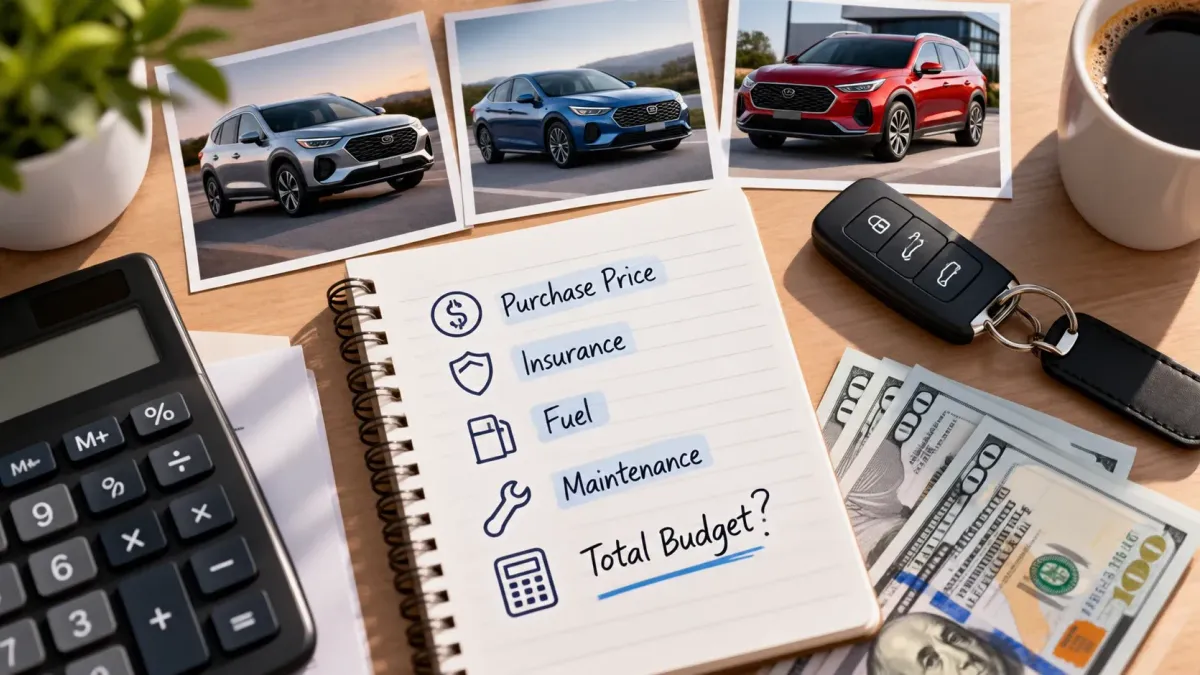
The average new-car payment is $765 in 2026, but the payment is only part of the cost. A realistic car budget also needs room for insurance, fuel, maintenance, repairs, registration, and savings.
This article is general information, not financial advice. Rates, prices and rules change; check the details with a qualified professional or the lender before you decide.
The Short Answer
- Keep the car payment at or below about 10% of monthly take-home pay.
- Keep total transportation costs, including insurance, fuel and maintenance, at about 15% or less.
- In Q2 2026 new-car payments averaged $765 a month and used-car payments $542.
- AAA puts the full annual cost of owning a new vehicle at $12,863, so budget for more than the payment.
In this article
- How Much Should I Spend on a Car Based on My Income?
- A $500 Car Payment Does Not Mean the Car Costs $500 a Month
- What Costs Should Be Included in Your Car Budget?
- How Much Should I Spend on a Car if I Finance It?
- The 10% Rule vs. the 20/4/10 Rule
- How Much Car Can You Afford With $5,000 a Month Take-Home Pay?
- Should I Spend 20%, 30%, or 50% of My Annual Salary on a Car?
- New or Used Changes How Much You Should Spend
- How Much Should I Spend on a Car if I Pay Cash?
- Signs You May Be Spending Too Much on a Car
- A Simple Way to Set Your Car Budget Before Shopping
- The Bottom Line
How much should I spend on a car? A useful starting point is to keep the car payment at or below about 10% of monthly take-home pay and total transportation costs around 15% or less. That total includes the payment, insurance, fuel or charging, maintenance, and other regular vehicle expenses, so the car itself may need to cost less than the dealership says you can finance.
That guideline is especially relevant in 2026 because average payments remain high. Experian reported an average monthly payment of $765 for a new vehicle and $542 for a used vehicle in Q2 2026, with average loan terms of 69.5 and 67.9 months respectively. The fact that millions of buyers carry payments at those levels does not mean those payments fit every household budget.
The safest answer to how much should I spend on a car comes from working backward from take-home income rather than forward from the vehicle price. Start with what the household can comfortably spend every month, subtract the costs of actually operating the vehicle, and only then calculate how much room remains for the loan payment.
How Much Should I Spend on a Car Based on My Income?
A practical guideline is to limit the monthly payment to roughly 10% of take-home pay while keeping the complete transportation budget near 15%. Experian uses the same general framework in its 2026 affordability guidance, although it emphasizes that individual expenses and financial goals can justify spending less. The Consumer Financial Protection Bureau also advises buyers to calculate insurance, fuel, maintenance, interest, fees, and other costs rather than judging affordability from the sticker price alone.
The table below shows what that framework looks like at several monthly income levels. These are planning limits, not recommendations to automatically spend the maximum amount. If insurance, fuel, parking, or existing debt is unusually expensive, the payment limit should be reduced.
Monthly take-home pay | Approx. maximum car payment | Approx. total transportation budget |
|---|---|---|
$3,000 | $300 | $450 |
$4,000 | $400 | $600 |
$5,000 | $500 | $750 |
$6,000 | $600 | $900 |
$8,000 | $800 | $1,200 |
$10,000 | $1,000 | $1,500 |
The second number is more important than the first. Someone earning $5,000 after tax may initially think a $500 payment fits the guideline, but that household has only about $250 left before reaching a $750 total transportation budget. If insurance, fuel, maintenance, and registration average $320 per month, a more realistic car payment would be closer to $430 or less.
A $500 Car Payment Does Not Mean the Car Costs $500 a Month
The monthly loan payment is only one part of the answer to how much should I spend on a car. Vehicle ownership also includes insurance, gasoline or electricity, maintenance, repairs, registration, taxes, parking, tolls, and depreciation. Some of those expenses are easy to overlook because they are paid annually or only when something breaks.
AAA's 2026 Your Driving Costs analysis estimates that the average cost to own and operate a new vehicle is $12,863 per year, or $1,071.92 per month under its methodology. Depreciation alone averages $4,422 per year and remains the largest ownership expense in the analysis.
That does not mean every household will spend $1,072 each month on every vehicle. A paid-off compact car driven relatively few miles can cost substantially less, while an expensive truck or luxury vehicle can cost much more. The point is that a payment that looks affordable can become expensive once the rest of the vehicle is added back in.
What Costs Should Be Included in Your Car Budget?
A realistic car budget should include every predictable cost of keeping the vehicle on the road. The CFPB specifically advises buyers to consider ownership expenses in addition to the loan itself because the monthly payment can understate the true financial commitment. That is particularly important when comparing a newer car with a cheaper older vehicle that may need more maintenance.
Before choosing a price range, estimate:
- Loan or lease payment.
- Auto insurance.
- Fuel or charging.
- Routine maintenance.
- Repairs and tires.
- Registration and recurring state fees.
- Parking and tolls where applicable.
- Taxes and dealer fees at purchase.
- Emergency repair savings.
Run those numbers for the actual vehicle rather than using one generic estimate. Insurance on two similarly priced cars can differ substantially, and fuel costs depend on mileage and efficiency. A cheaper used luxury vehicle can also carry maintenance and repair costs that are much higher than a newer mainstream model.
How Much Should I Spend on a Car if I Finance It?
If financing is involved, the purchase price should be determined by the payment the budget can support at a reasonable loan term and APR. A lender may approve a larger loan, but approval is a measure of lending criteria rather than a household affordability target. The CFPB recommends creating a monthly spending plan before shopping and comparing the complete loan cost rather than focusing only on the payment.
Interest rates matter because the same payment can support very different vehicle prices. Experian reported average Q2 2026 rates of 6.35% for new-car loans and 11.19% for used-car loans, which means a used car can require more interest even when its purchase price is much lower. Average loan amounts were $43,610 for new vehicles and $27,852 for used vehicles.
Do not solve an affordability problem by stretching the loan indefinitely. A longer term lowers the payment but increases the amount of time interest accrues and can leave the borrower owing more than the vehicle is worth. If a car only fits the budget after extending the loan to 72 or 84 months, a less expensive vehicle deserves serious consideration.
The 10% Rule vs. the 20/4/10 Rule
There are several popular answers to how much should I spend on a car, but they are best treated as screening tools rather than laws. One common approach keeps the car payment near 10% of take-home pay and total transportation expenses around 15%. Another, more conservative framework is the 20/4/10 rule.
Under 20/4/10, the buyer aims to put approximately 20% down, finance for no more than four years, and keep transportation expenses within a limited share of income. Experian describes this framework as one possible way to evaluate affordability, although real-world loan terms are now substantially longer than four years on average.
The value of the rule is not that every buyer must follow it precisely. Its purpose is to stop a large down payment, long loan, or low monthly figure from hiding an expensive purchase. If a stricter rule produces a vehicle budget that feels surprisingly low, that is useful information rather than a reason to ignore the calculation.
How Much Car Can You Afford With $5,000 a Month Take-Home Pay?
With $5,000 in monthly take-home income, a 10% payment guideline suggests starting near $500 per month, while a 15% total transportation ceiling would be about $750. That does not automatically mean a $500 loan payment is affordable because insurance, fuel, maintenance, and registration still have to fit inside the remaining $250. For many drivers, those non-loan costs can consume most or all of that amount.
Suppose the selected car is expected to cost $150 per month to insure, $120 for fuel, and an average of $80 for maintenance, registration, and repair savings. Those expenses total $350, leaving about $400 for the car payment if the buyer wants to keep total transportation spending around $750. A buyer with expensive parking or a long commute would need to lower the payment further.
This is why the question how much should I spend on a car cannot be answered accurately from salary alone. Two people taking home $5,000 can have completely different housing costs, childcare bills, student loans, savings goals, and commuting expenses. Income sets the outer limit, but the rest of the budget determines how much of that limit is actually available.
Should I Spend 20%, 30%, or 50% of My Annual Salary on a Car?
Using a percentage of annual salary to set the vehicle purchase price is less precise than working from monthly cash flow. A $60,000 salary can support very different car budgets depending on taxes, rent, debt, insurance, household size, and savings. That is why current CFPB guidance starts with actual income and expenses rather than recommending one universal vehicle-price-to-salary ratio.
A purchase price equal to 30% of annual salary may be manageable for one buyer paying cash with low living expenses. The same purchase can be uncomfortable for someone financing most of the price at a high APR while also paying substantial housing or childcare costs. Monthly take-home pay and total ownership cost provide a better affordability test than salary percentage alone.
Annual salary can still be useful as a quick reality check. If the vehicle costs nearly as much as the buyer earns in a year, the monthly budget deserves very close examination unless there is a large cash position or other unusual financial circumstance. The dealership's ability to produce a monthly payment does not make the underlying purchase inexpensive.
New or Used Changes How Much You Should Spend
Buying used can reduce the amount financed, but it does not automatically make the monthly budget easier. Cox Automotive reported an average used listing price of $27,239 in August 2026, while Kelley Blue Book put the average new-vehicle transaction price at $50,089. Used vehicles are far cheaper at the broad market level, but their average loan APR is also considerably higher.
A newer used car can also come surprisingly close to the price of a discounted new version. If the new vehicle qualifies for a lower interest rate, includes a full factory warranty, and needs less immediate maintenance, the difference in total cost may be smaller than the sticker prices suggest. A three- or four-year-old reliable used model often creates a stronger value gap, but the actual comparison depends on the model.
The correct approach is to calculate both choices using the same budget. Compare down payment, APR, loan term, insurance, fuel, expected maintenance, and likely depreciation. The less expensive sticker price wins only if the total ownership numbers still work.
How Much Should I Spend on a Car if I Pay Cash?
Cash buyers should still set a budget rather than asking only how much money is available in savings. Spending $30,000 in cash can eliminate loan interest but create another problem if it drains the emergency fund or money reserved for housing, medical costs, taxes, or other priorities. The car also continues to depreciate and require insurance, fuel, and maintenance after the purchase.
A better question is how much cash can be used without weakening the rest of the household finances. The CFPB's budgeting guidance recommends accounting for regular savings and less frequent expenses rather than treating every dollar left in a bank account as immediately spendable.
Paying cash can make an affordable car even cheaper because interest disappears. It should not be used to justify purchasing a more expensive vehicle simply because there is no monthly payment. A $40,000 cash purchase is still a $40,000 financial decision.
Signs You May Be Spending Too Much on a Car
A car budget is probably too aggressive when the payment works only if nothing else goes wrong. A household should still be able to handle normal expenses, maintain savings, and absorb an insurance increase or unexpected repair without relying on credit cards. The warning signs usually appear in the overall budget before they appear in the dealership paperwork.
Watch for these situations:
- The car payment alone exceeds roughly 10% of take-home pay.
- Total transportation costs are consuming well over 15% of take-home income.
- The down payment would empty emergency savings.
- The vehicle only becomes affordable with a very long loan.
- Insurance was not quoted before choosing the car.
- Regular maintenance and repair savings are missing from the calculation.
- Other debt payments make the remaining monthly cash flow tight.
- Retirement or emergency savings have to stop to make the payment.
- The budget depends on overtime, bonuses, or irregular income every month.
One of these signs does not automatically mean the purchase is impossible. A household in a location where a car is essential may reasonably spend more than a general guideline, while someone working from home may choose to spend far less. The problem begins when the vehicle consumes money that was already needed somewhere else.
A Simple Way to Set Your Car Budget Before Shopping
The easiest way to answer how much should I spend on a car is to calculate the budget before looking at vehicles. That prevents a favorite model from becoming the number around which the household budget is later forced to fit. It also makes financing offers much easier to evaluate.
Use this order:
- Write Down Monthly Take-Home Income. Use normal income rather than the best month of the year.
- Set a Total Transportation Ceiling. About 10% to 15% of take-home pay is a useful starting range.
- Estimate Insurance First. Get quotes for several vehicles before choosing one.
- Estimate Fuel or Charging. Use actual expected mileage.
- Allow for Maintenance and Repairs. Older vehicles generally need a larger buffer.
- Subtract Those Costs From the Transportation Budget. The remainder is the realistic payment limit.
- Compare Loan Offers. Use APR, term, down payment, and amount financed to determine the vehicle price that fits.
- Keep Emergency Savings Intact. Do not make the down payment so large that one repair creates new debt.
This method works whether the answer ends up being a $15,000 used car or a $45,000 new one. It also avoids using the lender's maximum approval as the shopping budget. The affordable car is the one that fits after the other costs are included, not the most expensive vehicle a lender will finance.
The Bottom Line
How much should I spend on a car in 2026? Start with about 10% of monthly take-home pay for the payment and roughly 15% for total transportation costs, then adjust downward based on insurance, fuel, maintenance, existing debt, and savings goals. Those are planning guidelines rather than hard limits, but they force the calculation to include more than the number shown by a dealership.
Current market averages show why that matters. New-car payments averaged $765 per month in Q2 2026, used payments averaged $542, and AAA estimates the complete annual cost of owning and operating a new vehicle at $12,863 under its 2026 methodology. A payment can therefore fit on paper while the vehicle as a whole still consumes too much of the household budget.
The best car budget is not the maximum a lender will approve. It is the amount that still leaves enough money for housing, normal expenses, emergency savings, other debt, and the unexpected costs that come with owning any vehicle. When those priorities still fit comfortably after the car is added, the purchase is much more likely to remain affordable after the excitement of buying it is gone.
Frequently asked questions
How much should I spend on a car?
A useful starting point is to keep the monthly car payment at or below roughly 10% of take-home pay and total transportation expenses near 15% or less. Those total expenses include insurance, fuel, maintenance, repairs, and other vehicle costs. The right number can be lower if housing, debt, childcare, or savings obligations already consume a large portion of income.
How much car can I afford on a $60,000 salary?
Gross salary alone is not enough to calculate an accurate car budget because taxes and household expenses differ. If take-home pay is around $4,000 per month, a 10% payment guideline would point to roughly $400 per month, with total transportation costs around $600 under a 15% ceiling. Insurance, fuel, and maintenance must come out of that total rather than being added afterward.
Is $500 a month too much for a car payment?
It depends on income and the rest of the transportation budget. A $500 payment equals 10% of $5,000 monthly take-home pay, but it may still be too high if insurance, fuel, parking, and maintenance push total vehicle costs well beyond a comfortable level. Experian reported that the average payment in Q2 2026 was $765 for new cars and $542 for used cars, but national averages are not affordability targets.
Should I spend 10% or 15% of my income on a car?
The percentages normally refer to different things. A common guideline places the car payment around 10% of take-home pay, while total transportation costs may be kept around 15%. If fuel, insurance, or other expenses are high, the payment itself should be reduced so the complete vehicle budget still works.
Is the 20/4/10 rule still realistic in 2026?
It is useful as a conservative benchmark, but many current borrowers use substantially longer loans than four years. Experian reported average Q2 2026 loan terms of 69.5 months for new vehicles and 67.9 months for used vehicles. Following a shorter term can reduce total interest, but it also requires a larger monthly payment or a less expensive vehicle.
Should I buy a cheaper car if I have other debt?
Often, existing debt should reduce the amount available for a vehicle because those payments are already competing for monthly cash flow. The CFPB recommends reviewing the complete household budget before deciding how much to borrow for a car. A buyer carrying expensive credit-card debt may reasonably choose a much lower vehicle budget than someone with the same income and no other debt.
Is it better to put more money down on a car?
A larger down payment reduces the amount borrowed and can lower the monthly payment and interest cost. However, the down payment should not drain emergency savings or leave the household unable to handle normal unexpected expenses. The right balance is enough cash to make the loan manageable without making the rest of the financial picture fragile.
Sources
- Experian, Average Car Payment in 2026
- AAA, Your Driving Costs
- Kelley Blue Book / Cox Automotive, Average Transaction Price Report, August 2026
- Consumer Financial Protection Bureau, Auto Loans
Spotted an error? Tell our editors. Read our corrections policy.