When Is the Best Time to Trade In a Car? Equity, Mileage and Age Matter More Than the Month
The best time to trade in a car is not automatically at 60,000 miles or after five years. In 2026, nearly 3 in 10 new-car trade-ins are underwater, making equity, repair costs and current market value more important than the calendar.
This article is general information, not financial advice. Rates, prices and rules change; check the details with a qualified professional or the lender before you decide.
The Short Answer
- The best time to trade in is after your loan reaches positive equity and before expensive repairs start piling up.
- Equity and condition matter more than the month on the calendar.
- About 29.6% of Q2 trade-ins toward new vehicles were underwater, by an average of $6,884.
- Keeping a dependable paid-off car two or three more years can save more than a slightly higher trade-in offer today.
In this article
- Best Time to Trade In a Car: The Five Signals That Matter Most
- 1. Trade When You Have Positive Equity – Not Just Because You Want a New Car
- 2. There Is No Magic Mileage for Trading In a Car
- 3. Understand Where the Car Is on Its Depreciation Curve
- Is Three to Five Years Really the Best Time to Trade In a Car?
- 4. Trade Before Expensive Repairs Only When the Math Supports It
- Should You Trade Before a Major Repair or Fix the Car First?
- 5. The Calendar Can Help – but It Is Not the Main Trade-In Signal
- Best Time to Trade In a Car at 3, 5, 7 or 10 Years
- When Is the Best Time to Trade In a Car You Still Owe Money On?
- What if Your Car Is Already Paid Off?
- Should You Trade In Before 100,000 Miles?
- Trade-In vs. Private Sale: Timing Is Only Part of the Decision
- How to Know if You Should Trade Now or Wait
- Is 2026 a Good Time to Trade In a Car?
- The Bottom Line
When is the best time to trade in a car? For most owners, the strongest moment comes when the vehicle still has meaningful market value, the loan has reached positive equity, and expensive repairs have not yet started arriving one after another. A favorable month can improve an offer, but equity and the condition of the car usually matter more than waiting for one particular date on the calendar.
That distinction is unusually important in 2026. Edmunds reported that 29.6% of vehicles traded toward new-car purchases in Q2 2026 had negative equity, with underwater owners owing an average of $6,884 more than their vehicles were worth. Those buyers averaged a $944 monthly payment on their replacement vehicles, compared with $777 across the broader financed new-car market.
The best time to trade in a car therefore is not simply “before 100,000 miles” or “after three years.” A financially stronger trade happens when the car's value, remaining loan balance, upcoming maintenance and replacement cost all work together. Owners who check those numbers before walking into a dealership can make a much better decision than someone trading simply because the odometer crossed a round number.
Best Time to Trade In a Car: The Five Signals That Matter Most
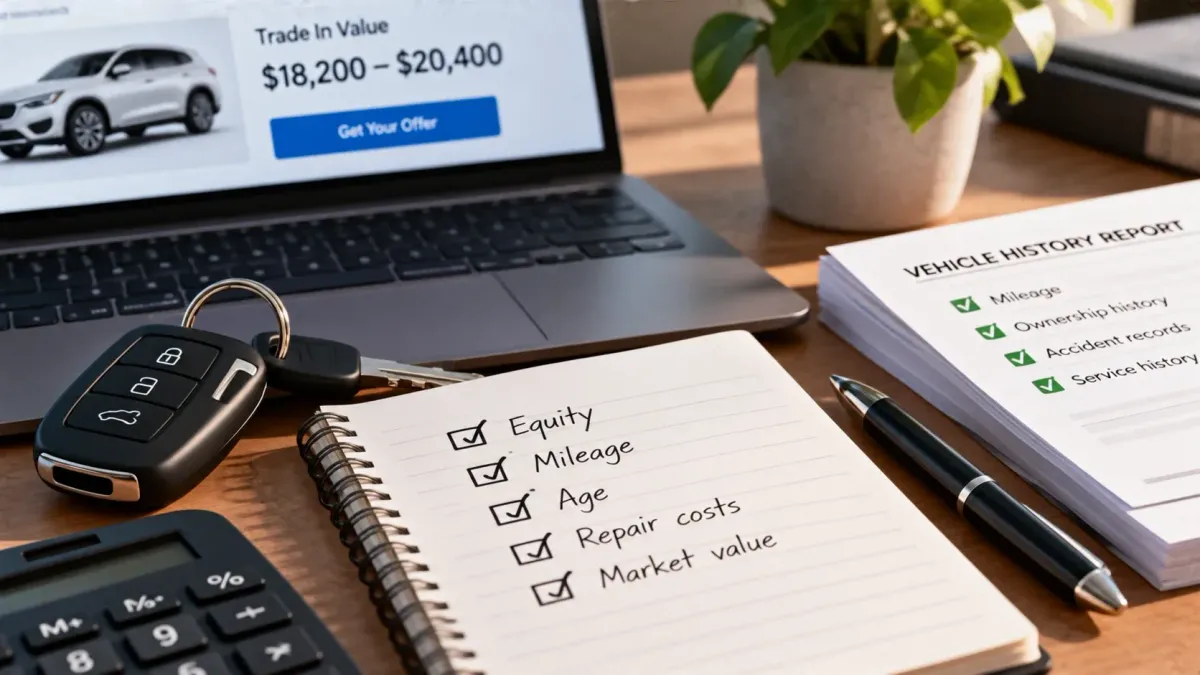
No single signal determines when to trade in a car. A five-year-old vehicle with 75,000 miles, no loan and excellent reliability can be worth keeping, while a three-year-old vehicle with 35,000 miles can be a poor trade candidate if its owner is still thousands of dollars underwater. The following framework shows which circumstances are most useful to evaluate together.
Signal | Trading may make sense when | Waiting may make sense when |
|---|---|---|
Loan equity | Trade value exceeds the loan payoff | You owe more than the vehicle is worth |
Repairs | Large or recurring repairs are approaching | Car remains reliable and inexpensive to maintain |
Depreciation | Value is still meaningful and the next vehicle fits the budget | Car has already absorbed most steep depreciation and remains reliable |
Mileage | Higher mileage is starting to affect demand or condition | Mileage is rising but the vehicle remains desirable and well maintained |
Market | Dealers are actively seeking your type of used vehicle | Replacement vehicles are unusually expensive or financing is poor |
The best time to trade in a car usually appears when several of these conditions line up. Positive equity combined with rising repair needs, for example, is a much stronger reason to trade than hitting 60,000 miles by itself. The goal is not to sell the car at its highest theoretical value – it is to change vehicles at a point that makes financial sense overall.
1. Trade When You Have Positive Equity – Not Just Because You Want a New Car
The first number to check is not mileage. It is equity, which is the difference between the vehicle's current trade-in value and the payoff amount on the existing loan. If the car is worth $24,000 and the lender says the payoff is $18,000, the owner has approximately $6,000 of positive equity that can potentially be applied toward the next vehicle.
Negative equity reverses the situation. If the car is worth $20,000 but the loan payoff is $25,000, the owner is $5,000 underwater and must either cover that shortfall or potentially roll it into another loan. The CFPB warns that financing negative equity increases the amount borrowed on the next car and can keep the borrower underwater for even longer.
This makes positive equity one of the clearest indicators of the best time to trade in a car. Owners do not necessarily need to wait until the vehicle is fully paid off, but trading while substantially underwater can turn an ordinary vehicle change into a much larger debt problem. Before requesting dealer offers, ask the lender for an actual payoff quote and compare it with several current estimates of the vehicle's trade-in value.
2. There Is No Magic Mileage for Trading In a Car
Drivers frequently search for the best time to trade in a car before 60,000, 80,000 or 100,000 miles, but modern trade-in values do not collapse automatically at one universal odometer reading. Edmunds says mileage affects resale value continuously, but there is no single major mileage cliff, and even 100,000 miles is not automatically a value killer when a vehicle is in good condition.
That makes condition and model reputation increasingly important. Consumer Reports notes that a properly maintained modern vehicle from a reliable model line can often reach 200,000 miles or more, meaning 100,000 miles should no longer automatically trigger a trade-in decision. Some high-mileage vehicles also remain valuable because buyers know the models have a strong reputation for longevity.
Mileage still matters because every additional mile creates wear and narrows the pool of potential buyers. A car with 40,000 miles will generally be worth more than the identical car with 90,000 miles, all else equal, but trading early merely to avoid a round mileage number can sacrifice years of inexpensive ownership. The better question is whether mileage is beginning to coincide with higher maintenance costs, weaker demand or a change in how long the owner intends to keep the vehicle.
3. Understand Where the Car Is on Its Depreciation Curve
Depreciation is another major part of determining the best time to trade in a car. Kelley Blue Book estimates that an average 2026 model-year vehicle will retain only about 45% of its original value after five years, although actual results vary substantially by make, model and market conditions. KBB's generalized depreciation curve shows the largest percentage decline occurring early in ownership before annual losses gradually moderate.
The simplified KBB pattern looks like this:
Ownership year | Approx. depreciation during year | Approx. residual value |
|---|---|---|
After Year 1 | 16% | 84% |
After Year 2 | 12% | 72% |
After Year 3 | 11% | 61% |
After Year 4 | 9% | 52% |
After Year 5 | 7% | 45% |
These percentages are broad estimates rather than predictions for an individual vehicle. Trucks, hybrids, sports cars, luxury vehicles and EVs can all follow very different depreciation curves, and KBB's 2026 best-resale models are projected to retain around 55% or more after five years rather than the market's roughly 45% average.
The table also reveals why repeatedly trading almost-new vehicles can be expensive. Owners who replace cars every two or three years repeatedly expose themselves to some of the steepest depreciation years. If the existing vehicle is reliable and already past that period, keeping it longer can be financially stronger than trading simply because its resale value has started falling.
Is Three to Five Years Really the Best Time to Trade In a Car?
Three to five years is often described as a trade-in “sweet spot,” but it should not be treated as a rule. At that age, many vehicles still look modern, mileage may remain attractive to used-car shoppers and some factory coverage may remain, yet the owner can still be underwater if the original purchase involved a small down payment, long loan or unusually high purchase price. Current 2026 data demonstrate exactly that problem.
Edmunds found that the average age of underwater trade-ins reached four years in Q2 2026. In other words, many owners trading vehicles at almost exactly the supposed three-to-five-year sweet spot still owed more than their cars were worth. The problem was not necessarily the vehicle itself – long loan terms and previous purchase economics were keeping borrowers underwater.
For an owner with positive equity, a desirable vehicle and plans to replace it anyway, years three through five can indeed be a reasonable trade window. For someone whose vehicle remains reliable and inexpensive to own, however, continuing past year five can provide more value because depreciation typically slows while there are no new-car transaction costs to restart. The age of the car should support the trade-in decision, not make it automatically.
4. Trade Before Expensive Repairs Only When the Math Supports It
Increasing repair frequency can signal that the best time to trade in a car is approaching. A vehicle that begins needing suspension work, cooling-system repairs, air-conditioning repairs, electrical troubleshooting and other age-related work can become expensive even when no single repair is catastrophic. Reliability and downtime also matter to drivers who depend on the vehicle every day.
That does not mean a $1,500 repair automatically justifies buying another $40,000 vehicle. Consumer Reports argues that keeping a reliable vehicle for many years can be financially advantageous because depreciation slows and the absence of a new-car payment can outweigh increasing maintenance costs. Its experts describe reaching 200,000 miles as a realistic goal for many well-maintained, reliable vehicles.
The useful comparison is expected repair cost versus expected replacement cost, not repair cost versus zero. If spending $1,800 keeps a paid-off vehicle dependable for another two years, that may be far cheaper than taking on a new loan, higher insurance and renewed depreciation. Trading becomes more compelling when expensive repairs are becoming frequent, reliability is deteriorating and the car still retains enough market value to provide meaningful equity.
Should You Trade Before a Major Repair or Fix the Car First?
Minor maintenance usually makes a car easier to appraise, but large repairs require more careful math. A dealer expects to recondition used inventory and generally will not increase the trade offer dollar-for-dollar for every repair an owner performs immediately before trading. Spending $2,000 solely to raise an offer by $800 obviously does not improve the transaction.
On the other hand, a vehicle with warning lights, severe body damage, unsafe tires or an obvious mechanical fault can receive a significantly weaker appraisal. Owners should obtain a repair estimate and at least one trade-in offer before authorizing major work solely for resale purposes. The best time to trade in a car may be before an expensive failure, but not necessarily after paying retail rates to repair everything first.
Routine maintenance is different. Providing service records, addressing inexpensive warning items and presenting a clean vehicle can reduce uncertainty for the appraiser. The goal is to demonstrate that the vehicle has been cared for without spending thousands on work that will not be recovered in trade value.
5. The Calendar Can Help – but It Is Not the Main Trade-In Signal
There is some seasonality in used-car values. Edmunds says its historical data show vehicles tending to hold their value better during the first and second quarters of the year, making the first half of the year a potentially favorable period for a trade-in. That pattern reflects used-vehicle demand and market dynamics rather than a guarantee that every March offer will exceed every September offer.
The current 2026 market also remains relatively supportive for many sellers. Kelley Blue Book reported in September that dealers continued to need used-car inventory and that many owners could still receive solid sale or trade offers, even as used retail prices remained elevated.
Calendar timing therefore works best as a tiebreaker. If the owner already has positive equity, plans to replace the vehicle soon and has flexibility, checking offers during a historically stronger used-car period can make sense. It rarely makes sense to keep an unreliable car for six extra months solely because a particular month is supposed to be better for trade-ins.
Best Time to Trade In a Car at 3, 5, 7 or 10 Years
Vehicle age changes the financial trade-off, but there is no age at which every owner should sell. Early ownership usually carries greater depreciation, while later ownership brings more maintenance exposure but slower value loss. Looking at age together with equity and condition gives a more useful picture.
Vehicle age | What usually matters most | Trade-in question to ask |
|---|---|---|
Around 3 years | Strong resale value but potentially significant loan balance | Do I have positive equity yet? |
Around 5 years | Depreciation begins slowing; warranty may be reduced or expired | Are upcoming repairs worth avoiding? |
Around 7 years | Lower value but often inexpensive years of ownership | Is reliability still strong enough to keep it? |
Around 10 years | Condition and model reputation matter heavily | Are repairs becoming frequent enough to justify replacement? |
At three years, trading can produce an attractive appraisal but may also mean repeating the steepest depreciation cycle on another new vehicle. Around five years, the car has already lost a substantial portion of its original value, so keeping a reliable vehicle can become increasingly economical. By seven or ten years, the trade decision often becomes less about depreciation and more about reliability, safety needs, repair frequency and how much value is still available.
That is why there is no universal “best ownership year.” A reliable seven-year-old car with no loan can be financially stronger than trading a three-year-old vehicle with $7,000 of negative equity. The owner needs to compare what is being given up with what the replacement will actually cost.
When Is the Best Time to Trade In a Car You Still Owe Money On?
The best time to trade in a financed car is generally after its market value has caught up with or exceeded the current loan payoff. A loan does not need to be completely paid off, but positive equity makes the transaction much cleaner because the excess value can become part of the down payment on the next vehicle. The CFPB confirms that net trade-in proceeds can reduce the amount that must be financed on the replacement.
Consider two simple examples:
Current trade situation | Car A | Car B |
|---|---|---|
Trade-in value | $24,000 | $20,000 |
Loan payoff | $18,000 | $25,000 |
Equity | +$6,000 | –$5,000 |
Effect on next purchase | $6,000 can reduce next purchase balance | $5,000 shortfall must be covered or financed |
Car A gives its owner a useful financial bridge into the next purchase. Car B creates the opposite problem because replacing it can mean financing part of the old vehicle and the new one at the same time. Unless there is an urgent reason to replace Car B, waiting and paying down the loan may be financially safer.
Current negative-equity numbers show why this deserves serious attention. Edmunds found that underwater Q2 2026 trade-in buyers financed an average of significantly more money and were projected to pay $16,270 in interest over the life of their new loans, compared with $9,811 for the average financed new-vehicle buyer.
What if Your Car Is Already Paid Off?
A paid-off vehicle gives the owner more flexibility because there is no lender payoff competing with the trade value. Every dollar of the agreed trade-in amount can generally contribute toward the next transaction, subject to the actual deal structure. That does not mean a paid-off vehicle should automatically be traded simply because equity is high.
In fact, this can be one of the cheapest periods of vehicle ownership. The steepest depreciation may already have passed, there is no monthly loan payment, and a reliable car can continue providing transportation for years. Consumer Reports specifically notes that long ownership can reduce overall vehicle costs even as maintenance increases later in life.
The best time to trade in a paid-off car is therefore usually when its remaining value is still meaningful and keeping it is beginning to conflict with reliability, safety, lifestyle or repair-cost goals. Trading a perfectly dependable paid-off car to restart a six-year loan is not automatically a financial upgrade. The replacement has to justify the new expense.
Should You Trade In Before 100,000 Miles?
Not automatically. The 100,000-mile mark still influences how some shoppers search and perceive vehicles, but modern cars do not mechanically transform into bad trade-ins when the odometer moves from 99,999 to 100,000. Edmunds explicitly says there is no major modern value drop at one particular mileage threshold.
A well-maintained 105,000-mile vehicle can be more desirable than an abused 75,000-mile example of the same model. Service history, tires, cosmetic condition, accident history, trim level, local demand and reputation for reliability all contribute to the appraisal. Consumer Reports' current longevity guidance reinforces that 100,000 miles can represent only the midpoint of a well-maintained modern car's useful life.
If an owner was already planning to trade around that mileage, getting appraisals before crossing 100,000 can still be sensible. The mistake is spending thousands of dollars to replace a reliable car solely because of the odometer. Mileage should trigger a value check, not an automatic vehicle replacement.
Trade-In vs. Private Sale: Timing Is Only Part of the Decision
A trade-in typically sacrifices some potential selling price in exchange for convenience. The dealership must account for inspection, reconditioning, inventory risk and its own resale margin, while a private buyer may pay closer to retail market value. Experian notes that owners can often receive more through a private sale, although selling independently requires more time and effort.
The correct comparison is the net result, not simply the highest advertised value. In some states, a trade-in can also affect the taxable amount of the replacement vehicle, which may reduce the effective gap between a dealer trade offer and a private-sale price. Tax treatment varies by state, so the specific rules need to be checked before calculating that advantage.
Owners who need speed and simplicity may reasonably accept a lower trade offer. Someone with several weeks to sell a desirable vehicle privately may be able to capture more value. The best time to trade in a car is therefore partly determined by how much the owner values convenience compared with maximizing the sale price.
How to Know if You Should Trade Now or Wait
The decision becomes easier when the existing car and replacement are evaluated in one calculation. Start with the current value and loan payoff, then estimate what keeping the car for another year is likely to cost. Finally, compare that with the actual out-the-door cost and financing of the replacement rather than with an advertised monthly payment.
Before trading, check these numbers:
- Current trade-in value.
- Exact loan payoff, if any.
- Positive or negative equity.
- Expected repairs and maintenance over the next 12–24 months.
- Insurance cost on the replacement.
- Replacement vehicle out-the-door price.
- APR and loan term on the new financing.
- Expected monthly payment and total interest.
- Private-sale value if maximizing proceeds matters.
- At least two or three independent trade-in offers.
Several offers are especially important because a trade-in is not priced like a gallon of gasoline. One dealer may already have several examples of the same model and offer less, while another may actively need exactly that type of inventory. The CFPB recommends checking pricing guides and obtaining estimates from more than one dealership before deciding what a trade-in is worth.
The strongest trade is therefore rarely the one arranged impulsively while buying another car. Know the value of the old vehicle before negotiating the new one, and keep the trade-in, replacement price and financing as separate numbers until each makes sense.
Is 2026 a Good Time to Trade In a Car?
For many owners with positive equity, 2026 remains a reasonable market in which to request offers. Kelley Blue Book reported in mid-September that dealers continued to need used vehicles and that sellers and trade-in customers could still receive solid offers, while used-car prices remained elevated compared with recent history.
The complication is the financing side. Nearly three in ten Q2 trade-ins toward new vehicles were underwater, and the average negative-equity balance approached $6,900. That makes 2026 a potentially good selling environment for some owners but a poor trade environment for borrowers carrying too much remaining debt.
This is why market headlines cannot answer when is the best time to trade in a car for one household. A strong trade value helps only if the owner understands how much equity is actually left after the loan is paid. Someone with $10,000 of positive equity is in a fundamentally different position from someone driving the same vehicle with a $7,000 loan shortfall.
The Bottom Line
When is the best time to trade in a car? The strongest financial window usually comes after the loan reaches positive equity but before reliability problems and expensive repairs begin materially changing the ownership experience. Mileage, age and season matter, but none of them should be used as a standalone trade-in rule.
Current 2026 data make equity especially important. Nearly 29.6% of Q2 trade-ins toward new vehicles were underwater, with an average $6,884 shortfall, showing how costly it can be to change vehicles before the loan balance catches up with depreciation.
There is also no need to panic at 60,000 or 100,000 miles. Modern reliable vehicles can remain useful for far longer, while depreciation generally slows as a car ages. Keeping a dependable paid-off vehicle for another two or three years can save more money than capturing a slightly higher trade-in value today.
The best time to trade in a car therefore arrives when the current vehicle still has useful equity, its future costs are beginning to rise, and the replacement makes sense on its own numbers. Check the payoff, get several trade offers, estimate upcoming repairs and compare the complete cost of the next vehicle. If those numbers all point toward a change, the calendar becomes secondary.
Frequently asked questions
When is the best time to trade in a car?
The best time to trade in a car is usually when the vehicle has positive equity, retains meaningful resale value and is approaching a period of higher repair or maintenance costs. Seasonal market conditions can improve an offer, but they are generally less important than the car's value and loan balance. Owners should compare the current trade value with the payoff amount before deciding.
What is the best mileage to trade in a car?
There is no universal best mileage. Mileage gradually affects resale value, but Edmunds says there is no modern cliff at 60,000 or even 100,000 miles, and condition and model reputation also matter heavily. A mileage milestone is a useful time to request an appraisal, not an automatic reason to replace the vehicle.
Is five years the best time to trade in a car?
Five years can be a reasonable trade point because the car may still have substantial value while its steepest depreciation years are passing. It is not automatically the best time, especially if the vehicle remains reliable and is already paid off or close to it. KBB projects that the average 2026 vehicle retains about 45% of original value after five years, meaning much of the early depreciation has already occurred.
Should I trade my car before the warranty expires?
An approaching warranty expiration can be one factor in the decision, particularly if the vehicle has a history of expensive problems. It should not by itself determine the best time to trade in a car because warranty terms vary and a reliable vehicle may remain inexpensive to own for many years afterward. Compare likely repair exposure with the cost of replacing the vehicle before making the decision.
Should I trade in my car if I still owe money?
You can trade a financed vehicle, but first compare the current value with the lender's payoff amount. Positive equity can reduce the amount needed for the next vehicle, while negative equity must be paid or may be rolled into the replacement loan. The CFPB warns that rolling negative equity forward increases the amount financed and can prolong the cycle of being underwater.
Should I trade my car before 100,000 miles?
Not solely because of the mileage. Modern reliable cars can remain useful well past 100,000 miles, and Consumer Reports says properly maintained examples can often reach 200,000 miles or more. Trading before 100,000 miles makes more sense when the owner already plans to replace the car and wants to preserve as much marketability as possible.
Is spring the best time to trade in a car?
It can be a favorable period because used-car values have historically tended to perform better during the first two quarters of the year. Edmunds identifies the first half of the year as a potentially stronger trade-in window, but the seasonal effect does not apply equally to every vehicle or local market. Equity, condition and current dealer demand should remain the primary decision factors.
Is it better to trade in or keep a paid-off car?
Keeping a reliable paid-off vehicle is often financially attractive because there is no loan payment and early depreciation has already occurred. Trading can make sense when repair frequency, changing transportation needs, safety priorities or reliability concerns outweigh those savings. The best choice depends on the full cost of the replacement rather than the trade value alone.
Sources
- Edmunds, Q2 New-Vehicle Purchases With Negative-Equity Trade-Ins
- Kelley Blue Book, Car Depreciation Calculator
- Consumer Financial Protection Bureau, Auto Loans
Spotted an error? Tell our editors. Read our corrections policy.